Yannic Kilcher
Technical@YannicKilcher 280K subscribers24 briefs
Deep critiques of ML research papers - strong technical lens.
- papers
- research
Latest video briefs

I BUILT A FULLY AUTOMATIC MANSPLAINER
Yannic Kilcher demonstrates a fully automated 'mansplainer' using advanced AI technology. The setup uses NVIDIA DGX Spark for processing audio and generating responses. Key technologies include Whisper for transcription, Mistral for generating explanations, and VIVE Voice for speech synthesis.
Mar 6, 2026Read brief

Traditional X-Mas Stream
Yannic Kilcher hosts a holiday Minecraft live stream. The gameplay focuses on basic survival strategies and exploration. Chat interaction is a key part of the stream as Yannic engages with viewers.
Dec 29, 2025Read brief

TiDAR: Think in Diffusion, Talk in Autoregression (Paper Analysis)
TiDaR optimizes GPU usage during autoregressive inference. It proposes a hybrid model combining autoregressive and diffusion methods. The model achieves efficiency without the trade-offs of traditional approaches.
Dec 27, 2025Read brief

Titans: Learning to Memorize at Test Time (Paper Analysis)
The Titans model addresses limitations of transformer context windows by enabling memorization at test time. It allows models to recall information from long texts which surpasses traditional context capabilities. Some concepts in the paper echo existing ideas in the field, sparking debate on originality.
Dec 14, 2025Read brief
![Thumbnail for [Paper Analysis] The Free Transformer (and some Variational Autoencoder stuff)](https://i3.ytimg.com/vi/Nao16-6l6dQ/hqdefault.jpg)
[Paper Analysis] The Free Transformer (and some Variational Autoencoder stuff)
The Free Transformer incorporates latent variables for generating sequences. It generates consistent movie reviews by sampling tokens based on prior context. Randomness in Transformers occurs during the token sampling step. The model balances good and bad reviews in proportion to movie quality. Self-consistency is crucial for maintaining coherence in generated text.
Nov 1, 2025Read brief
![Thumbnail for [Video Response] What Cloudflare's code mode misses about MCP and tool calling](https://i1.ytimg.com/vi/0bpYCxv2qhw/hqdefault.jpg)
[Video Response] What Cloudflare's code mode misses about MCP and tool calling
Cloudflare's code mode uses TypeScript APIs for MCP tools. LLMs perform better when tools are presented as APIs instead of direct calls. Stringing together multiple API calls can reduce token waste and increase efficiency. Real-world scenarios can introduce complexities that challenge this approach.
Oct 19, 2025Read brief
![Thumbnail for [Paper Analysis] On the Theoretical Limitations of Embedding-Based Retrieval (Warning: Rant)](https://i3.ytimg.com/vi/zKohTkN0Fyk/hqdefault.jpg)
[Paper Analysis] On the Theoretical Limitations of Embedding-Based Retrieval (Warning: Rant)
The video discusses theoretical limitations of embedding-based retrieval from a recent paper. Embedding-based retrieval struggles with random combinations of data due to dimensional representation limits. The paper highlights these limitations but is more applicable to random data rather than practical applications.
Oct 11, 2025Read brief

AGI is not coming!
OpenAI's recent models suggest a plateau in notable advancements. The era of foundational breakthroughs in AI, particularly AGI, may be over. Current model training focuses on specific use cases and cost efficiency.
Aug 9, 2025Read brief

Context Rot: How Increasing Input Tokens Impacts LLM Performance (Paper Analysis)
Increased input tokens lead to performance degradation in LLMs. Smart context engineering is more effective than simply increasing input length. The paper highlights the findings with various LLMs like Claude and GPT.
Jul 23, 2025Read brief
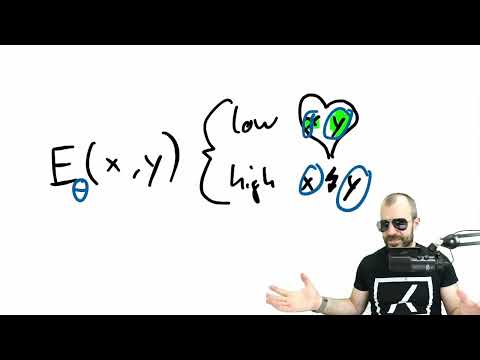
Energy-Based Transformers are Scalable Learners and Thinkers (Paper Review)
The paper explores energy-based models combined with transformers for scalable learning. It addresses the potential for machines to engage in 'system two thinking' through unsupervised learning. Results so far are promising but not yet verified at large scales.
Jul 19, 2025Read brief
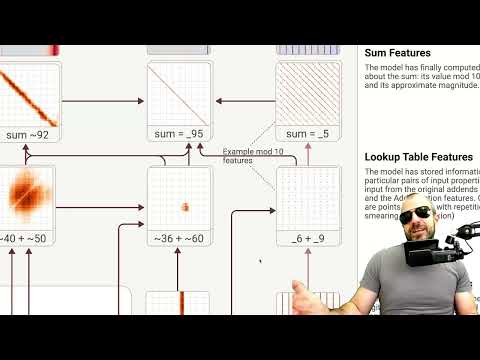
On the Biology of a Large Language Model (Part 2)
Anthropic's replacement model is designed to analyze transformer models using attribution graphs. This model allows cross layer connections to better understand feature influence. The model has features that enable the analysis of arithmetic tasks like addition through activated pathways.
May 3, 2025Read brief
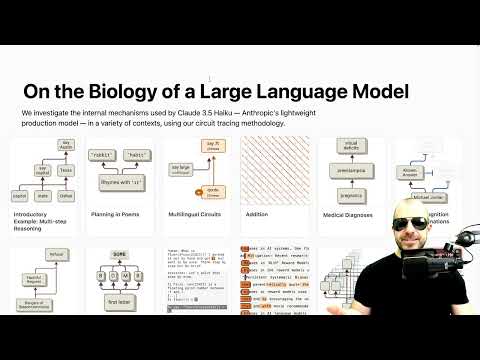
On the Biology of a Large Language Model (Part 1)
The video discusses Anthropic's methods for understanding transformer language models. Circuit tracing is a key technique for interpreting the internal operations of language models. Replacement models, specifically transcoders, aid in deciphering feature interactions within transformers.
Apr 5, 2025Read brief
![Thumbnail for [GRPO Explained] DeepSeekMath: Pushing the Limits of Mathematical Reasoning in Open Language Models](https://i3.ytimg.com/vi/bAWV_yrqx4w/hqdefault.jpg)
[GRPO Explained] DeepSeekMath: Pushing the Limits of Mathematical Reasoning in Open Language Models
DeepSeekMath introduces GRPO for enhancing math reasoning in language models. The DeepSeekMath Corpus contains 120 billion math tokens sourced from Common Crawl. The 7B parameter DeepSeekMath model competes well against larger, generalist models like GPT-4.
Jan 26, 2025Read brief

Traditional Holiday Live Stream
Yannic hosts a holiday live stream while playing Minecraft. He discusses the growing influence of AI and benchmarks in the tech industry. Yannic reflects on spending time with family and the mainstream acceptance of tools like ChatGPT. He emphasizes the difference between model performance and true intelligence.
Dec 27, 2024Read brief

The strange world of Influencer VPN ads
VPN advertisements by influencers often overstate their effectiveness. Research explores how these ads influence public perception of internet security. Understanding VPNs is crucial for users to avoid insecure practices. The study analyzed influencer marketing methods for VPNs on YouTube.
Aug 13, 2023Read brief

Geneva's AI + Art conference (AiiA Festival)
The AI Art Festival (AiiA Festival) in Geneva showcases innovative AI technologies. Artists at the festival interact with an AI tool called Chimera, powered by stable diffusion and GPT-J. Unique exhibits include AI-designed instruments and AI-generated musical scores.
Oct 20, 2022Read brief

Madrid Travel Vlog (Startup Pitching Competition)
The video showcases a trip to Madrid for a startup pitching competition. Participants had two minutes to present their projects to a major construction company. Despite challenges, the experience was deemed successful, with hopes for future collaboration.
Apr 21, 2022Read brief

Could AI solve this puzzle? (ARC-Game)
Yannic Kilcher explores the ARC Game, testing AI's ability to solve abstract reasoning problems. Players analyze patterns and relationships between squares to derive solutions. The game features varying levels of difficulty, challenging both humans and AI.
Nov 16, 2021Read brief

This game was made for robots, I played it anyway - Crafter Let's Play
Crafter is a fast-paced 2D game inspired by Minecraft. Players must manage resources like food and water to survive. The game is primarily designed for reinforcement learning agents.
Nov 12, 2021Read brief

What is the Hardware Lottery? (Machine Learning Research Paper Explained by Yannic Kilcher) #Shorts
The term 'hardware lottery' refers to research winning due to hardware compatibility. Researchers often conform to existing hardware limitations rather than pursue diverse ideas. The high cost and inflexibility of hardware restrict innovation in machine learning.
Feb 20, 2021Read brief

GPT-3 is doing Fuzzy Retrieval (I think), not Reasoning (Deep Learning / Yannic Kilcher) #Shorts
GPT-3 uses fuzzy retrieval rather than true reasoning. Input context is split into task descriptions and examples. Retrieval process involves pattern matching and interpolation of training data.
Feb 18, 2021Read brief

I DON'T CARE About Author Names in Machine Learning Research Papers (Yannic Kilcher) #Shorts
Author names in research papers often don't matter. Famous authors can indicate certain research styles, but aren't the sole quality indicator. First authors may provide more relevant insights into the work.
Feb 15, 2021Read brief

Yannic DEBUNKS anonymous peer-review (Vision Transformer)
The video critiques the effectiveness of anonymous peer review in academic publishing. Key points include the overlap of datasets and methodologies among papers. The creator emphasizes that anonymity may hinder accountability and transparency.
Feb 12, 2021Read brief

What is a Hopfield Network?
Hopfield networks are a type of neural network designed for storing patterns. They retrieve data using a partial input pattern and an internal update rule. Modern Hopfield networks can store exponentially many patterns compared to the number of neurons.
Feb 3, 2021Read brief