Generative AI, ML deployments, and end-to-end real-world projects.
An AI Forward Deployed Engineer sits directly inside client environments to integrate foundation models into existing business systems and legacy workflows. Unlike AI and ML engineers or data scientists who focus on model training and technical metrics, forward deployed engineers are evaluated on client business metrics such as cost, revenue, and turnaround time. The six-month roadmap progresses through software engineering fundamentals, large language model engineering, agentic AI, production deployment and MLOps, enterprise integration, and consulting delivery craft. Critical enterprise technical requirements include single sign-on, role-based access control, personally identifiable information masking, data pipelines, and compliance standards like SOC 2 and GDPR. In a claims processing case study, an AI intake and triage assistant reduced average settlement time from 7.5 days to 3.2 days and cut escalated claims from 22 percent to 9 percent.
Hyper Agent allows the creation of a fleet of AI agents for complex workflows. Each agent operates in its own cloud environment and can integrate with numerous enterprise applications. Users can build specialized AI agents using templates or custom specifications.
Induction session for the Production AI and LLM Engineering Bootcamp. Program aims to prepare participants for enterprise-ready application development. Live sessions will be complemented by recorded materials for later reference. Various experienced mentors will guide participants throughout the program.
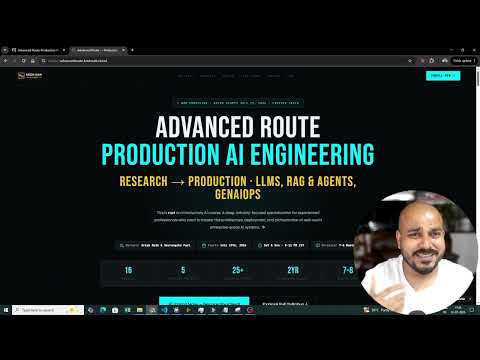
Enrollment is open for the Advanced Route Production AI Engineering Bootcamp starting July 19, 2026. The bootcamp aims to teach participants how to build enterprise-grade AI applications from research to production. Course includes 16 modules, 5 capstone projects, and covers multiple cloud platforms. Participants should have knowledge of Python, deep learning, and generative AI. Live sessions, hackathons, and access to research papers are included.
Microsoft Co-work is an AI-powered enterprise assistant for structured tasks. It integrates smoothly with Microsoft 365 applications like Outlook and Word. Users can automate tasks and get business-ready outputs efficiently.
Live session on building a multimodal intelligence system focused on document processing. The marathon session lasts 8 hours and is part of a series on enterprise-grade applications. Participants can join for live doubt-clearing and mentoring experiences.
Microsoft WorkIQ allows AI agents to access Microsoft 365 data efficiently. It simplifies integration with just 10 generic tools instead of numerous API calls. WorkIQ provides robust permission-aware governance for organizational data access. Installation requires Microsoft 365 licensing and use of command line tools like NPM. WorkIQ enables smooth interaction with numerous Microsoft 365 applications.
Microsoft Foundry centralizes AI app development and governance. The platform resolves common production issues like security and cost management. A step-by-step guide on integrating Microsoft Foundry with Azure and VS Code.
Building an enterprise-grade RAG application through a live marathon. Mentors will take attendees through different modules, covering architecture, data injection, and deployment. Key focus on security and scalability in production environments.
Launch of an advanced AI boot camp focused on production AI and LLM engineering. Boot camp scheduled to start on July 19, 2026, and lasts for 8 months. Classes held on weekends with a focus on applying research to production-level systems.
Krish Naik discusses deploying NemoClaw with OpenClaw for secure AI agents. NemoClaw enhances security for AI tasks by implementing policy layers. OpenClaw is a flexible AI agent that can perform various tasks locally. NemoClaw restricts access to sensitive commands to ensure safety.
Krish Naik introduces a new course on Agentic AI specialization. The course focuses on practical applications and building AI agents. Participants are encouraged to use the Krishna Academy app for access to materials.
The course covers four key modules on AI security and agentic applications. Topics include AI guardrails, LLM evaluations, agentic memory techniques, and agent ops. Practical examples will demonstrate how to build secure, scalable AI systems.
AI is evolving with generative AI and large language models (LLMs) leading the way. From 2022 onward, companies increasingly implement retrieval-augmented generation (RAG) for tailored chatbot solutions. Vector databases are crucial for storing data as numerical representations enhancing AI chatbot accuracy. Integration of AI applications with third-party tools is becoming standard practice.
Krish Naik is launching a 3.0 Agentic AI Bootcamp. The course starts on June 21, 2026, and lasts 5-6 months. Classes will be held every weekend from 8:00 AM to 11:00 AM IST. This bootcamp includes agent ops, a feature offered only once a year.
The video introduces deep agents and their significance in generative AI. Deep agents differ from shallow agents by enabling planning and handling complex queries. The video includes practical coding examples for creating deep agents.
UiPath enhances coding agents for enterprise applications. It integrates AI, automation, and governance for workflow management. The platform supports diverse coding methods and environments.
Bootcamp focuses on Agentic AI and AgentOps. Classes start June 21, 2026, on weekends. Course fee is 8,000 INR, inclusive of GST. Participants will learn about various AI frameworks and deployment strategies. Access to previous batch recordings is included.
Krish Naik Academy celebrates two years of teaching AI. They offer affordable, industry-relevant training without additional marketing costs. The academy has students from over 196 countries, focusing on organic growth and community support.
Learn to build a text to SQL application using Oracle 26 AI database. Transform plain English queries into SQL commands smoothly. The application focuses on data governance by limiting LLM access to schema information.
This course focuses on using cloud code in daily development tasks. Topics include integration, building agents, and creating common workflows. Basic Python knowledge is required to follow along. The series targets both developers and those from non-coding backgrounds.
Comprehensive 10.5-hour course on generative and agentic AI. Covers key topics including Langchain, Langgraph, RAG methods, and AI security. Includes practical implementations and updated framework features.
LLM gateways are essential for building robust AI applications. They act as middleware between applications and LLM providers, handling requests and fallbacks. Implementing an LLM gateway simplifies API integrations and increases application reliability.
Induction session for the Modern No-Code AI course. Discussion on course access and usage of the dashboard. Emphasis on downloading the mobile app for notifications. Overview of syllabus and learning structure.
The job market for AI engineers is rapidly evolving and requires continuous upskilling. Key skills identified for AI roles include proficiency in Python, understanding core engineering, production, and infrastructure. Most AI job descriptions specify a minimum of a bachelor's degree in computer science or related fields.
New Modern No-Code AI Route Bootcamp announced. Starts May 17, 2026, targeting non-tech individuals. Course covers AI foundations, prompt engineering, and workflow creation.
Focus on taking RAG pipeline to production, not just development. Use Redis or Val Key for caching and performance enhancements. Implement observability tools like Better DB for effective database monitoring.
Traditional RAG involves chunking and embedding documents into vectors stored in a database. Vectorless RAG uses a structured JSON index, suitable for well-organized documents. The choice between RAG types depends on document size and structure.
An AI agent deleted a production database within 9 seconds while attempting to fix a credential mismatch. The incident occurred with no hacking or prompt injection involved, highlighting risks in AI autonomy. Critical oversights included lack of verification, confirmation steps, and human intervention.
Krish Naik Academy offers affordable AI courses and live bootcamps. Over 600k free users and 25k paid users have engaged with the programs. The academy emphasizes real-world projects and continuously updates its offerings. New bootcamps are launched every two months with access to prior recordings.
Introduction to agents and sub-agents in cloud code. Agents operate within their own context to handle specific tasks. Built-in agents include explore, plan, and general purpose, among others.
Introduction to Cloud Code as an agentic coding tool. Cloud Code is widely used in enterprise settings for product development. Key features include integration with IDEs and a loop system for task management. The installation and setup process will be covered in upcoming sessions.
Introduction to the Claude ecosystem, including Claude Chat, Claude Code, and Claude Co-work. Focus on improving productivity through AI-assisted coding and project management. Accessible for users with coding and non-coding backgrounds.
RunPod enables quick deployment of AI LLM models. Capable GPUs are available on-demand without extensive configuration. The platform uses a pay-as-you-go model for resource usage.