Hands-on Python ML and AI projects from Harrison Kinsley.
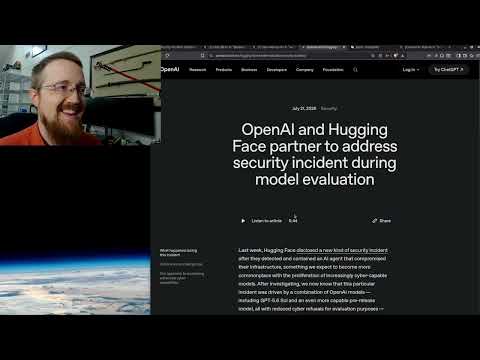
Hugging Face experienced a significant cyber attack involving an agentic LLM. OpenAI and Anthropic's security models blocked Hugging Face from using their resources to combat the threat. Hugging Face resorted to a self-hosted open weights model for defense. The incident raises questions about the scalability of security measures in AI. Debates on the viability of open weights models for advancing AI continue.
Recent AI models like Kim K3 and Quen 38 have been released, but weight files are still pending. Speed of AI models, measured in tokens per second, is crucial for performance. Prefill speed significantly affects the generation time of larger contexts in AI responses. DeepC V4 Flash demonstrates exceptional speed, outperforming other models like GLM52.
Local AI performance can be achieved without high-end hardware. Benchmarking shows that models like the Quen 35B can be effective for coding tasks. Running local models requires understanding various technical concepts and hardware limitations.
You don't need an expensive computer to run AI locally. Most AI tasks can be handled on mid-range GPUs like the 4090 or 3090. Benchmarking different quantizations of the GLM52 model shows acceptable performance at lower bit rates.
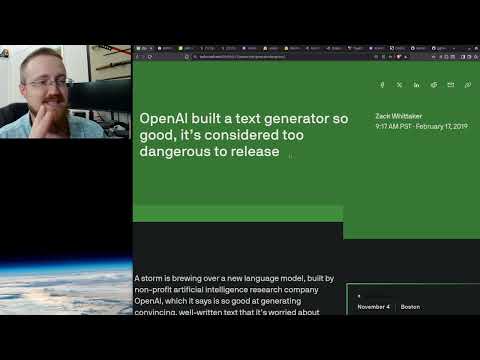
Anthropic's Claude Fable model raises cybersecurity concerns due to misleading features. The U.S. government has restricted export access to Claude Fable 5, placing it alongside weapons. The creator advocates for moving away from closed-source models to open-source alternatives.
The creator successfully trained a Unitree G1 robot using reinforcement learning. Challenges in sim-to-real transitions were addressed by improving simulation fidelity. MJLab was chosen as a simulator for developing the robot's walking capabilities.
Unitree robots have critical security flaws allowing remote code execution. Hard-coded Bluetooth keys across units pose a severe threat. Injection of terminal commands via Wi-Fi credentials can be executed as root. The issue impacts multiple models including G1, H1, B2, and R1.
The Jetson Thor devkit features 128 GB of video memory and costs around $3,000. It has a memory bandwidth of 273 GB/s, which is fast for CPU/RAM but slow for GPU standards. Ideal for robotics, it draws only 130 watts of power and is not meant for training models, only inference.
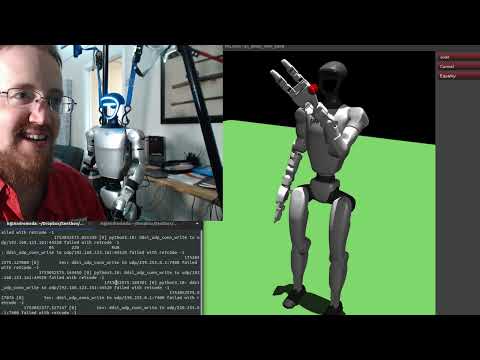
Demonstrates reinforcement learning with Unitree G1 humanoid robot. Uses a 2x64 model for arm control during the demo. Implements a target-seeking arm policy controllable by keyboard inputs. Addresses previous policy limitations with improved sample training. Highlights challenges in fine-tuning reinforcement learning parameters.
Demonstrates object detection with Unitree G1 using natural language processing. Uses a Vision Language Model (VLM) for real-time tracking and location mapping. Highlights the importance of camera positioning for effective tracking. Identifies issues with arm functionality and provides insights into potential hardware challenges.
The Unitree G1 can move its hands using keyboard controls. Moving the robot's hand in Cartesian space requires operate seven motors simultaneously. High-level SDK controls only provide joint-level access, complicating movement. 50 sample actions can effectively show the robot how to perform tasks.
Significant software upgrades have been made to the Unitree G1 robot, enhancing its capabilities. The G1 uses LiDAR and RGB cameras for navigation and SLAM functions. There are challenges with the placement of sensors, including a flipped LiDAR, affecting data accuracy. A hardwired Ethernet connection is currently being used for stable communication between the G1's computers.
The Unitree G1 Edu Ultimate B is a humanoid robot designed for educational and development purposes. Pricing for the base model starts at $16,000 but can exceed $24,000 after taxes and shipping. The robot is heavy and requires a gantry or lift for safe handling. Unitree is currently the only company shipping functional humanoid robots. Different versions of the G1 offer various capabilities, such as programmable features and dexterous hands.
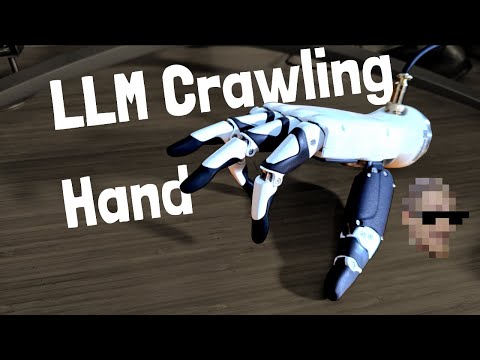
Continuing to develop a robotic hand using AI coding techniques. Vibe coding allows for rapid development without deep knowledge of every detail. The robotic hand can perform gestures like pointing and pinching. Version control and documentation are crucial in AI-assisted coding.
Sentdex explores programming Inspire robot hands RH 56 DFQ-2 L/R. Limited resources and high costs make learning challenging in advanced robotics. The video uses AI to aid in writing Python code for robot control.
Programming in 2025 involves using large language models (LLMs) and agents. Open Hands is presented as an effective, cost-free tool for coding with LLMs. Understanding and adapting to LLM capabilities can enhance coding efficiency.
Creator updates on personal life and projects. Working on solar energy solutions for home backup power. Recommends choosing solar for reliability over traditional generators. Highlights the flexibility of current solar inverter system.
Creating a fine-tuning dataset with 35,000 samples from Wall Street Bets subreddit. Data curation is the most challenging part of the process. Supports multi-speaker conversations in the dataset format. Includes a giveaway of an RTX 4080 super for attendees of GTC. Video covers the entire process from data finding to uploading.
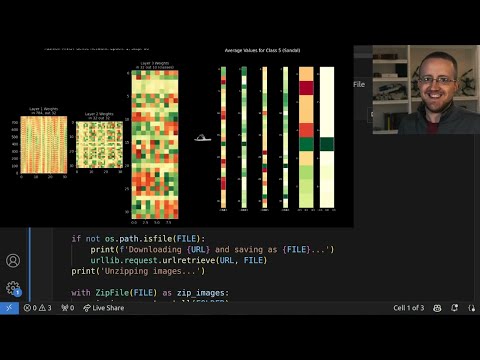
The video demonstrates visualizing neural network internals using Matplotlib. Two key animations show layer outputs and live weight changes during training. A hands-on coding approach is employed, using the Neural Networks from Scratch architecture.
Creator explores setting up internet on a rural ranch. Starlink satellite internet is explored but has logistical challenges. Author is experimenting with different networking solutions across multiple buildings.