ML algorithms and statistics, simplified into the BAM!-iest explanations on YouTube.
The GELU (Gaussian Error Linear Unit) and SiLU (Sigmoid Linear Unit) activation functions provide smooth, differentiable alternatives to the ReLU activation function. Unlike the standard ReLU function which outputs zero for all negative values, GELU and SiLU create a subtle dip between negative two and zero. The GELU activation function can be mathematically derived from the weighted average of applying input-dependent dropout with a Gaussian cumulative distribution function. The SiLU activation function is similarly derived using a standard sigmoid function to determine the input-dependent dropout probability. SwiGLU enhances the Swish/SiLU approach by incorporating extra trainable weights and a gated linear unit multiplication, offering greater shape flexibility. Major artificial intelligence architectures employ these functions, with Google often using GELU and Meta frequently adopting SwiGLU.
September 4th is celebrated by Josh Starmer as Global Frank Starmer Day to mark his father Frank's birthday. The acronym ABC stands for Always Be Curious, a principle Josh Starmer attributes to ninety-nine percent of his career and personal growth. Daily physical exercise like jogging stimulates clearer thinking and enhances productivity when solving complex workplace problems. Cultivating friendships with a wide variety of people enriches life and is naturally facilitated by remaining curious about others. StatQuest provides downloadable study guides and illustrated guidebooks covering statistics, machine learning, neural networks, and artificial intelligence.
The simplex algorithm optimizes by moving through feasible vertices. Constraints must be set with 'less than or equal to' for proper functioning. Slack variables help convert inequalities into equalities for calculations. The method begins from the origin to find an optimal solution.
Linear programming is a method for optimization using clever algorithms. The simplex algorithm helps maximize revenue under constraints. Revenue can be computed by evaluating vertices in a graph representing constraints.
Random forests can handle missing data through iterative refining of guesses. Missing values are initially estimated and gradually improved by calculating sample similarities. The proximity matrix tracks similarities between samples to enhance predictions.
False Discovery Rates (FDR) help filter out misleading data in high-throughput sequencing. FDR accounts for the occurrence of false positives when comparing multiple genetic tests. Using methods like Benjamini-Hochberg can control the number of false positives effectively.
Linear regression is used to make predictions based on data. The quality of predictions is measured using sum of squared residuals. Residuals are the differences between observed and predicted values.
AI operates by converting prompts into numerical coordinates. Predictions can be made using a simple line equation. Large data sets enhance the accuracy of AI predictions.
Always be curious to uncover core problems. Value everyone's contributions to build confidence. Small steps lead to significant progress over time. Unix pipes can simplify software design.
Reinforcement learning with human feedback (RLHF) is essential for training large language models. Pre-training models involves predicting the next token using vast text datasets, like Wikipedia. Supervised fine-tuning aligns models to generate human-like responses, but can lead to overfitting. RLHF helps improve response generation for new, unseen prompts without needing extensive datasets.
Reinforcement learning can be integrated with neural networks using policy gradients. Cross entropy is used to quantify differences in probabilities during training. The process involves calculating derivatives to optimize network parameters.
Reinforcement learning uses trial and error to improve decision-making. Policy gradients are a key method in training neural networks without known outputs. Understanding back propagation helps in grasping the limitations of traditional training methods.
Reinforcement learning enables computers to learn from experiences. It can help make decisions, such as choosing a restaurant based on prior satisfaction. Learning rates influence how quickly a system adjusts its probabilities.
Learn about the foundational technique of attention in deep learning. Explore query, key, and value matrices and their roles in attention. Understand different types of attention: self, masked, and cross attention. Discover how multi-head attention improves performance and scalability.
Josh Starmer hosts a live session interacting with viewers from around the world. He promotes his newly released book, 'The StatQuest Illustrated Guide to Neural Networks and AI'. Starmer announces an upcoming short course on attention mechanisms in deep learning.
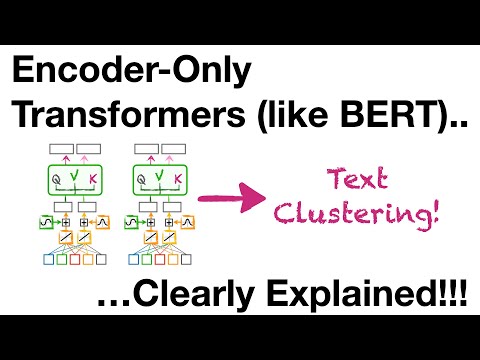
Encoder-only Transformers, like BERT, are capable models for text representation. They create word embeddings to convert words into numerical values, enhancing context understanding. Despite the prominence of decoder-only models, encoder-only models maintain significant utility.
Luis Serrano and Josh Starmer engaged in a lively Q&A livestream. Topics included experience in machine learning, the Nobel Prize in physics, and learning strategies. Audience participation was emphasized, encouraging viewers to ask questions.
Nana Janashia transitioned from marketing to software development for job security. She found her passion in DevOps and Kubernetes, leading to a successful YouTube channel. The channel grew rapidly, reaching over 1 million subscribers in four years. Nana aims to simplify complex tech concepts for engineers through her tutorials.
Do what you love and make a positive impact. Friendship can be found everywhere in the world. View challenges as experiments to encourage learning.
Abbas Merchant initially considered dropping out of high school to join his family business. He faced rejection from his family but later learned the importance of education. After three years in the family business, he recognized the need for further education. Merchant pivoted to complete his schooling to strengthen his foundational knowledge for business success.
Josh Starmer discusses the origins and goals of his educational content. The live stream features prominent AI figures Luis Serrano and Jay Alammar. Josh's original audience was genetics researchers needing help with statistics. He adapted his teaching style to be approachable for a broader audience. Humor and relatable examples like M&M's are key to his educational approach.