Data science career, AI-powered analytics, and learning-in-public workflows.
Tina Huang uses a custom pixel-art avocado Pomodoro tracking system on desktop and wanted to expand it to iOS. Lacking design skills and mobile development experience, Huang used Genspark Design to generate mobile app mockups and interface screens. The tool generated design options including lock screen widgets and system notifications based on supplied assets and workflow prompts. Team members can collaborate directly on the generated designs through in-chat adjustments, comments, and direct editing. Beyond mobile application interfaces, Genspark Design can also generate marketing assets if the internal tool is converted into a public consumer product.
Tina Huang created an AI tool called Asset Forge to automate the creation and organization of retro video game visual assets for her videos. The tool uses GPT-5.6 Luna to analyze a video script and determine whether a section requires a diagram, an overlay, or B-roll footage. Asset Forge generates detailed creative briefs specifying the style, format, dimensions, and timeline placement for each visual asset. All produced assets are automatically named, tagged, and filed into a centralized library for reuse in future video editing projects. Switching the tool's backend to GPT-5.6 Luna reduced operating costs by 80 percent compared to the previously used Sol model.
Tina Huang uses a custom AI agent called LifeBot to optimize daily focus and productivity based on personal tracking data. Data logged from custom desktop Pomodoro and to-do apps is synchronized to Obsidian and analyzed by the AI. LifeBot advises starting work before 1:00 PM, because every hour delayed past 1:00 PM costs 20 to 25 minutes of total daily output. Work sessions between 20 and 25 minutes yield a 100 percent completion rate, whereas unplanned breaks often result in abandoned tasks. Scripting has a low continuation rate of 29 percent, meaning it should be scheduled during peak energy windows or followed immediately by a high-continuation task. Real-time coaching and data-backed negotiation prevent unproductive behaviors like doomscrolling or taking unstructured breaks.
Robotic systems can learn physical movements such as folding laundry or packing boxes through teleoperated demonstration. A human operator uses a leader arm to control a follower arm, collecting training datasets across task repetitions. Trained physical AI models allow robotic arms to perform learned physical skills automatically. Trained robotic physical skills can be shared, uploaded, and monetized across an open marketplace. Hardware and physical AI integration allows intelligent software models to directly manipulate physical environments.
Tokens are the currency used by AI models. A token isn't always a single word; it can be multiple segments. Token limitations affect AI speed and context during interactions.
Setting up Hermes Agent is crucial for an optimal experience. Multiple hardware options are available for different budgets. The setup process includes downloading the software and configuring it with models.
AI video technology has significantly advanced. Inky is a lonely octopus featured in a short film. Creating videos can now be done quickly using platforms like OpenArt.
Notebook LM now creates documents, infographics, and multimedia content. Users can explore featured notebooks from renowned sources like The Economist. The AI tool provides business gap analysis for aspiring entrepreneurs. Examples include AI-driven products for health and job market adaptation.
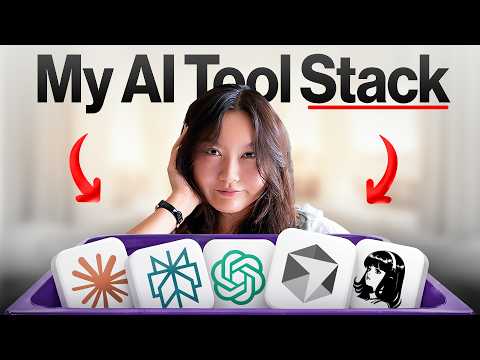
Tina Huang shares her favorite AI tools for various aspects of life. Key tools include Claude Cowork for custom workflows, Claude Chat for general inquiries, and Perplexity for objective searching. In the builder dungeon, AI coding tools like Claude code and Cursor assist in software development.
Explores three efficient OpenClaw setups. Demonstrates methods to enhance productivity. Encourages practical application for immediate results.
Discover three transformative features of Claude Cowork. Learn how these features enhance collaboration and productivity. Get insights on optimizing your workflow with Claude Cowork.
Tina Huang's current AI stack emphasizes fewer tools for deeper use. Claude has become her main tool for thinking and writing. She has canceled several subscriptions by building her own free versions. Cloud code and Warp are her preferred tools for coding. Perplexity is her go-to for search-related tasks.
Co-working can enhance productivity when set up effectively. Five key tools were created: a resource hub, a mission control dashboard, a video asset skill, an investment dashboard, and a daily digest feature. These tools streamline work processes and communications.
Understanding AI agents is key to effective workflow. Push back against AI decisions to ensure accuracy. Learning the fundamentals of AI tools is essential.
AI agents frequently fail due to faulty workflows. Assuming an agent is working can lead to wasted resources. Clean up existing processes before implementing automation.
AI skills are evolving rapidly; an updated roadmap is necessary for 2026. Key foundational skills include investment awareness regarding AI impact, effective prompting, and mastering essential AI tools. Intermediate skills involve understanding and using AI agents to automate tasks and achieve broader goals.
Domain knowledge is crucial for effective AI use. Quality outputs rely on understanding what makes them good. AI should be seen as a skill set, not just a tool. Reduce consumption of AI content; focus on building personal skills.
Tina Huang shares her Claude co-work setup to optimize productivity. The setup includes daily digests, custom dashboards, and automated software building. Key steps involve configuring settings, writing a product requirement document (PRD), and establishing co-work protocols.
The RSTI framework enhances AI prompting. R: Revisit your original prompt with more context. S: Separate prompts into clear, concise sentences. T: Try different phrasings for better outputs. I: Introduce constraints to narrow AI focus.
Use the T.C.R.E.I. framework for effective AI prompting. Provide clear tasks and detailed context. Incorporate references for better output results. Evaluate results and iterate for improvements.
Claude Co-work automates various workflows for personal and business tasks. Users can manage investments, emails, and bookkeeping without coding skills. The software acts as a local AI agent specifically designed for non-technical users.
Open Claw, also known as Claw Bot, is considered dead. Anthropic has introduced a new remote control mode for Claude. Remote control mode and Open Claw are fundamentally different products. Open Claw serves as a local AI agent with diverse capabilities. Remote access tools should not be conflated with Open Claw's functionalities.
Discusses the concept of vibe coding. Explores the implications of emerging technologies. Highlights the complexity of epigenetic engineering.
Choose a single AI chatbot for writing tasks. Use free research tools like NotebookLM. Leverage existing workflow tools with built-in AI features.
White-collar jobs are facing the highest risk of AI disruption. Computer programmers have a 75% task exposure to AI. High-skill, desk-based roles are more affected than physical presence jobs. The most exposed workers tend to be more educated and higher paid. Embracing AI can enhance job performance and opportunities.
Discussion of three specific AI apps created by Tina Huang. A freelancer toolkit to manage contracts, invoices, and payments. An automated presentation builder for preferred slide deck formats. Custom accounting software developed to simplify accounting tasks.
There are four distinct levels of using AI. Most users are found at levels one and two. Level three involves using AI as a thought partner. Level four focuses on building custom systems with AI.
Local AI agents run on your personal machine and autonomously complete tasks. Custom designing local AI agents is crucial for optimal performance. Practical examples include personalized financial tracking and business analysis. Consider hardware specifications and privacy when choosing a machine for local AI agents. This new category of AI products offers significant opportunities for enhanced workflows.
Vibe coding is now called agentic engineering. Thorough planning before building is essential for success. Expect and plan for breakdowns during the development process. Focus on both the method and the product in agentic engineering.