A developer's guide to publishing agents in Gemini Enterprise and Google Cloud Marketplace
Software-as-a-service (SaaS) is evolving into Agents-as-a-service (AaaS). Instead of isolated applications, developers are creating AI agents that interoperate using standardized open protocols such as the Agent2Agent (A2A) protocol and can be orchestrated through centralized agent platforms like Gemini Enterprise Agent Platform. When building for your specific use case, we believe the goal should always be to engineer high-quality agents that combine autonomy with the ability to reliably execute complex, multi-step workflows that deliver clear business value.
Key Takeaways
- For agent builders and developers looking to publish and commercialize these high-impact, third-party agents through Google Cloud Marketplace and to deploy them to the Gemini Enterprise app , this guide provides a step-by-step path to a fully integrated, marketplace-ready solution.
Step 1: Design your agent architecture for integration with Marketplace The end-state architecture bridges Google Cloud Marketplace billing, identity provider (IdP) security, and Gemini Enterprise Agent Platform.
- Partner Marketplace project: Manages the Partner Procurement API and Pub/Sub topics for Marketplace events like account creation or entitlement approvals.
- All agents listed on Marketplace must comply with the above standard requirements plus several agent-specific mandates: Define your agent use case: We recommend defining specific, agentic use cases targeting high-value enterprise functions designed to solve tangible pain points and scale across multiple enterprise customers.
A2A protocol adherence: Agents must comply with the A2A protocol specifications for interoperability.
- Marketplace integration: Mandatory integration with Procurement APIs and Pub/Sub for entitlement lifecycle management.
Step 3: Review the technical requirements for your agent to be compatible with Marketplace and the Gemini Enterprise app A2A protocol When designing and implementing your agent, ensure you follow the A2A protocol documentation .
- A2A agent card To list your Agent-as-a-Service product on the Marketplace, you must provide an A2A Agent Card for your agent.
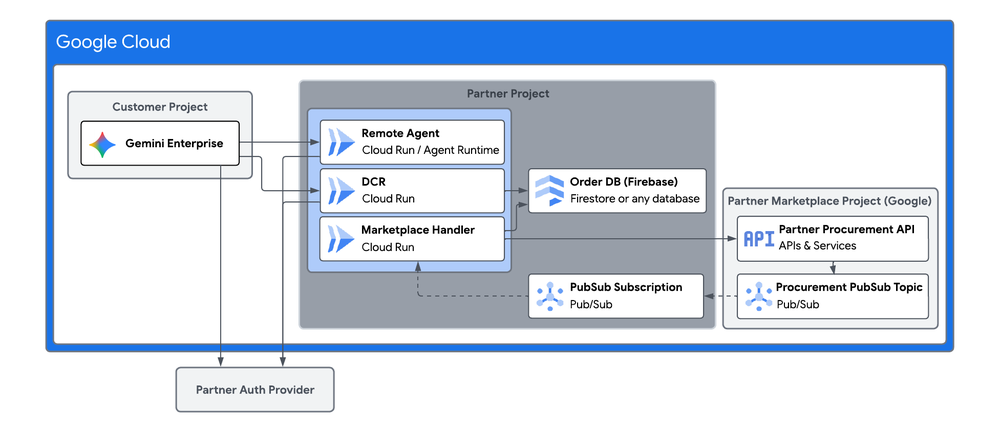
For agent builders and developers looking to publish and commercialize these high-impact, third-party agents through Google Cloud Marketplace and to deploy them to the Gemini Enterprise app , this guide provides a step-by-step path to a fully integrated, marketplace-ready solution. Step 1: Design your agent architecture for integration with Marketplace The end-state architecture bridges Google Cloud Marketplace billing, identity provider (IdP) security, and Gemini Enterprise Agent Platform. Here's an overview of these architectural elements: Customer project: Where users discover agents via the dedicated Agent Marketplace category within Google Cloud Marketplace and interact with these agents through the Gemini Enterprise app.
Partner project: Hosts your agent as well as the marketplace handler, which handles the logic for procurement, and Dynamic Client Registration (DCR) for authorization. Partner Marketplace project: Manages the Partner Procurement API and Pub/Sub topics for Marketplace events like account creation or entitlement approvals.
Review Agent-as-a-Service listing requirements. Verify that your organization meets the requirements to list your solutions on Marketplace . Marketplace Vendor Agreement: Review and accept the Marketplace Vendor Agreement (MVA).
Nominate your agent for Google Cloud Marketplace by contacting your Google Cloud representative. All agents listed on Marketplace must comply with the above standard requirements plus several agent-specific mandates: Define your agent use case: We recommend defining specific, agentic use cases targeting high-value enterprise functions designed to solve tangible pain points and scale across multiple enterprise customers. A2A protocol adherence: Agents must comply with the A2A protocol specifications for interoperability.
This can include the A2UI protocol which enables your agents to generate rich, interactive user interfaces. A2A Agent Card: Create an Agent Card , a JSON file declaring capabilities (skills), authentication methods, and service endpoints. Authentication: Agents must support public access or OAuth 2.0 Authorization Code Grant Flow .
Marketplace integration: Mandatory integration with Procurement APIs and Pub/Sub for entitlement lifecycle management. Step 3: Review the technical requirements for your agent to be compatible with Marketplace and the Gemini Enterprise app A2A protocol When designing and implementing your agent, ensure you follow the A2A protocol documentation . This will guide you on choices for interaction patterns (e.g., streaming or asynchronous tasks) that your agent can provide and can include incorporating an interactive UI experience using the A2UI protocol .
Using A2UI allows you to leverage the latest and greatest UX controls available-such as advanced, dynamic charts and modern interaction models. By utilizing these native user controls, you ensure your agent doesn't just function reliably, but looks, feels, and operates with a premium sense of "pride in craft" inside the Gemini Enterprise app. A2A agent card To list your Agent-as-a-Service product on the Marketplace, you must provide an A2A Agent Card for your agent.
For more details please read the original article at Google Cloud AI.
Continue Learning
Comments
Comments appear only after moderation. Your email identifies your submission to the moderator and is never displayed here.
No approved comments yet.