AI Agent Failure Detection and Root Cause Analysis with Strands Evals
AWS Machine Learning released a guide detailing how to use detector functions in "Strands Evals" to diagnose AI agent failures and conduct root cause analysis. The post explains how to interpret diagnostic outputs, which categorize issues, assign confidence scores, and recommend precise fixes for system prompts or tool definitions. Additionally, it demonstrates how developers can embed these automated checks directly into their evaluation pipelines.
Key Takeaways
- AWS Machine Learning published a guide explaining how developers can diagnose real agent failures using detector functions within "Strands Evals".
The process centers on interpreting structured diagnostic outputs that assign confidence scores to categorized failures.
- By establishing causal chains, the system connects root causes directly to downstream symptoms, giving developers a clear view of where an execution path broke down.
The framework provides targeted remediation advice by specifying whether corrective actions should be made to system prompts or tool definitions.
- Furthermore, developers learn how to incorporate these detector functions directly into automated evaluation pipelines, enabling systematic root cause analysis on every test run.
Automated diagnostics allow teams building complex AI workflows to pinpoint and resolve errors more efficiently.
- AWS Machine Learning outlined a framework for using detector functions in Strands Evals to analyze agent failures.
Diagnostic outputs provide categorized failure classifications, confidence scores, and causal chains tracing downstream symptoms.
- Developers can integrate failure detection directly into evaluation pipelines to run automated diagnostics on every test run.
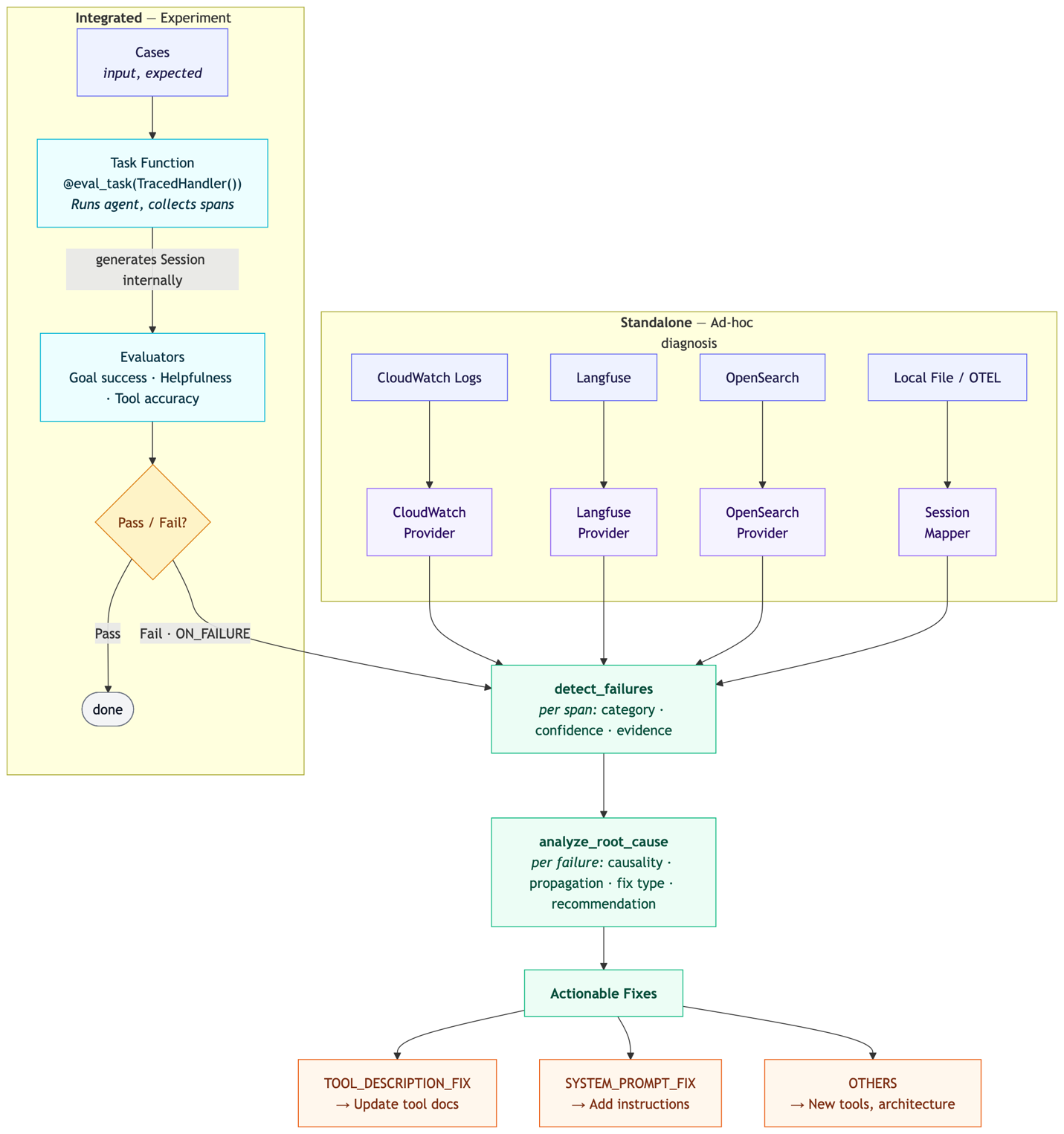
AWS Machine Learning published a guide explaining how developers can diagnose real agent failures using detector functions within "Strands Evals". The process centers on interpreting structured diagnostic outputs that assign confidence scores to categorized failures. By establishing causal chains, the system connects root causes directly to downstream symptoms, giving developers a clear view of where an execution path broke down.
The framework provides targeted remediation advice by specifying whether corrective actions should be made to system prompts or tool definitions. Furthermore, developers learn how to incorporate these detector functions directly into automated evaluation pipelines, enabling systematic root cause analysis on every test run. Automated diagnostics allow teams building complex AI workflows to pinpoint and resolve errors more efficiently.
AWS Machine Learning outlined a framework for using detector functions in Strands Evals to analyze agent failures. Diagnostic outputs provide categorized failure classifications, confidence scores, and causal chains tracing downstream symptoms. Automated detector functions generate fix recommendations targeting either system prompts or tool definitions.
For more details please read the original article at AWS Machine Learning.
Continue Learning
Comments
Comments appear only after moderation. Your email identifies your submission to the moderator and is never displayed here.
No approved comments yet.