AI Innovators Adopt NVIDIA Vera - Why Max Single-Threaded CPU at Scale Matters
Max single-threaded CPUs at scale are a new category of CPUs built for the agentic AI era. Across the creation and deployment of an agentic system, the CPU is on the critical path for reasoning, response time and learning. CPUs are the processor which executes the work the AI model commands: the tool calling, code [...]
Key Takeaways
- NVIDIA Vera exemplifies a new class of CPU, architected for the era of agents and being adopted by AI innovators including Perplexity; NVIDIA CPU roadmap continues with the NVIDIA Rosa CPU and its Rigel core.
A cross the creation and deployment of an agentic system, the CPU is on the critical path for reasoning, response time and learning.
- Today's data center CPUs are not designed for speed at scale.
While the world has fast CPUs for PCs and workstations, data center CPUs have been evolving in directions away from single-threaded performance.
- Max single-threaded CPUs at scale are designed differently to deliver: Strong performance per core under load Enough memory bandwidth per core to keep active cores supplied with data Predictable latency Every core can finish its task without any other core slowing it down, delivering excellent throughput and, more importantly, the fastest possible single-core task performance possible.
- Traditional CPU work is intermittent and user-driven, made up of short interactions triggered by people.
Agentic work is persistent and parallel: swarms of agents running continuously, each advancing through a chain of steps where each step depends on the result of the one before it.
- And since each action is dependent on the previous result, per-core speed determines how fast the loop advances.
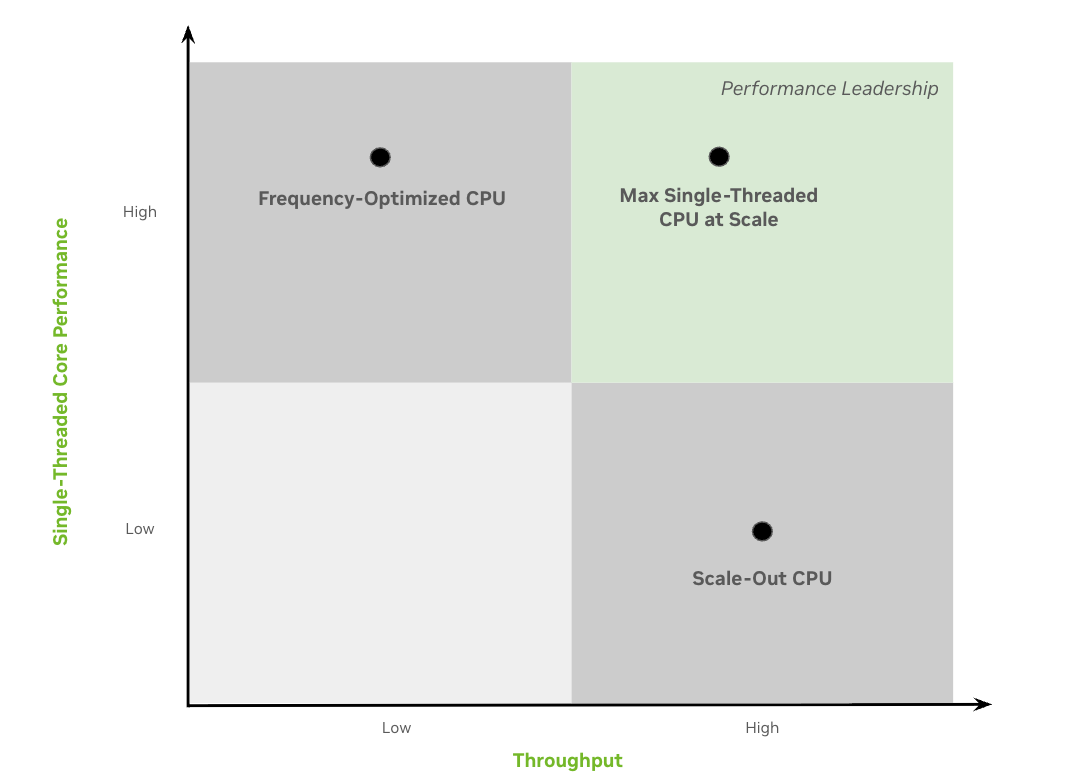
NVIDIA Vera exemplifies a new class of CPU, architected for the era of agents and being adopted by AI innovators including Perplexity; NVIDIA CPU roadmap continues with the NVIDIA Rosa CPU and its Rigel core. Max single-threaded CPUs at scale are a new category of CPUs built for the agentic AI era. A cross the creation and deployment of an agentic system, the CPU is on the critical path for reasoning, response time and learning.
CPUs are the processor which executes the work the AI model commands: the tool calling, code execution, data processing, KV-cache and result analysis. For agents in AI factories, speed matters. The faster the CPU can run the tool, the faster the agent can perform the task at hand.
For the AI factory, the utilization of GPU is the most valuable resource in the data center so any time waiting for a task to complete constrains the revenue of an AI factory - or worse, impacts the GPU utilization waiting for the CPU to finish its task. AI factories need a CPU with max single-threaded performance to maximize AI factory revenue and agent performance. Today's data center CPUs are not designed for speed at scale.
While the world has fast CPUs for PCs and workstations, data center CPUs have been evolving in directions away from single-threaded performance. The advent of the cloud has pushed CPU makers to build higher core-count CPUs while minimizing cost at the expense of performance. Building CPUs that optimize costs per rentable core increased the number of cores per chip while taking away silicon area from what makes those cores run fast - like high-performance memory fabrics and faster instruction processing per core.
The move to chiplet architectures further reduced cost but created a "chiplet tax" where each CPU's cores can no longer can get access to the full memory performance of the chip. AI agents need a CPU designed for max single-threaded performance at scale. A max single-threaded CPU at scale keeps each agent step fast while the system is fully loaded.
Every core completes the agent task at full performance without other cores slowing it down. Max single-threaded CPUs at scale are designed differently to deliver: Strong performance per core under load Enough memory bandwidth per core to keep active cores supplied with data Predictable latency Every core can finish its task without any other core slowing it down, delivering excellent throughput and, more importantly, the fastest possible single-core task performance possible. NVIDIA Vera exemplifies this new class of CPU design.
How Max Single-Threaded CPUs at Scale Are Built to Run the Agentic Loop A n AI agent doesn't stop running after a single request. The model reasons about the next step. The CPU executes the work around the model.
Agentic work is persistent and parallel: swarms of agents running continuously, each advancing through a chain of steps where each step depends on the result of the one before it. More cores in a CPU means more agent tasks per CPU, and data center CPUs need lots of cores to maximize throughput of tasks. However, adding more cores to a CPU cannot shorten the time for each step inside a single agent loop.
More cores can't make any one task run faster. In fact, CPUs designed to maximize core count can even slow down the performance of each core as they contend for resources. Individual per-core performance matters to drive the speed of each step's completion.
For more details please read the original article at NVIDIA Blog.
Continue Learning
Comments
Comments appear only after moderation. Your email identifies your submission to the moderator and is never displayed here.
No approved comments yet.