AI Leaders Propose SAFE Guidelines for Cybersecurity Transparency
Members of the Open Secure AI Alliance - now more than 120 organizations strong - are developing new guidelines to strengthen agentic AI cybersecurity as the annual Black Hat conference begins in Las Vegas today. The Linux Foundation today shared a Request for Comments on Shared AI Findings Exchange (SAFE), a proposed set of guidelines [... The Linux Foundation today shared a Request for Comments on Shared AI Findings Exchange (SAFE), a proposed set of guidelines designed to turn agentic cybersecurity incidents into shared protection for the entire ecosystem.
Key Takeaways
- The SAFE guidelines are being drafted by an Open Secure AI Alliance working group.
NVIDIA, Cisco, CrowdStrike , Hugging Face and Red Hat are among Open Secure AI Alliance members working with the Linux Foundation to contribute to the initial proposal.
- Every major technology shift has created new potential attack surfaces.
Defenders must move now at agent speed to respond rapidly to protect infrastructure and intellectual property - and the best way to do that is together.
- It's a system - identity controls, harnesses, guardrails, logs and evaluation - and securing it requires more than vulnerability scanning.
Security has always been strongest in the layers - and in the community's willingness to share what it knows.
- NVIDIA's open model families - NVIDIA Nemotron for agentic AI, NVIDIA Cosmos for physical AI, NVIDIA Isaac GR00T for robotics, NVIDIA BioNeMo for healthcare and life sciences, and NVIDIA Alpamayo , the world's largest model for autonomous vehicles licensed for commercial use - ship with open weights, datasets and training techniques.
NVIDIA open source verified agent skills extend that trust to the capability layer.
- And Garak , NVIDIA's open source LLM vulnerability scanner, lets security teams check models for data leaks, prompt injections and jailbreak scenarios before they ship.
Stats & Key Facts
- #Members of the Open Secure AI Alliance - now more than 120 organizations strong - are developing new guidelines to strengthen agentic AI cybersecurity as the annual Black Hat conference begins in Las Vegas today.
- #] Members of the Open Secure AI Alliance - now more than 120 organizations strong - are developing new guidelines to strengthen agentic AI cybersecurity as the annual Black Hat conference begins in Las Vegas today.
- #] Members of the Open Secure AI Alliance - now more than 120 organizations strong - are developing new guidelines to strengthen agentic AI cybersecurity as the annual Black Hat conference begins in Las Vegas today.
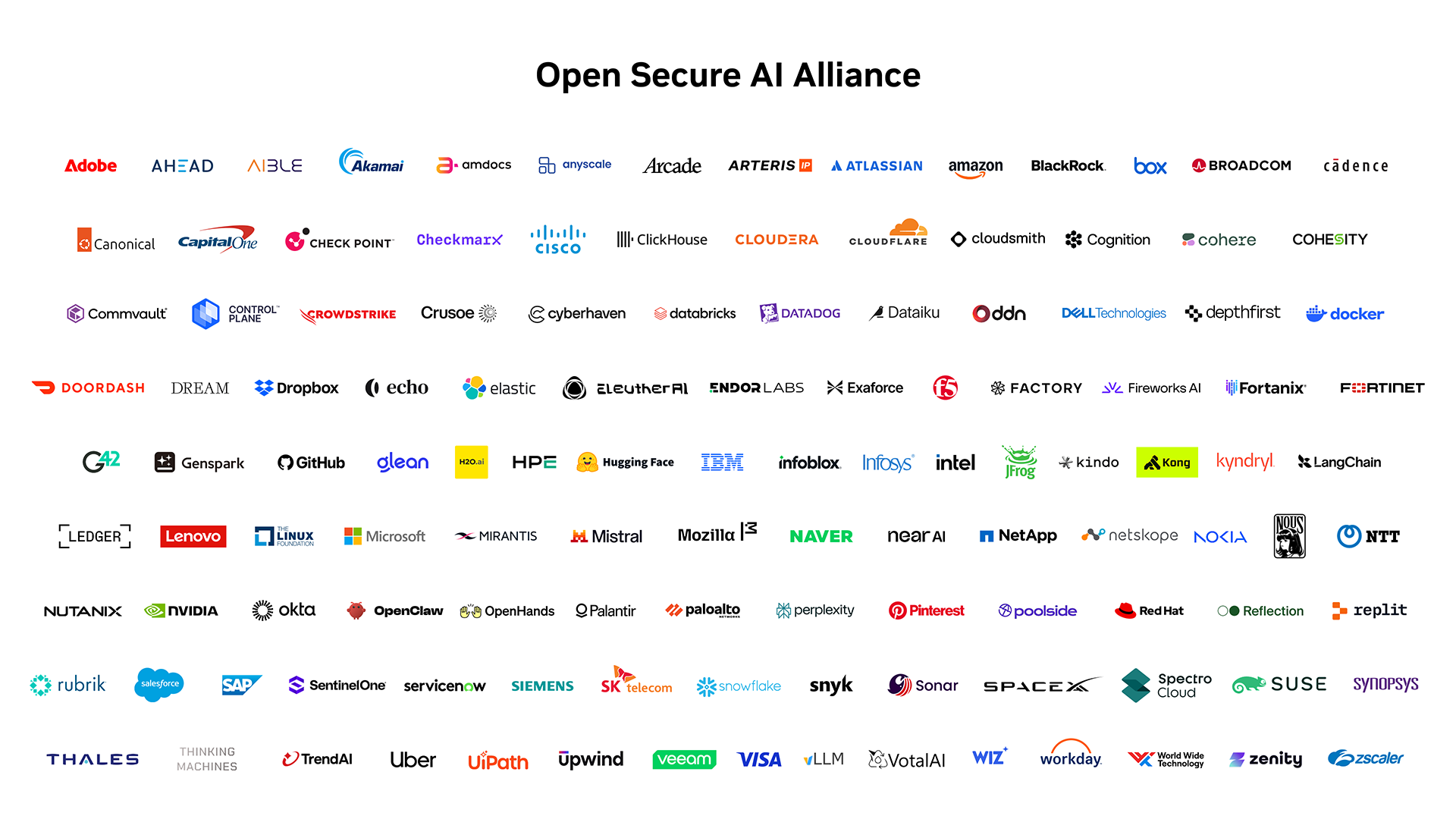
Members of the Open Secure AI Alliance - now more than 120 organizations strong - are developing new guidelines to strengthen agentic AI cybersecurity as the annual Black Hat conference begins in Las Vegas today. The Linux Foundation today shared a Request for Comments on Shared AI Findings Exchange (SAFE), a proposed set of guidelines [... ] Members of the Open Secure AI Alliance - now more than 120 organizations strong - are developing new guidelines to strengthen agentic AI cybersecurity as the annual Black Hat conference begins in Las Vegas today.
The Linux Foundation today shared a Request for Comments on Shared AI Findings Exchange (SAFE), a proposed set of guidelines designed to turn agentic cybersecurity incidents into shared protection for the entire ecosystem. The SAFE guidelines are being drafted by an Open Secure AI Alliance working group. NVIDIA, Cisco, CrowdStrike , Hugging Face and Red Hat are among Open Secure AI Alliance members working with the Linux Foundation to contribute to the initial proposal.
The SAFE guidelines include proposals to confidentially collect and analyze AI incidents and near misses, inform those impacted, identify recurring control failures and publish evidence-based operating recommendations that reduce systemic risk. Cybersecurity is a race without a finish line. Every major technology shift has created new potential attack surfaces.
Defenders must move now at agent speed to respond rapidly to protect infrastructure and intellectual property - and the best way to do that is together. When trusted ecosystems share threat intelligence openly, collective defense becomes a force multiplier. Open Secure AI Alliance Delivers More Tools for AI Cybersecurity The SAFE framework adds to technology contributions Open Secure AI Alliance members are making as part of a shared commitment to building and sharing open, inspectable tools across the full AI security stack.
An AI agent isn't just a model. It's a system - identity controls, harnesses, guardrails, logs and evaluation - and securing it requires more than vulnerability scanning. Security has always been strongest in the layers - and in the community's willingness to share what it knows.
The hardest problems get solved when defenders learn from each other, openly and at speed. Full Stack of Open NVIDIA Cybersecurity Software and Models NVIDIA's contributions run the length of the stack, starting with the NVIDIA Labs Object-Oriented Agent (NOOA) research harness, on GitHub - which makes agent behavior easier to test, trace, audit and govern. The NVIDIA OpenShell runtime restricts what an agent can see, touch and do - enforcing security and privacy controls at the agent level, so an agent can't reach what it shouldn't.
NVIDIA's open model families - NVIDIA Nemotron for agentic AI, NVIDIA Cosmos for physical AI, NVIDIA Isaac GR00T for robotics, NVIDIA BioNeMo for healthcare and life sciences, and NVIDIA Alpamayo , the world's largest model for autonomous vehicles licensed for commercial use - ship with open weights, datasets and training techniques. NVIDIA open source verified agent skills extend that trust to the capability layer. Each skill provides portable instruction sets - cataloged, scanned for risks such as prompt injection and tools poisoning, cryptographically signed and documented with a skill card.
Defenders know exactly what an agent skill does, where it came from and whether it was modified after publication. NeMo Guardrails, NeMo Anonymizer and NeMo Safe Synthesizer help enforce safety policies, protect sensitive data and generate privacy-safe synthetic data. And Garak , NVIDIA's open source LLM vulnerability scanner, lets security teams check models for data leaks, prompt injections and jailbreak scenarios before they ship.
For more details please read the original article at NVIDIA Blog.
Continue Learning
Comments
Sign in to join the conversation