Back to News Hub
🟧AWS Machine Learning
July 22, 2026
E-Commerce

AI Teammates: how monday.com runs production AI agents on Amazon Bedrock

Overview

monday.com operates production AI agents called AI Teammates on Amazon Bedrock at significant scale, achieving substantial productivity gains across its engineering organization. The company reports that nine in ten builders use AI coding tools monthly and per-engineer pull request throughput has increased by over 50 percent. monday.com shares its architectural approach, integration strategies for legacy codebases, and confidence-scoring mechanisms that enable near-autonomous code merges.

Key Takeaways

  • monday.com runs AI Teammates as production agentic AI on Amazon Bedrock, operating at a scale few engineering organizations match.
  • AI adoption among builders has grown dramatically, from roughly 50 percent to 90 percent monthly usage within a year.
  • Per-engineer pull request throughput increased by more than 50 percent after implementing AI agents.
  • monday.com successfully integrated agentic AI into a decade-old codebase through targeted retrofits.
  • Confidence-scored merge processes enable AI agents to merge code autonomously, moving toward full automation.

Stats & Key Facts

  • #90 percent of builders at monday.com use AI coding tools monthly
  • #50 percent increase in monthly AI tool usage among builders over the past year
  • #50+ percent increase in per-engineer PR throughput
  • #Decade-old codebase retrofitted to support production agentic AI
AI Teammates: how monday.com runs production AI agents on Amazon Bedrock

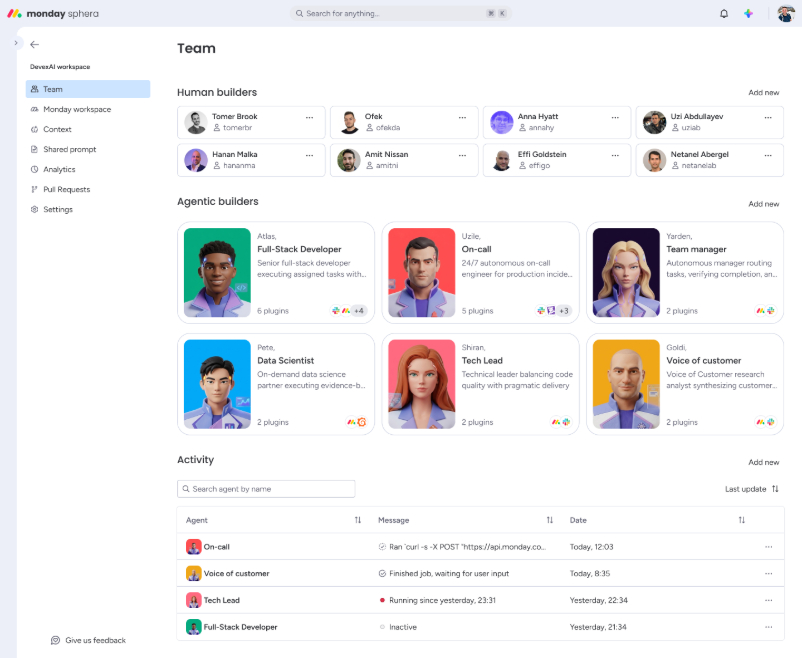
The Rise of AI Teammates in Production

monday.com has positioned itself as a leader in deploying agentic AI at production scale.

  • ›AI Teammates represent a new category of agentic AI running on Amazon Bedrock infrastructure.
  • ›Nine in ten builders at monday.com now use AI coding tools every month, a dramatic increase from approximately 50 percent adoption one year prior.
  • ›This adoption rate reflects widespread confidence in the capabilities and reliability of the AI systems.
  • ›monday.com's internal production data validates both adoption rates and productivity improvements across the engineering organization.

Productivity Gains and Engineering Impact

The integration of AI agents has produced measurable improvements in engineering velocity.

  • ›Per-engineer pull request throughput has increased by more than 50 percent since AI agent deployment.
  • ›This productivity gain reflects faster code generation, review, and integration cycles enabled by agentic assistance.
  • ›The improvement spans the entire engineering organization, indicating broad, not isolated, benefits.
  • ›All reported metrics come directly from monday.com's internal production systems and real engineering workflows.

Architectural Foundation on Amazon Bedrock

monday.com's AI Teammates leverage Amazon Bedrock as the underlying platform for agentic capabilities.

  • ›Amazon Bedrock provides the foundational models and infrastructure enabling agentic behavior at scale.
  • ›The architecture supports multiple concurrent AI agents working across the codebase without creating bottlenecks.
  • ›Bedrock's managed service model reduces operational overhead compared to self-hosted alternatives.
  • ›The platform choice reflects monday.com's commitment to reliable, enterprise-grade AI deployment.

monday.com selected Amazon Bedrock to power its AI Teammates after evaluating the requirements for production agentic systems. The platform needed to support high concurrency, maintain consistent performance, and integrate seamlessly with existing CI/CD pipelines. Bedrock's managed infrastructure and access to multiple foundation models provided the flexibility and scale required for monday.com's ambitious deployment.

Retrofitting Legacy Systems for Modern AI

One of monday.com's key achievements was integrating agentic AI into a codebase spanning a decade.

  • ›The decade-old codebase presented unique integration challenges typical of mature engineering organizations.
  • ›monday.com developed specific retrofits to make legacy systems compatible with AI agent operations.
  • ›These retrofits preserved existing functionality while enabling new agentic workflows.
  • ›The approach demonstrates that organizations need not rewrite entire systems to adopt production agentic AI.

Legacy codebases often present barriers to modern AI integration due to architectural patterns, dependency structures, and accumulated technical debt. monday.com's engineering team identified these friction points and developed targeted retrofits rather than pursuing a costly rewrite. This pragmatic approach allowed the company to preserve institutional knowledge embedded in the existing code while unlocking the benefits of agentic AI tools.

The retrofit strategy included updates to code structure, enhanced logging and observability for AI agent interactions, and integration layers that allow AI agents to understand and work within the existing system boundaries. These modifications were made incrementally, reducing risk and allowing teams to validate improvements at each stage.

Confidence-Scored Merge and Autonomy

monday.com has implemented a novel confidence-scoring system that enables increasingly autonomous code merges.

  • ›Confidence scores quantify the likelihood that an AI-generated pull request meets quality and correctness standards.
  • ›Higher confidence scores enable more autonomous merge decisions, reducing human review overhead.
  • ›This scoring mechanism closes the gap toward full autonomy by providing measurable thresholds for automated actions.
  • ›The approach balances innovation and safety by requiring human approval for lower-confidence changes.

The confidence-scored merge strategy represents a critical step toward true autonomous AI agents. Rather than requiring human review for every AI-generated change, monday.com uses a scoring system that evaluates code quality, test coverage, architectural alignment, and other relevant factors. Changes exceeding a high confidence threshold can be merged automatically, while lower-confidence changes remain subject to human review.

This tiered approach allows the organization to progressively expand AI autonomy as confidence scores improve and historical performance validates the system's reliability. Over time, as AI agents demonstrate consistent quality, confidence thresholds can be adjusted, moving the organization closer to fully autonomous code generation and integration without sacrificing safety or code quality.

Implications for Engineering Organizations

monday.com's success with production agentic AI carries important lessons for other engineering teams.

  • ›Agentic AI is viable in production for organizations willing to invest in proper architecture and integration.
  • ›Legacy systems need not be obstacles to AI adoption; targeted retrofits can enable integration without costly rewrites.
  • ›Adoption rates suggest engineering teams rapidly embrace AI coding tools when implementation is well-designed and reliable.
  • ›Confidence-based automation provides a practical path to increased autonomy while maintaining quality standards.

Measuring Success Through Real Production Data

monday.com's transparency about using only internal production metrics strengthens confidence in reported results.

  • ›All statistics presented come directly from monday.com's production systems, not synthetic benchmarks or external testing.
  • ›This approach ensures that reported gains reflect actual engineering velocity improvements in real workflows.
  • ›Production data provides the most credible validation of agentic AI effectiveness.
  • ›Publishing real metrics sets a standard for transparency in AI adoption reporting.

Frequently Asked Questions

What are AI Teammates and how do they differ from standard AI coding tools?

AI Teammates are agentic AI systems running on Amazon Bedrock that can operate with greater autonomy than traditional coding assistants. They can take independent actions, make decisions, and through confidence-scored merging, even integrate code changes into production with minimal human oversight. This represents a step beyond suggesting code snippets or completing lines of code.

How did monday.com integrate AI agents into a decade-old codebase?

Rather than rewriting the legacy system, monday.com developed targeted retrofits that made existing code compatible with AI agent operations. These retrofits addressed architectural patterns, enhanced observability, and created integration layers allowing agents to understand and work within established system boundaries without disrupting existing functionality.

What does a confidence score mean in monday.com's merge system?

A confidence score quantifies how likely an AI-generated pull request is to meet quality and correctness standards. Higher scores enable automatic merging with minimal human review, while lower scores require human approval. This creates a tiered autonomy system where increasingly reliable changes can be merged automatically as confidence improves.

Can other engineering organizations achieve similar results with agentic AI?

monday.com's success suggests that agentic AI is achievable for organizations willing to invest in proper architecture, legacy system integration strategies, and confidence-scoring mechanisms. The company's transparency about using real production data indicates these are genuine, reproducible gains rather than theoretical benchmarks.

Why did monday.com choose Amazon Bedrock for its AI Teammates?

Bedrock provides managed infrastructure for agentic AI, access to multiple foundation models, and the scale and reliability required for production deployment. The managed service model reduces operational overhead, allowing monday.com to focus on building application logic rather than maintaining AI infrastructure.

monday.com's production deployment of AI Teammates demonstrates that agentic AI is no longer theoretical-it can drive measurable engineering velocity gains at organizational scale when properly architected and integrated.

Continue Learning

Originally published by AWS Machine Learning
Read the original

Comments

Sign in to join the conversation