Back to News Hub
🟧AWS Machine Learning
June 3, 2026
E-Commerce

Automate model quota request and operational issue triage on Amazon Bedrock

Overview

Amazon Bedrock Ops Alert is a new three-layer automated monitoring solution that detects operational issues, adjusts alarm thresholds dynamically, categorizes alarms, and automatically creates context-aware support cases while preventing duplicates and notifying AI SRE teams. This automation helps organizations manage model quota requests and operational issues more efficiently on Amazon Bedrock.

Key Takeaways

  • Amazon Bedrock Ops Alert automates detection of operational issues with dynamic alarm threshold adjustment to reduce false positives.
  • The solution automatically creates context-aware support cases and prevents duplicate case creation for the same alarm category.
  • Three-layer architecture provides comprehensive monitoring, classification, and notification delivery to AI SRE teams.
  • Intelligent triage system categorizes alarms by type to streamline issue resolution workflows.
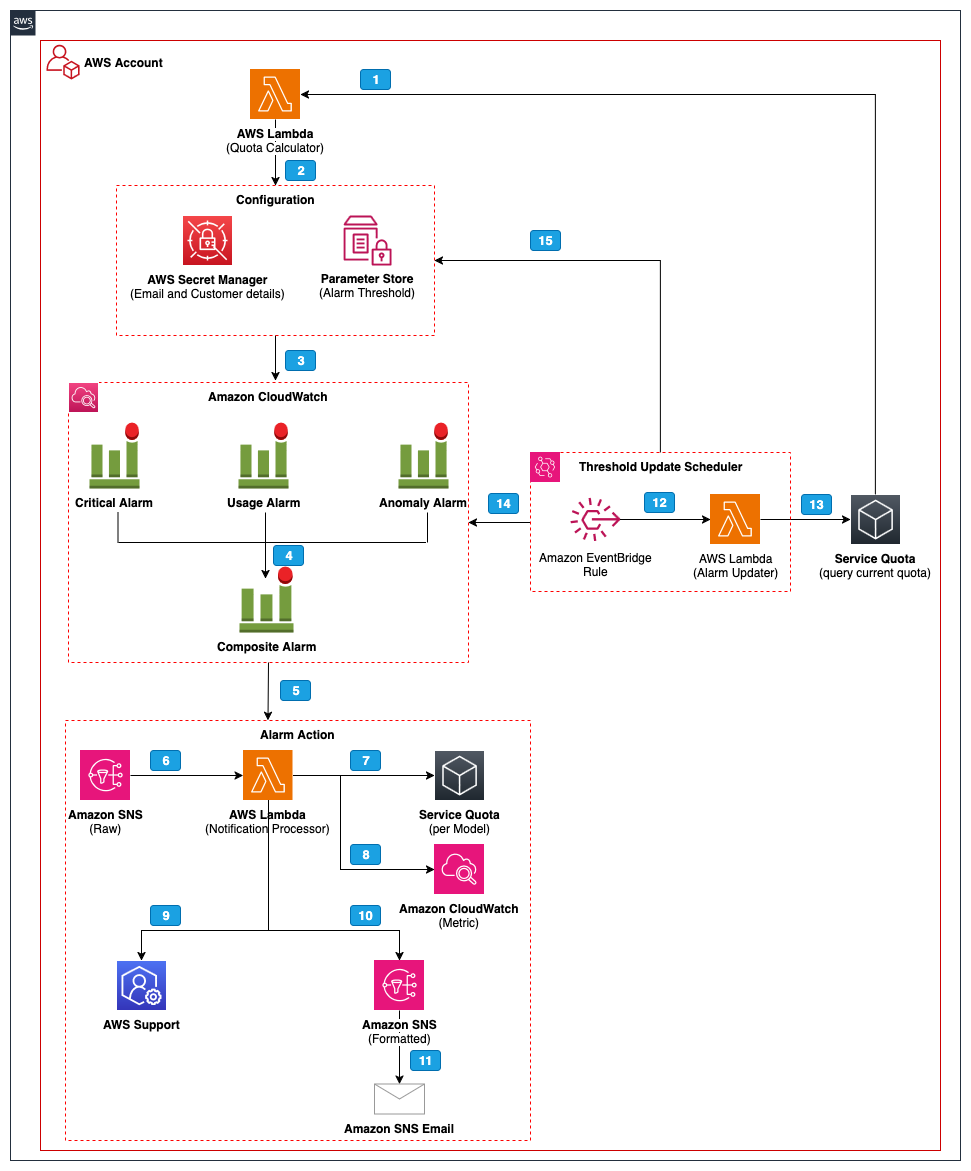
  • Organizations can deploy the solution in their own environments following the provided solution architecture.
Automate model quota request and operational issue triage on Amazon Bedrock

Overview of Amazon Bedrock Ops Alert

Amazon Bedrock Ops Alert represents a significant advancement in operational monitoring for AI infrastructure.

  • ›Three-layer automated monitoring solution designed specifically for Amazon Bedrock environments
  • ›Proactively detects operational issues before they impact production systems
  • ›Reduces manual overhead by automating issue triage and case creation
  • ›Provides intelligent categorization of alarms to streamline SRE team workflows

The solution addresses a critical pain point for organizations running AI workloads on Amazon Bedrock: the complexity of managing multiple operational alerts and routing them appropriately to support teams. Traditional monitoring approaches often generate excessive noise, leading to alert fatigue and delayed response times. Bedrock Ops Alert solves this by implementing intelligent automation at each stage of the monitoring lifecycle.

By combining dynamic threshold adjustment with context-aware case creation, the solution ensures that only relevant alerts reach human teams, and those that do include sufficient context for rapid resolution. This approach significantly reduces the time between issue detection and remediation.

Key Features and Capabilities

The solution delivers several interconnected features that work together to streamline operational issue management.

  • ›Dynamic alarm threshold adjustment that learns from historical patterns to reduce false positives
  • ›Intelligent alarm classification system that categorizes issues by type and severity
  • ›Automatic context-aware support case creation with relevant operational data attached
  • ›Duplicate case prevention that checks for unresolved cases in the same alarm category
  • ›Contextualized notifications delivered directly to AI SRE teams with actionable information

The dynamic threshold adjustment capability is particularly valuable for organizations dealing with variable workloads. Rather than using static alert thresholds that trigger too frequently or not frequently enough, the system learns from historical data patterns and adjusts thresholds intelligently. This reduces alert fatigue without sacrificing visibility into genuine problems.

The alarm classification system provides the foundation for intelligent routing and case creation. By automatically categorizing issues, the solution enables more targeted notification and faster triage. When an alert arrives, the system already knows its category and severity, allowing it to route it to the most appropriate team member or escalation path.

The automatic case creation feature transforms raw alerts into actionable support tickets with all necessary context pre-populated. This eliminates the manual work of creating cases and searching for relevant operational data, allowing SRE teams to focus on solving problems rather than administrative tasks.

Three-Layer Architecture

The solution's architecture is built around three distinct layers that work in concert.

  • ›Detection layer: Identifies operational issues and anomalies in real-time
  • ›Triage and classification layer: Categorizes alerts and determines appropriate response actions
  • ›Notification and case management layer: Routes alerts to teams and creates support cases

The detection layer serves as the foundation, continuously monitoring Amazon Bedrock environments for operational issues. This layer is responsible for gathering metrics, analyzing patterns, and identifying anomalies that warrant attention. The dynamic threshold adjustment happens at this layer, ensuring that detection becomes more precise over time.

The triage and classification layer adds intelligence to the raw detection data. Rather than simply reporting every detected issue, this layer analyzes the alert, determines its category, checks for related unresolved cases, and decides whether a new support case should be created. This layer prevents alert storms and case duplication, two major sources of operational inefficiency.

The notification layer delivers actionable information to SRE teams through appropriate channels. By the time an alert reaches a human operator, it has been classified, contextualized, and verified as non-duplicate. The notification includes all the information the team needs to begin investigating and resolving the issue immediately.

Preventing Duplicate Cases and Alert Fatigue

One of the most valuable aspects of Bedrock Ops Alert is its approach to preventing duplicate work.

  • ›Checks for existing unresolved cases in the same alarm category before creating new ones
  • ›Reduces manual review work by eliminating redundant case creation
  • ›Maintains alert history to provide context for ongoing issues
  • ›Improves team efficiency by ensuring focus on unique problems

Alert fatigue is a common problem in large-scale operations, where similar alerts can fire repeatedly for the same underlying issue. Rather than creating multiple support cases for the same problem, Bedrock Ops Alert implements intelligent deduplication. Before creating a new case, the system queries the case management system to determine if an unresolved case already exists for that alarm category.

This approach has multiple benefits. It prevents SRE teams from receiving duplicate notifications about the same issue, reduces case noise in tracking systems, and helps maintain a cleaner incident history. Most importantly, it allows teams to focus their efforts on making progress on existing issues rather than triaging redundant alerts.

Contextualized Notifications and SRE Integration

The solution is designed with AI SRE teams in mind, delivering notifications in a format that drives immediate action.

  • ›Notifications include full operational context relevant to issue investigation
  • ›Alerts are pre-classified and categorized for rapid triage
  • ›Support cases are automatically populated with diagnostic information
  • ›Integration with existing SRE workflows and communication channels

Context is critical for rapid issue resolution. When a notification reaches an SRE team, it should include all the information necessary to begin investigation without requiring additional queries or manual research. Bedrock Ops Alert delivers exactly this by attaching relevant operational data, configuration details, and historical patterns to each notification.

The pre-classification of alerts means that SRE teams immediately understand the nature and category of each issue. Rather than spending time analyzing raw data, teams can focus on diagnosis and remediation. This significantly reduces mean time to resolution (MTTR) and improves overall operational efficiency.

Deployment and Implementation

Organizations can deploy Bedrock Ops Alert in their own environments following a clear solution architecture.

  • ›Detailed solution architecture provided for self-service deployment
  • ›Step-by-step guidance for integrating with existing Bedrock deployments
  • ›Configuration options for customizing thresholds and classification rules
  • ›Integration points with existing case management and notification systems

The solution is designed to be implementable by organizations with varying levels of AWS expertise. The provided architecture documentation outlines all components, data flows, and integration points necessary for deployment. Organizations can follow the architecture to deploy the solution in their own AWS accounts and customize it to match their specific operational requirements.

Deployment involves configuring monitoring for Bedrock resources, setting up the classification and triage logic, and integrating with existing case management and notification systems. The modular nature of the solution allows organizations to start with basic deployment and gradually enhance it with additional customizations.

Use Cases and Benefits for Quota Management

Bedrock Ops Alert is particularly valuable for managing model quota requests and related operational issues.

  • ›Automatically detects quota threshold violations before they impact applications
  • ›Creates support cases for quota requests with all necessary context pre-populated
  • ›Enables rapid response to quota-related issues with minimal manual intervention
  • ›Provides visibility into quota patterns and trends for capacity planning

Model quota management is a critical operational concern for organizations using Amazon Bedrock. Quota violations can cause application failures if not detected and addressed quickly. Bedrock Ops Alert automates this process by monitoring quota utilization, detecting threshold violations, and automatically creating appropriately categorized support cases.

The dynamic threshold adjustment is particularly useful for quota management, as quota utilization patterns often vary significantly based on application behavior and time of day. The system learns these patterns and adjusts thresholds accordingly, reducing false alarms while maintaining visibility into genuine quota concerns.

Frequently Asked Questions

What is Amazon Bedrock Ops Alert?

Amazon Bedrock Ops Alert is an automated three-layer monitoring solution that detects operational issues, dynamically adjusts alarm thresholds, classifies alarms by category, automatically creates context-aware support cases, prevents duplicate cases, and delivers contextualized notifications to AI SRE teams.

How does the solution prevent duplicate support cases?

Before creating a new support case, the system checks for existing unresolved cases in the same alarm category. If an unresolved case already exists, no new case is created, preventing redundant case creation and alert fatigue.

What are the three layers of the architecture?

The detection layer identifies operational issues in real-time, the triage and classification layer categorizes alerts and determines response actions, and the notification layer routes alerts to teams and creates support cases.

How can organizations deploy this solution?

Organizations can deploy Bedrock Ops Alert by following the provided solution architecture documentation in their own AWS environments. The solution includes step-by-step guidance for integration with existing Bedrock deployments and case management systems.

How does dynamic threshold adjustment reduce false positives?

The system learns from historical patterns and adjusts alarm thresholds intelligently rather than using static thresholds. This allows it to accommodate normal variations in workload while still detecting genuine operational issues.

Bedrock Ops Alert transforms operational monitoring from a reactive, manual process into a proactive, intelligent system that enables SRE teams to focus on solving problems rather than managing alerts.

Continue Learning

Originally published by AWS Machine Learning
Read the original

Comments

Sign in to join the conversation