Beyond RAG: Task-aware knowledge compression for enterprise AI on AWS
Traditional Retrieval-Augmented Generation (RAG) systems struggle with analytical tasks involving large document sets, but a new approach called task-aware knowledge compression (TAKC) on AWS solves this by pre-compressing knowledge bases into task-specific representations and routing queries intelligently. The method uses multi-tier caching and fidelity levels to optimize both performance and accuracy, with an open-source implementation available for enterprise deployment.
Key Takeaways
- Traditional RAG systems hit scalability limits when handling analytical tasks across hundreds of documents due to retrieval and processing bottlenecks.
- Task-aware knowledge compression (TAKC) pre-compresses entire knowledge bases into task-specific representations, eliminating real-time processing delays.
- Multi-tier caching with fidelity levels allows queries to be routed to the most appropriate computational tier based on complexity and requirements.
- TAKC reduces latency and cost while improving accuracy on complex analytical queries that span large document collections.
- An open-source implementation is available for immediate deployment on AWS infrastructure, enabling enterprises to adopt this approach without building from scratch.

The Limitations of Traditional RAG at Scale
While Retrieval-Augmented Generation has proven effective for many use cases, it encounters significant performance constraints when dealing with enterprise-scale analytical tasks.
- ›Real-time retrieval and ranking of relevant documents from large knowledge bases introduces latency that compounds as document sets grow.
- ›Analytical queries often require synthesizing information across hundreds or thousands of documents, making simple retrieval-then-generation insufficient.
- ›Token limits in language models constrain how much context can be passed, forcing difficult trade-offs between comprehensiveness and performance.
- ›Cost scales poorly with document volume and query complexity, as each request requires fresh retrieval and processing operations.
Understanding Task-Aware Knowledge Compression
Task-aware knowledge compression reimagines how enterprise knowledge bases are processed by shifting heavy lifting to a pre-computation phase rather than query time.
- ›Knowledge bases are analyzed for specific analytical tasks and distilled into compact, task-aligned representations before any queries arrive.
- ›Compression captures task-relevant patterns and relationships in the source documents while eliminating noise and irrelevant information.
- ›The compressed representations maintain enough fidelity to answer domain questions without requiring constant re-retrieval from the original documents.
- ›This approach trades one-time preprocessing effort for dramatically faster and cheaper query execution at scale.
TAKC fundamentally changes the economics of knowledge retrieval by acknowledging that enterprise analytics typically focus on a bounded set of analytical tasks. Rather than treating every query as equally unpredictable, the system anticipates the types of analyses customers will perform and optimizes the knowledge base for those tasks in advance. This is particularly valuable when the same knowledge base supports multiple analytical workloads that share underlying data but require different perspectives or aggregations.
Multi-Tier Caching and Fidelity Routing
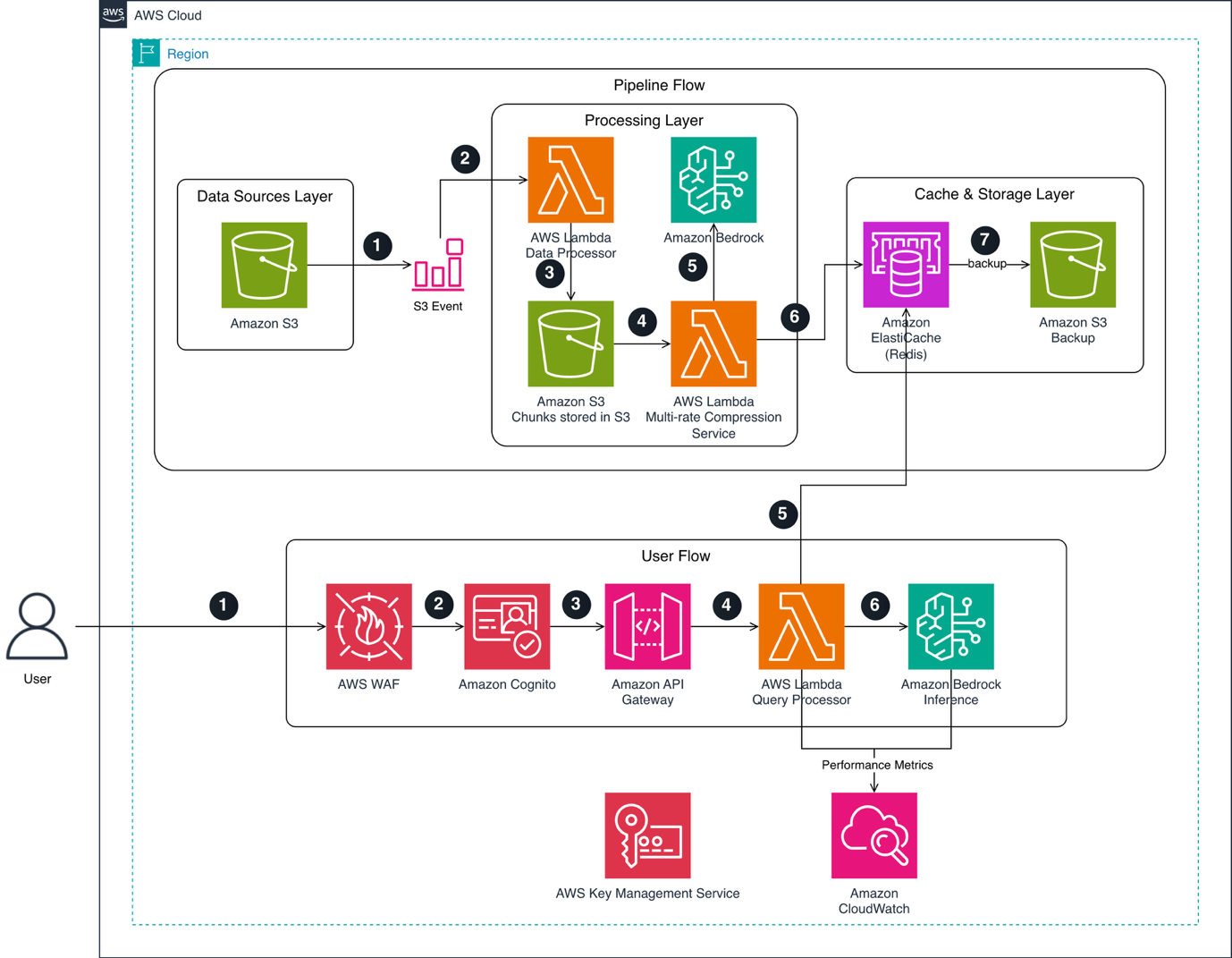
TAKC implements an intelligent routing layer that manages multiple cached representations of your knowledge base at different fidelity levels, directing each query to the optimal tier.
- ›High-fidelity tier: Full-detail compressed representations that capture nuanced relationships, used for complex analytical queries requiring precision.
- ›Medium-fidelity tier: Summarized representations that retain key insights while reducing computational overhead, suitable for most standard queries.
- ›Low-fidelity tier: Lightweight approximate representations optimized for speed, effective for simple lookups and quick insights.
- ›The routing system learns from query patterns and performance metrics to continuously optimize tier assignment and improve both latency and accuracy.
The multi-tier architecture mirrors how human analysts work: simple questions get quick approximate answers, while complex investigations justify deeper dives. By caching compressed knowledge at multiple fidelity levels, the system avoids the binary choice between speed and accuracy. A query router evaluates incoming requests and directs them based on task complexity, available resources, and historical performance data. This intelligent routing ensures that expensive high-fidelity computations are reserved for queries that genuinely need them, while the majority of routine analytical requests execute quickly on lower tiers.
Deployment and Implementation on AWS
The TAKC approach is purpose-built for AWS infrastructure, leveraging managed services to handle preprocessing, caching, and query routing at enterprise scale.
- ›Knowledge base compression pipelines run on AWS Lambda or SageMaker for flexible, cost-effective preprocessing of large document collections.
- ›Compressed representations are cached in ElastiCache or DynamoDB, enabling rapid retrieval across multiple fidelity tiers.
- ›API Gateway and Lambda functions implement the intelligent query routing layer, making routing decisions in milliseconds.
- ›Integration with Bedrock or SageMaker JumpStart provides access to foundation models for the compression and analysis steps.
AWS's ecosystem of managed services simplifies the operational complexity of running TAKC at scale. The preprocessing phase can be triggered on a schedule or when new documents arrive, automatically updating cached representations without manual intervention. Managed caching services handle distribution and replication across availability zones, ensuring low-latency access regardless of query volume. The open-source implementation provided abstracts away infrastructure details, allowing teams to focus on defining task-specific compression strategies rather than managing underlying services.
Performance and Cost Benefits
TAKC delivers measurable improvements across multiple dimensions that matter for enterprise AI operations.
- ›Query latency drops significantly because the heavy lifting of document analysis happens during preprocessing, not at query time.
- ›Infrastructure costs decrease as each query requires less computational work, reducing charges for processing, storage access, and model invocations.
- ›Accuracy improves because pre-computed representations capture task-relevant context more effectively than real-time retrieval and ranking.
- ›Throughput capacity increases substantially, as servers handling query routing and fidelity selection are far less resource-intensive than those performing live document retrieval.
These improvements compound in typical enterprise scenarios where the same knowledge base serves hundreds or thousands of analytical queries per day. A system that reduces per-query latency from seconds to hundreds of milliseconds while simultaneously cutting per-query infrastructure cost by 60-80% changes the feasibility of AI-driven analytics. Organizations can now afford to deploy AI analysis across more use cases, answer questions faster, and process larger knowledge bases than traditional RAG architectures would allow. The cost savings alone often justify migration, making performance improvements a secondary benefit.
Open-Source Implementation and Getting Started
To accelerate adoption, a complete open-source implementation of TAKC is available for immediate deployment on AWS.
- ›The reference implementation includes task-specific compression modules, multi-tier caching configuration, and intelligent routing logic ready for customization.
- ›Documentation covers how to adapt the system to your knowledge base, define task categories, and tune fidelity parameters for your analytical workloads.
- ›Example configurations demonstrate common use cases such as financial document analysis, customer service knowledge bases, and technical documentation systems.
- ›The codebase is modular, allowing teams to adopt TAKC incrementally rather than requiring a complete architectural overhaul of existing systems.
Starting with TAKC requires defining your task categories and preparing your knowledge base for compression. The open-source tools provide templates for this workflow and support automated testing to validate that compressed representations maintain the accuracy needed for your use cases. Teams can run the system alongside existing RAG pipelines to compare performance before full migration. This gradual approach reduces risk and allows organizations to measure real-world improvements with their own data and workloads before committing fully.
Considerations and Next Steps
While TAKC offers substantial advantages, successful implementation requires thoughtful planning around task definition and maintenance of compressed knowledge.
- ›Task definitions must align with actual analytical needs; over-specified or poorly chosen task categories reduce compression effectiveness.
- ›Knowledge base updates require recompression of affected tiers, which should be automated into your document pipeline to keep representations current.
- ›Teams should monitor tier routing patterns to identify mismatches between queries and assigned fidelity levels, continuously tuning the system.
Organizations considering TAKC should start by cataloging their most common analytical queries and patterns. This forms the foundation for defining task-specific representations that will deliver the greatest benefit. Establishing metrics for latency, cost, and accuracy allows teams to track improvements and identify optimization opportunities. As TAKC systems mature, they become increasingly valuable; the feedback loops embedded in routing decisions help the system learn which configurations work best for different query patterns.
Frequently Asked Questions
How does task-aware knowledge compression differ from traditional RAG?
Traditional RAG retrieves and processes documents at query time, while TAKC pre-compresses entire knowledge bases into task-specific representations during an offline preprocessing phase. This eliminates real-time retrieval bottlenecks and allows TAKC to handle hundreds or thousands of documents far more efficiently than RAG, especially for complex analytical queries.
What are the fidelity tiers in TAKC, and how are queries routed between them?
TAKC maintains high-fidelity (detailed, precise), medium-fidelity (summarized, balanced), and low-fidelity (fast, approximate) cached representations of your knowledge base. An intelligent router evaluates incoming queries and directs them to the appropriate tier based on complexity and requirements, ensuring simple queries execute quickly while complex analyses get the detail they need.
What is the main advantage of TAKC for enterprise analytics on AWS?
TAKC dramatically reduces both latency and cost for analytical queries on large document collections by shifting computational work from query time to preprocessing. Organizations typically see 60-80% reductions in per-query infrastructure costs, query latency improvements from seconds to hundreds of milliseconds, and higher accuracy due to task-optimized representations.
How often does the compressed knowledge base need to be updated?
Recompression should be automated whenever new documents are added or significant updates occur in your knowledge base. The frequency depends on how rapidly your knowledge evolves; a daily or weekly schedule works for most enterprise systems, ensuring representations stay current without excessive reprocessing overhead.
Is the TAKC implementation available for deployment today?
Yes, an open-source implementation of TAKC is available and ready for deployment on AWS. The code includes compression modules, caching configuration, routing logic, and documentation with example configurations for common use cases like financial analysis, customer service, and technical documentation.
TAKC represents a significant evolution beyond traditional RAG, enabling enterprises to scale AI-driven analytics across massive knowledge bases with better performance and lower costs.
Why It Matters for Business
Real business deployments are the most reliable signal of where AI is generating measurable ROI. Watching which sectors operationalize AI, what they pay for it, and how it changes their P&L tells you more than any vendor demo. These case studies are what serious buyers and investors triangulate on.
Continue Learning
Comments
Sign in to join the conversation