Bringing Conversational Analytics to your entire data ecosystem
Increasing the adoption of generative AI across the enterprise requires you to do more than deploy a generic chatbot with a custom wrapper. Interacting with business-critical databases demands absolute trust, strict governance, and deep grounding in enterprise semantics. Over the last year, Conversational Analytics (CA) in Google Cloud has moved from isolated experiments to scaled, enterprise-wide deployments.
Key Takeaways
- BigQuery Conversational Analytics and the Conversational Analytics API are now generally available, adding to the general availability of Conversational Analytics in Looker last year.
Building on this momentum, Conversational Analytics in Databases are also available in Preview.
- You can also analyze data stored in Lakehouse Managed Service tables, Apache Iceberg REST catalogs, and federated AWS S3 Unity Catalogs.
Whether your data resides exclusively in Google Cloud or across multiple cloud providers, your agents can query it natively.
- Our APIs and MCP tools let you embed Conversational Analytics wherever your business users work, like custom applications and multi-agent systems, or as slack chatbot that can answer questions across data sources, as we showed at Google Cloud Next.
Enterprise security and governance controls Scaling generative AI to tens of thousands of users requires ironclad governance and transparent cost controls .
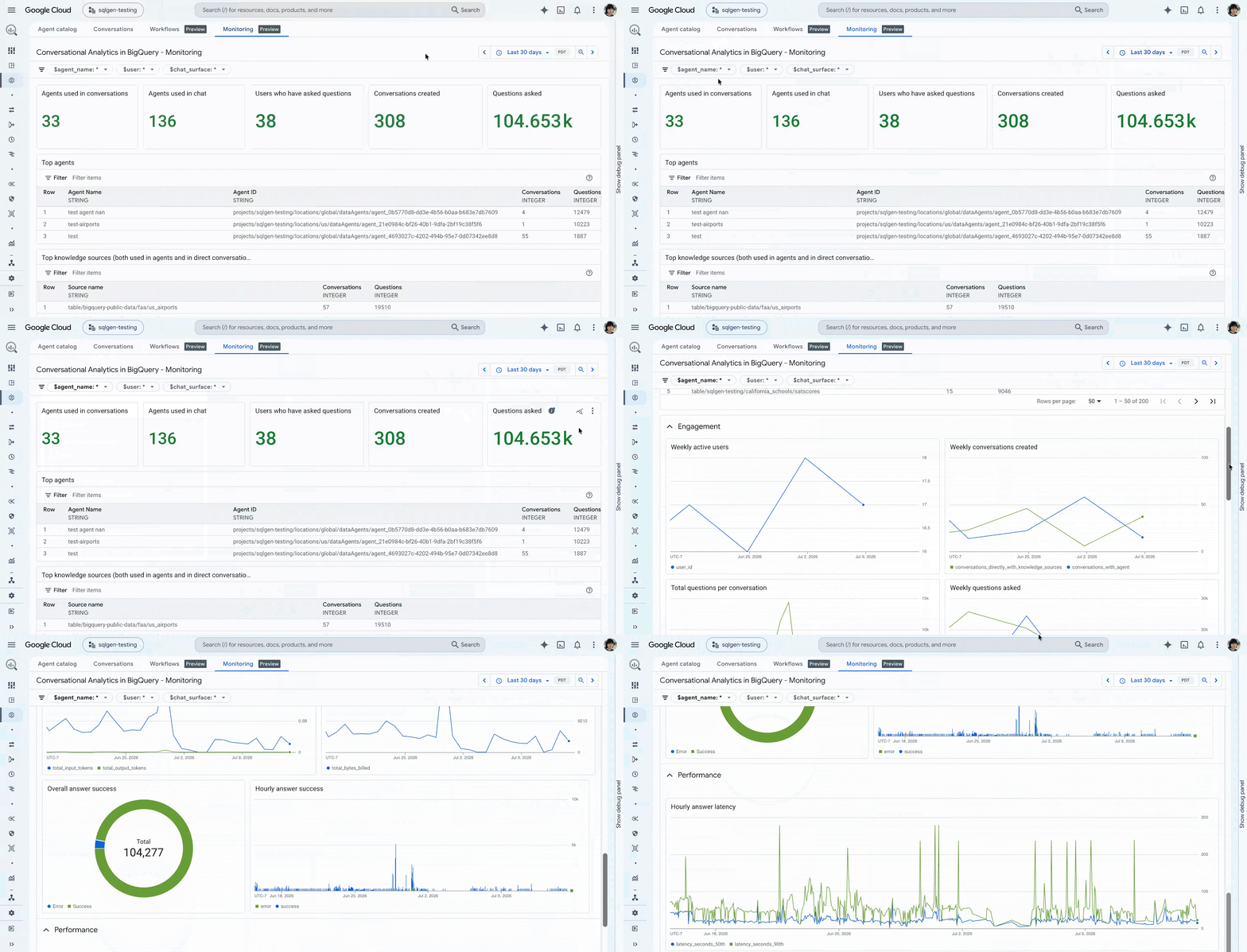
- Monitoring Conversational Analytics in BigQuery to track agent fleet health, active users, query volumes, and top knowledge sources.
As usage grows, administrators need tools to manage costs, observe system health, and improve accuracy.
- To minimize this, we co-designed Conversational Analytics agents alongside the data platforms they query.
BigQuery Conversational Analytics and the Conversational Analytics API are now generally available, adding to the general availability of Conversational Analytics in Looker last year. Building on this momentum, Conversational Analytics in Databases are also available in Preview. And so much more has happened - Google Cloud Conversational Analytics is available for more data, across more surfaces, with more enterprise controls, and greater capability than ever before.
Let's take a deeper look at the state of Conversational Analytics in the Google Data Cloud - what you can do with it, the benefits that it brings, and how to get started with it today. Query across multi-cloud and database workloads Conversational Analytics is now generally available for BigQuery and Looker, and in preview for AlloyDB, Cloud SQL, and Spanner. You can also analyze data stored in Lakehouse Managed Service tables, Apache Iceberg REST catalogs, and federated AWS S3 Unity Catalogs.
Whether your data resides exclusively in Google Cloud or across multiple cloud providers, your agents can query it natively. For data practitioners, Conversational Analytics is integrated directly into BigQuery Studio, BigQuery Data Canvas, Database Studio and Data Agent Kit . For business teams, these conversational capabilities extend directly into Looker , Data Studio , and Gemini Enterprise .
Data teams can publish Conversational Analytics agents created in BigQuery, Looker, AlloyDB, Spanner, and Cloud SQL directly into Gemini Enterprise, giving business leaders a centralized interface to query complex data safely. Our APIs and MCP tools let you embed Conversational Analytics wherever your business users work, like custom applications and multi-agent systems, or as slack chatbot that can answer questions across data sources, as we showed at Google Cloud Next. Enterprise security and governance controls Scaling generative AI to tens of thousands of users requires ironclad governance and transparent cost controls .
Conversational Analytics includes Customer Managed Encryption Keys (CMEK) , Private IP , and Virtual Private Cloud (VPC) controls. We guarantee Data Residency (DRZ) at rest and machine learning processing inside multi-region endpoints within the European Union and the United States, along with HIPAA compliance. For data access, role-based controls, including parameterized secure views in AlloyDB for PostgreSQL , help ensure users chatting with an agent only see data they are authorized to view, enforced down to row- and column-level permissions.
Monitoring Conversational Analytics in BigQuery to track agent fleet health, active users, query volumes, and top knowledge sources. As usage grows, administrators need tools to manage costs, observe system health, and improve accuracy. You can configure native cost controls to define limits on maximum query sizes in bytes, and track usage through BigQuery query labels and Looker system activity logs.
To maintain fleet visibility, agents can also export health, tool usage, latency, and token consumption metrics via OpenTelemetry (OTEL) standards. Integrated feedback loops allow administrators to review agent traces and user feedback, establishing a foundation for continuous evaluation and accuracy improvements over time. Grounded context through agent and data co-design Wrapping a generic LLM around an enterprise database can sometimes lead to hallucinated logic.
For more details please read the original article at Google Cloud AI.
Continue Learning
Comments
Comments appear only after moderation. Your email identifies your submission to the moderator and is never displayed here.
No approved comments yet.