Bristol Myers Squibb Building Life Science Industry's Most Advanced AI Factory on NVIDIA Vera Rubin
Erin Davis calls it the "SuperDuperPOD." That's two things in one name: pharmaceutical giant Bristol Myers Squibb (BMS) already runs one of the largest AI clusters in life sciences, with serious results to show for it. BMS announced today it is deploying its second NVIDIA DGX SuperPOD, this one built on [...]
Key Takeaways
- The pharmaceutical company has demonstrated how AI can transform how drugs discovery and is now scaling AI across R&D to accelerate the discovery of next-generation medicines.
BMS announced today it is deploying its second NVIDIA DGX SuperPOD , this one built on eight DGX Vera Rubin NVL72 systems - the most powerful and energy-efficient AI cluster in life sciences.
- What Davis and other top BMS researchers are really after is what that access makes possible: faster cycles, bigger chemical spaces and a full drug discovery pipeline where researchers think about the science, not the logistics of lining up resources.
- AI is also applied in lead optimization stages of drug discovery using a methodology Sheth calls "Predict First," which informs experimental gating based on design predictions.
"We use predictions as a way to prioritize synthesis of molecules with multi parameter optimization," she explains, "to weed out molecules that wouldn't necessarily meet the property landscape we're working towards.
- With the new system coming, Davis already has her pitch for researchers thinking about where to do their best work: "Welcome to Limitless Compute."
A computational chemist by training, Davis spent years doing the science before concluding the technology wasn't keeping up - and that she'd rather go fix it.
- Her father died five years ago, she says, "a very horrible death of Alzheimer's."
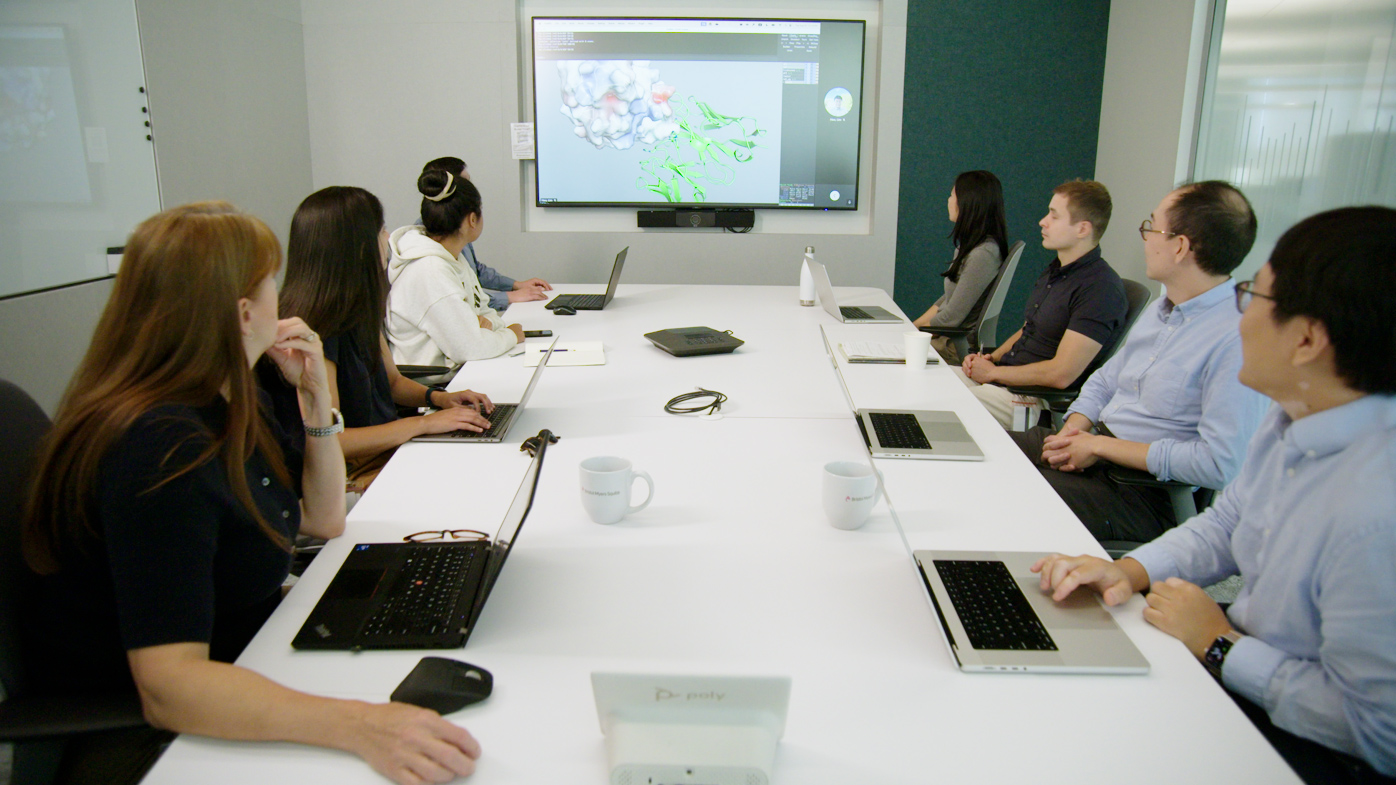
The pharmaceutical company has demonstrated how AI can transform how drugs discovery and is now scaling AI across R&D to accelerate the discovery of next-generation medicines. Erin Davis calls it the "SuperDuperPOD." That's two things in one name: pharmaceutical giant Bristol Myers Squibb (BMS) already runs one of the largest AI clusters in life sciences, with serious results to show for it.
BMS announced today it is deploying its second NVIDIA DGX SuperPOD , this one built on eight DGX Vera Rubin NVL72 systems - the most powerful and energy-efficient AI cluster in life sciences. "Instead of equipping a small group of researchers with access to the supercomputer, we're opening it up to literally every scientist," says Davis, vice president of research business insights and technology at BMS. "No one has to wait, and no one is told they have a limit."
The eight rack-scale systems, each comprising NVIDIA Vera CPUs and Rubin GPUs, deliver up to 10x the performance per megawatt of the infrastructure it replaces. It will give researchers at the global pharmaceutical giant access to a unified AI platform - including NVIDIA BioNeMo Agent Toolkit for biological AI - for running predictions, training models and powering agentic workflows across the full drug discovery pipeline. What Davis and other top BMS researchers are really after is what that access makes possible: faster cycles, bigger chemical spaces and a full drug discovery pipeline where researchers think about the science, not the logistics of lining up resources.
The mandate, says Payal Sheth - a scientist who spent her career inside drug discovery labs before taking on an expanded role in January as senior vice president of therapeutic discovery sciences at BMS - is moving from "sort of this abstract position of what AI can do to actually translating that to measurable impact." BMS has operated a DGX SuperPOD for about three years, producing meaningful results. AI-enabled target identification already saves scientists weeks of manual work, freeing time to focus on the highest-value scientific decisions.
BMS's team has used AI to expand its library of CELMoD compounds - molecules engineered to selectively degrade cancer-causing proteins, with applications in blood cancer treatment and beyond. This has opened the door to new targets and new potential medicines across a wider range of diseases. AI is also applied in lead optimization stages of drug discovery using a methodology Sheth calls "Predict First," which informs experimental gating based on design predictions.
"We use predictions as a way to prioritize synthesis of molecules with multi parameter optimization," she explains, "to weed out molecules that wouldn't necessarily meet the property landscape we're working towards. This ensures precious laboratory experiments are aligned with progressing molecules that have the highest probability of success. These research AI applications have significant impact on compute needs across the research organization."We're saturated," Davis says.
"We're in production with some very large-scale predictions around large molecules. We're building our own foundational models, and that takes a lot of GPUs." With the new system coming, Davis already has her pitch for researchers thinking about where to do their best work: "Welcome to Limitless Compute."
A computational chemist by training, Davis spent years doing the science before concluding the technology wasn't keeping up - and that she'd rather go fix it. She spent roughly 15 years on the vendor side, building enterprise platforms at ChemAxon, Schrödinger and X-Chem. At every company, pharma was wrestling with the same bottleneck.
"It's not the technology," she says. "The challenge is how to get that into the hands of actual scientists and learn from it." She knows what's at stake personally.
For more details please read the original article at NVIDIA Blog.
Continue Learning
Comments
Comments appear only after moderation. Your email identifies your submission to the moderator and is never displayed here.
No approved comments yet.