Build an AI-Powered Equipment Repair Assistant Using Amazon Bedrock AgentCore
AWS published a step-by-step guide for building an AI-powered equipment repair assistant on Amazon Bedrock AgentCore, aimed at farmers and field technicians who need fast machinery diagnosis. The assistant lets users describe a problem in plain language, then pulls answers from manufacturer manuals, identifies the parts needed, and walks through approved repair steps. It runs on AgentCore Runtime with the Strands Agents SDK, uses Amazon Nova 2 Lite as the model, and adds a Bedrock Knowledge Base for document retrieval plus AgentCore Memory to remember past conversations.
Key Takeaways
- The assistant targets a costly real-world problem: farm equipment breaking down during harvest, when technicians often arrive without the right parts and have to return for second visits.
- Users type a question in natural language, and the agent retrieves answers from indexed manufacturer documentation using retrieval-augmented generation, so every answer cites its source.
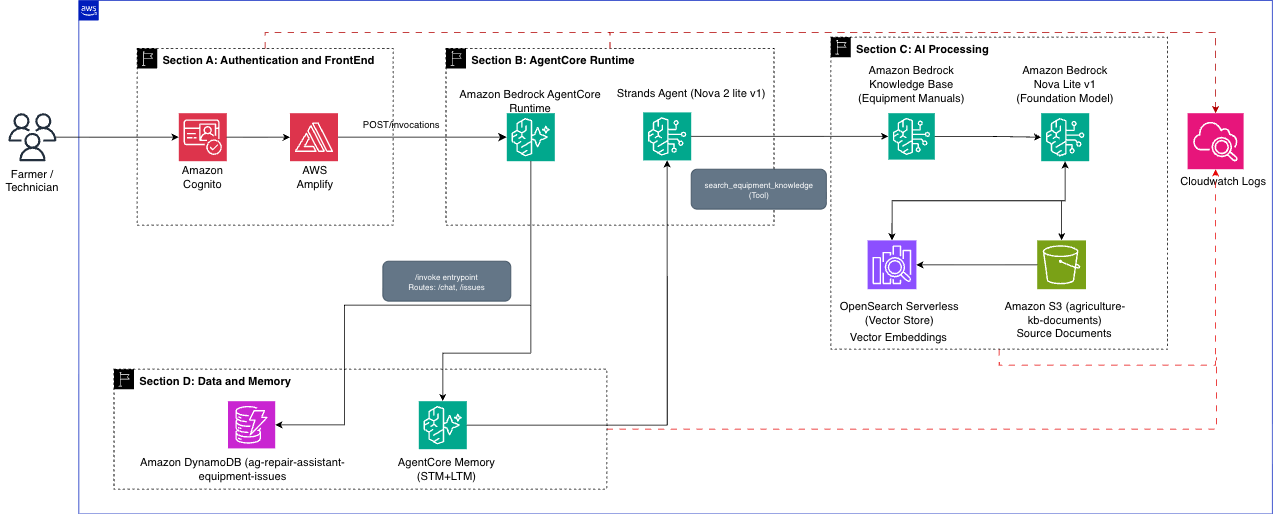
- The system is built from managed AWS pieces: AgentCore Runtime hosts the agent, a Bedrock Knowledge Base stores the manuals, and AgentCore Memory keeps conversation context across sessions.
- Amazon Nova 2 Lite is the foundation model handling the reasoning, chosen as a smaller, lower-cost option for this diagnostic workload.
- Developers extend the assistant by adding small tool functions to the agent code, so new features like parts ordering or dealer contact need no infrastructure rebuild.
- The walkthrough uses real John Deere compact tractor models and their manuals as the sample knowledge base.
Stats & Key Facts
- #Amazon Bedrock AgentCore reached general availability in October 2025 after a July 2025 preview.
- #AgentCore Runtime supports execution windows of up to eight hours per agent session.
- #Deploying the agent to AgentCore takes roughly 5 to 10 minutes, with no local Docker container required.
- #Nova 2 Lite model invocations in the example run about $0.30 per million input tokens and $2.50 per million output tokens.
- #Bedrock Knowledge Base operations cost roughly $0.24 per active hour in the sample setup.
- #The request workflow runs through nine sequential steps, from user authentication to a cited response.

The Harvest-Season Downtime Problem This Assistant Targets
The guide opens with a clear business pain point in agriculture.
Heavy farm machinery breaks down at the worst possible times, often mid-harvest when every hour of downtime carries a financial cost. The usual repair process forces technicians to diagnose a problem on site without knowing in advance which parts they will need.
That gap leads to repeat visits, longer equipment downtime, and lost revenue for both farmers and service providers. The AWS example frames the assistant as a way to do more diagnosis up front, so a technician shows up already knowing the likely fault and the parts to bring.
How Farmers and Technicians Use the Assistant in Plain Language
The point of the tool is to remove the need for technical search skills.
- ›A user signs in through a web interface and types a question about a machine, such as a hydraulic system losing pressure.
- ›The assistant searches manufacturer documentation and returns repair guidance written for the specific equipment.
- ›Answers include source citations, so the user sees which manual or page the guidance came from.
- ›Sample questions in the guide cover hydraulic diagnostics, fluid specifications, and parts identification.
The AWS Building Blocks: AgentCore Runtime, Knowledge Base, and Memory
The solution stitches together several managed Amazon services rather than custom infrastructure.
- ›AgentCore Runtime hosts the diagnostic agent and handles execution and isolation.
- ›Amazon Nova 2 Lite is the foundation model doing the reasoning and response generation.
- ›A Bedrock Knowledge Base stores indexed manufacturer manuals and retrieves relevant passages through retrieval-augmented generation.
- ›AgentCore Memory keeps conversation history so the assistant remembers context within a session and across return visits.
- ›Supporting services include Amazon Cognito for sign-in, AWS Amplify for web hosting, DynamoDB and S3 for storage, and OpenSearch Serverless for vector search.
What Retrieval-Augmented Generation Adds for Repair Accuracy
RAG is the piece that keeps the AI grounded in real manuals.
Retrieval-augmented generation means the model does not answer from memory alone. Instead, it first searches a trusted document store, the Knowledge Base of manufacturer manuals, and then writes its answer using those retrieved passages.
For repair work this matters because guidance has to match the exact equipment and approved procedures, not a generic guess. The approach also produces citations, which gives a technician a way to verify the advice before acting on it.
Extending the Assistant Without Rebuilding Infrastructure
The design favors easy expansion through small code additions.
- ›New capabilities are added by writing tool functions in the agent code rather than changing the underlying setup.
- ›Examples of future tools include parts ordering and direct dealer communication.
- ›A single unified API endpoint replaces what used to require several separate legacy services.
- ›Built-in observability through AWS X-Ray and CloudWatch lets teams monitor agent behavior in production.
A Worked Example Built on Real Tractor Manuals
The tutorial grounds the abstract architecture in concrete equipment.
The walkthrough loads operator manuals and technical documentation for John Deere compact utility tractors, specifically the 1023E and 1025R models, into the Knowledge Base. A user might ask about hydraulic pressure loss or the correct fluid specification, and the assistant answers from those exact documents.
Deployment relies on CloudFormation templates and requires Python 3.10 or later and a recent AWS CLI. Pushing the agent to AgentCore takes about 5 to 10 minutes and needs no local Docker container, which lowers the setup barrier for teams trying it.
Frequently Asked Questions
What does this AI repair assistant actually do?
It lets a farmer or technician describe an equipment problem in plain language and returns diagnosis help, the parts likely needed, and approved repair steps drawn from manufacturer manuals. Each answer cites the source document so the user can verify it.
What is Amazon Bedrock AgentCore?
It is an AWS platform for building, deploying, and running production AI agents, with components for hosting the agent (Runtime), storing conversation context (Memory), and connecting to data sources. It reached general availability in October 2025.
Why does the assistant use a Knowledge Base instead of letting the AI answer on its own?
The Knowledge Base holds the real manufacturer manuals, and the agent retrieves from it before answering, an approach called retrieval-augmented generation. This keeps repair guidance tied to approved, equipment-specific documentation rather than a generic guess.
Do I need to be a developer to set this up?
Yes, this is a technical build guide aimed at developers, requiring Python, the AWS CLI, and CloudFormation. The end product, though, is meant for non-technical users like farmers who only type questions into a web interface.
How hard is it to add new features later?
New capabilities are added by writing small tool functions in the agent code, such as parts ordering or dealer contact, without rebuilding the infrastructure. The example notes a single API endpoint replaces several older separate services.
The guide shows how managed AWS services combine into a practical agent that shortens equipment downtime and improves first-visit repair rates. For non-technical readers, the takeaway is that natural-language AI tied to trusted manuals is moving into hands-on field work like farm machinery repair.
Continue Learning
Comments
Sign in to join the conversation