Back to News Hub
🟧AWS Machine Learning
June 30, 2026
E-Commerce

Build generative UI for AI agents on Amazon Bedrock AgentCore with the AG-UI protocol

Overview

Amazon Bedrock AgentCore now supports AG-UI protocol, a new framework for building dynamic user interfaces for AI agents. Combined with CopilotKit, developers can create generative UIs that handle shared state and human-in-the-loop workflows, streamlining the deployment of interactive agent applications on Bedrock.

Key Takeaways

  • AG-UI protocol enables seamless integration of interactive frontends with Amazon Bedrock AgentCore agents
  • CopilotKit extends AG-UI capabilities to include generative UI components that adapt to agent behavior
  • The Fullstack AgentCore Solution Template (FAST) provides a pre-built foundation for implementing these technologies together
  • Human-in-the-loop interactions allow end-users to guide and verify agent actions in real time
  • Shared state management simplifies communication between agents and frontend interfaces
  • Developers can build production-ready agent applications without extensive custom infrastructure
Build generative UI for AI agents on Amazon Bedrock AgentCore with the AG-UI protocol

Understanding AG-UI Protocol and Its Role

AG-UI is a protocol that standardizes how AI agents communicate with user interfaces.

  • ›Defines a consistent interface specification between backend agents and frontend components
  • ›Eliminates the need for custom, one-off communication layers for each agent application
  • ›Works natively with Amazon Bedrock AgentCore to enable rapid UI development
  • ›Reduces development friction by providing a clear contract between agent logic and presentation layers

The AG-UI protocol bridges the gap between complex agent orchestration and user-facing interfaces. Rather than building unique communication mechanisms for every agent project, developers can rely on a standardized protocol that speaks the language of both AI agents and web frontends. This standardization is critical for teams building multiple agent applications or scaling from prototypes to production systems.

By implementing AG-UI, developers gain predictability in how agents expose their capabilities and state to the UI layer. This means teams can focus on business logic and user experience rather than debugging custom serialization or messaging code.

The Fullstack AgentCore Solution Template (FAST)

FAST provides a complete, production-ready foundation for deploying agents with interactive frontends.

  • ›Pre-configured integration of Bedrock AgentCore with AG-UI protocol
  • ›Includes example agent implementations and corresponding UI components
  • ›Accelerates time-to-market by eliminating boilerplate infrastructure setup
  • ›Supports scaling from proof-of-concept to enterprise deployments

The Fullstack AgentCore Solution Template combines backend agent orchestration with frontend tooling in a single, cohesive package. Instead of starting from scratch and piecing together various libraries and frameworks, teams using FAST inherit best practices and architectural patterns vetted for production use.

FAST's design philosophy emphasizes separation of concerns: agents focus on decision-making and tool execution, while the AG-UI protocol handles the handoff to interactive frontends. This clean architecture makes it easier to maintain, test, and iterate on both agent behavior and user experience independently.

Generative UI Powered by CopilotKit

CopilotKit extends the AG-UI foundation with AI-driven, context-aware interface generation.

  • ›Automatically generates UI components based on agent state and capabilities
  • ›Adapts interfaces dynamically as agent behavior and available actions change
  • ›Reduces manual UI coding through intelligent component suggestions
  • ›Enables more natural, conversational interactions between users and agents

Generative UI represents a paradigm shift in how frontend interfaces are built for agent applications. Rather than hard-coding every possible screen, button, and form, CopilotKit can intelligently render interfaces on-the-fly based on what the agent needs to communicate or what input the agent requires from the user. This approach scales to handle complex agent workflows without exponential growth in UI code.

For example, if an agent transitions from a data-gathering phase to a decision-validation phase, CopilotKit can automatically shift from a form-heavy interface to a summary view with confirmation buttons, all without explicit UI rewrites. This dynamic adaptation keeps the user experience aligned with the agent's current needs and context.

Shared State Management for Multi-Layer Coordination

Shared state ensures consistent data flow between agents, UI components, and user inputs.

  • ›Centralizes application state, eliminating sync conflicts between agent and UI layers
  • ›Enables real-time state updates across distributed components
  • ›Simplifies debugging by providing a single source of truth for application data
  • ›Supports complex workflows that require multiple agents or UI components to coordinate

In distributed agent systems, state management is a common pain point. Without a shared state mechanism, agents and UI components can become out of sync, leading to confusing user experiences or incorrect decisions. Shared state architecture solves this by establishing a unified data model that all parts of the application reference and update.

This approach is especially valuable for multi-step workflows where user decisions flow back into agent logic. For instance, a user might reject an agent-proposed action, and that rejection needs to propagate immediately to the agent so it can recalibrate its plan. Shared state makes this bidirectional communication seamless.

Human-in-the-Loop Interactions

Human oversight ensures agents remain controllable and aligned with user intentions throughout execution.

  • ›Agents pause or flag decisions for human review before taking critical actions
  • ›Users can provide real-time feedback, corrections, or approvals
  • ›Builds trust by maintaining human agency in high-stakes workflows
  • ›Supports compliance and governance requirements in regulated industries

Fully autonomous agents are valuable in low-risk, repetitive tasks, but many real-world scenarios demand human oversight. Human-in-the-loop interactions create a collaborative model where agents handle complexity and repetition while humans provide judgment, approval, and course correction. This hybrid approach combines the speed and scale of AI with the reliability and accountability of human decision-making.

CopilotKit's generative UI makes human-in-the-loop workflows feel natural. Instead of presenting users with raw agent state dumps, the UI can clearly highlight which decisions require human input, what the agent recommends, and what alternatives exist. This reduces cognitive load and makes it easier for humans to participate meaningfully in the loop.

Deployment on Amazon Bedrock AgentCore

The integrated stack simplifies deployment and management of production agent applications.

  • ›Bedrock AgentCore handles agent execution, scaling, and security
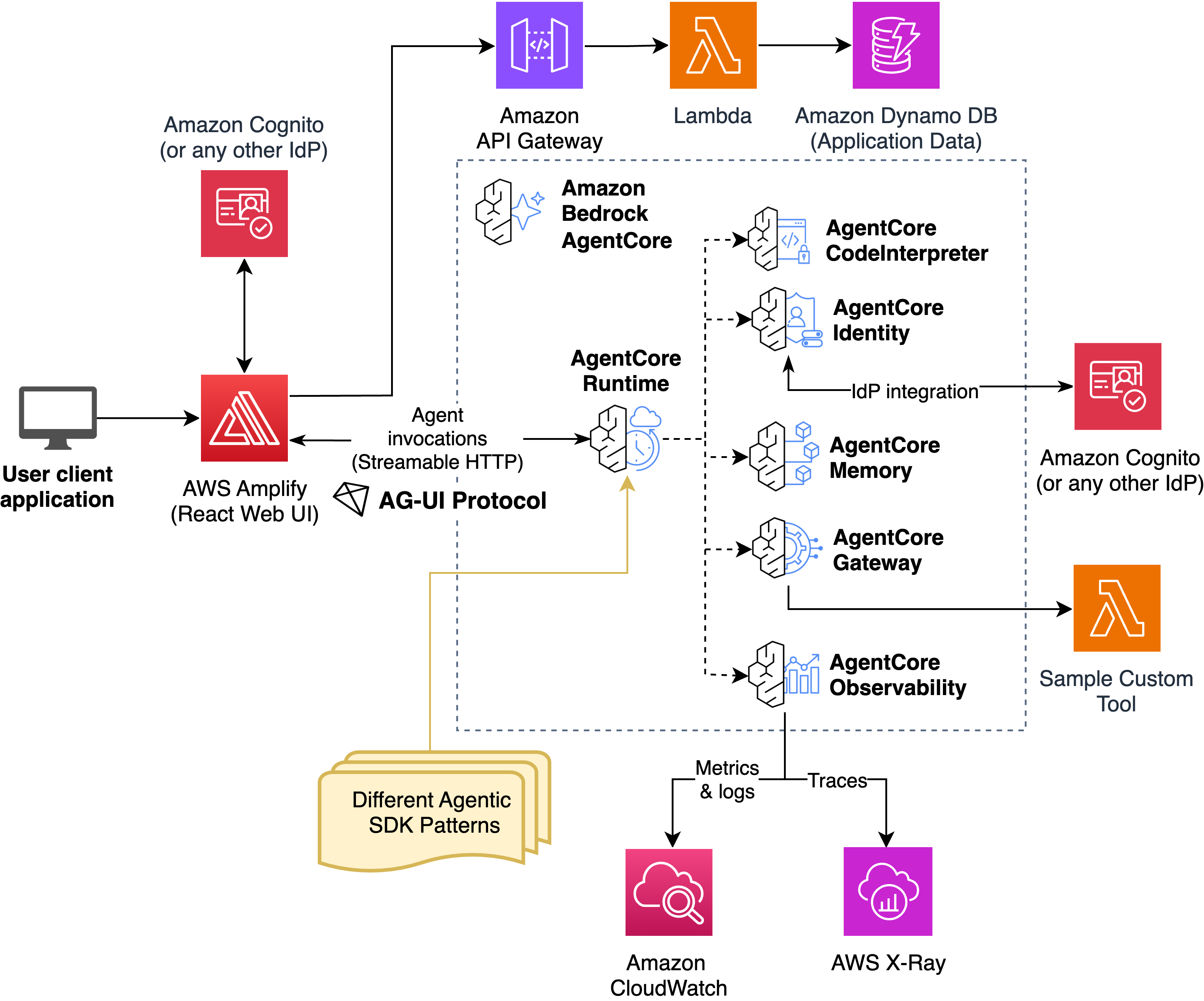
  • ›AG-UI protocol ensures clean handoff between backend agents and frontend services
  • ›CopilotKit components can be deployed as serverless functions or containerized services
  • ›Built-in observability and monitoring help track agent behavior and user interactions

Deploying on Bedrock AgentCore means agents benefit from AWS's managed infrastructure, eliminating operational overhead. Teams no longer need to provision compute, manage scaling, or worry about agent availability. Bedrock handles these concerns, allowing development teams to focus on agent logic and user experience.

The AG-UI and CopilotKit layers integrate seamlessly with Bedrock's API and event model. Developers can deploy their frontend components on any platform-web, mobile, or desktop-and they will communicate with Bedrock agents through well-defined interfaces. This flexibility enables omnichannel agent experiences.

Getting Started with AG-UI and CopilotKit

Teams can begin building generative UI agents by leveraging the FAST template and available documentation.

  • ›Start with the Fullstack AgentCore Solution Template as a foundation
  • ›Review AG-UI protocol specifications and example implementations
  • ›Explore CopilotKit's generative component library and customization options
  • ›Deploy a proof-of-concept to validate the approach before scaling

The barrier to entry for building interactive agents is now lower than ever. By providing FAST as a starting point, AWS removes the need to architect infrastructure from first principles. Developers can focus on defining what their agents should do and what users should see, rather than wrestling with framework integration.

Documentation, tutorials, and community examples are available to guide developers through each phase of adoption. Whether building a simple chatbot or orchestrating complex multi-agent workflows with human review, the AG-UI and CopilotKit combination provides the tools needed to succeed.

Frequently Asked Questions

What is the AG-UI protocol and why is it important?

AG-UI is a standardized protocol that defines how AI agents on Amazon Bedrock AgentCore communicate with user interfaces. It eliminates the need for custom communication layers between agents and frontends, reducing development time and enabling consistent, scalable agent applications.

How does CopilotKit extend AG-UI functionality?

CopilotKit adds generative UI capabilities on top of AG-UI, automatically generating adaptive interface components based on agent state. It also provides shared state management and human-in-the-loop features, enabling more sophisticated and user-friendly agent interactions.

What is the Fullstack AgentCore Solution Template (FAST)?

FAST is a pre-built, production-ready template that integrates Amazon Bedrock AgentCore with AG-UI and frontend tooling. It provides example implementations and best-practice architecture, allowing teams to accelerate their agent development from proof-of-concept to deployment.

Why is human-in-the-loop interaction important for agents?

Human-in-the-loop ensures that agents remain controllable and aligned with user intentions, particularly in high-stakes or regulated environments. It combines agent speed and scale with human judgment and accountability, building trust and enabling compliance.

Can I deploy CopilotKit and AG-UI components outside of AWS?

While the backend agents run on Amazon Bedrock AgentCore, AG-UI and CopilotKit frontends can be deployed on any platform (web, mobile, or desktop). They communicate with Bedrock agents through standardized interfaces, enabling flexible, omnichannel deployments.

The combination of AG-UI, CopilotKit, and Bedrock AgentCore makes it practical for teams to build sophisticated, interactive AI agent applications with human oversight and minimal infrastructure overhead.

Continue Learning

Originally published by AWS Machine Learning
Read the original

Comments

Sign in to join the conversation