Back to News Hub
🟧AWS Machine Learning
July 20, 2026
E-Commerce

Build specialized agent workflows for your business with Amazon Quick and NVIDIA NeMo Agent Toolkit

Overview

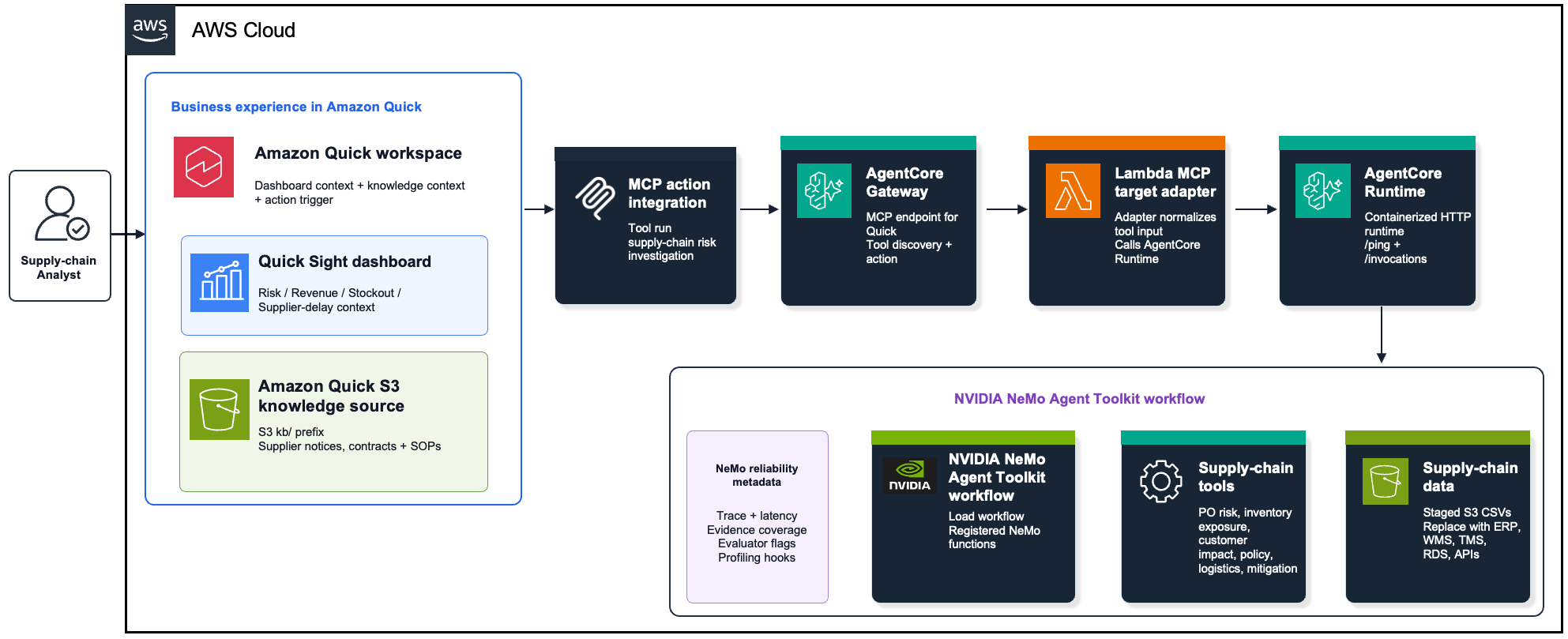
Amazon Quick and the NVIDIA NeMo Agent Toolkit enable businesses to build specialized agent workflows that guide users through complex decision-making processes. The example demonstrates how a supply-chain planner can use an intuitive dashboard to access real-time risk analysis and receive guided mitigation recommendations without requiring technical expertise.

Key Takeaways

  • Amazon Quick provides an accessible business-user interface for launching specialized agent workflows, eliminating the need for technical coding knowledge.
  • The NVIDIA NeMo Agent Toolkit enables the creation of intelligent agents capable of analyzing complex business problems and recommending solutions.
  • Supply-chain risk management workflows can integrate real-time dashboards with AI-driven guidance to help planners identify and mitigate threats proactively.
  • The combination of Quick and NeMo creates a seamless experience from problem identification to actionable mitigation recommendations.
  • Business users can leverage pre-built knowledge contexts within agent workflows to accelerate decision-making and reduce operational risk.
Build specialized agent workflows for your business with Amazon Quick and NVIDIA NeMo Agent Toolkit

Understanding Amazon Quick as a Workflow Entry Point

Amazon Quick serves as the primary interface through which business users initiate specialized agent workflows.

  • ›Provides an intuitive dashboard designed specifically for non-technical business users.
  • ›Eliminates the complexity of directly interacting with backend systems or writing code.
  • ›Allows users to access relevant business context and historical data before launching agents.
  • ›Supports multiple workflow types, enabling organizations to tailor solutions to specific departments or use cases.

Quick acts as a user-friendly front door that democratizes access to advanced AI capabilities. Rather than requiring business users to understand underlying machine-learning models or agent architectures, Quick abstracts away technical details and presents a clean, business-focused interface. This approach reduces training requirements and accelerates adoption across organizations of all sizes.

The Role of NVIDIA NeMo Agent Toolkit in Workflow Automation

The NeMo Agent Toolkit provides the underlying intelligence layer that powers sophisticated multi-step workflows.

  • ›Enables creation of specialized agents capable of reasoning through complex business scenarios.
  • ›Supports integration with external data sources and knowledge bases for real-time decision support.
  • ›Allows agents to break down complex problems into manageable steps and guide users through each phase.
  • ›Provides tools for validation, error handling, and fallback strategies when agent confidence is low.

NeMo Agent Toolkit allows developers and organizations to construct intelligent agents that go beyond simple chatbots. These agents can perform multi-step reasoning, access specialized knowledge domains, and provide contextually relevant recommendations. The toolkit is designed to work seamlessly with business intelligence systems and enterprise data platforms, making it practical for real-world deployment in mission-critical workflows.

Supply-Chain Risk Management Use Case

The supply-chain risk example illustrates how Quick and NeMo work together to address a complex operational challenge.

  • ›Planners start with a dashboard showing real-time supply-chain metrics and flagged risk areas.
  • ›Upon identifying a potential disruption, the user launches a specialized agent through the Quick interface.
  • ›The agent analyzes the risk situation using integrated knowledge about suppliers, logistics routes, and historical disruption patterns.
  • ›The system generates guided mitigation recommendations tailored to the specific risk context and organizational constraints.

Supply-chain disruptions can cost organizations millions of dollars in lost revenue and operational delays. By combining Quick's accessibility with NeMo's reasoning capabilities, the workflow enables rapid response to emerging threats. A planner can move from identifying a problem on their dashboard to receiving actionable recommendations within minutes rather than hours, reducing decision-making latency and enabling faster corrective action.

The agent workflow incorporates domain-specific knowledge about supply-chain risks, including common mitigation strategies, alternative supplier options, and impact assessments. This embedded expertise ensures that recommendations are not generic but tailored to the organization's specific supply network and business requirements.

Knowledge Context Integration

Specialized agent workflows rely on rich knowledge contexts to provide relevant and accurate guidance.

  • ›Knowledge contexts can include supplier databases, logistics network maps, historical disruption records, and best-practice repositories.
  • ›Agents access this context in real-time to ground recommendations in organizational reality rather than generic advice.
  • ›Context can be regularly updated to reflect current conditions, supplier performance changes, and emerging threats.
  • ›Proper context curation ensures that agent outputs remain relevant, reliable, and aligned with organizational policies.

The power of an intelligent workflow lies not just in the reasoning capability but in the quality and relevance of the knowledge it draws upon. By embedding business-specific context within the agent workflow, organizations ensure that recommendations reflect their unique situation. This might include preferred suppliers, geographic constraints, regulatory requirements, or financial thresholds that influence decision-making. The agent can then reason through scenarios in light of these constraints, producing guidance that is immediately actionable rather than requiring human reinterpretation.

Guided Mitigation Recommendations

The final output of the workflow is a structured set of mitigation recommendations that guide the user toward resolution.

  • ›Recommendations are prioritized based on risk severity, implementation feasibility, and potential impact.
  • ›Each recommendation includes supporting context explaining why it was selected and what outcomes to expect.
  • ›Users can explore alternative recommendations or drill deeper into the agent's reasoning.
  • ›The system tracks recommendation acceptance and outcome, enabling continuous improvement over time.

Rather than presenting users with a list of generic options, the agent delivers prioritized, contextualized recommendations that account for the specific situation. A mitigation recommendation might include alternative suppliers with their lead times and pricing, suggested inventory adjustments, communication templates for key stakeholders, or timeline estimates for implementation. This level of guidance transforms the agent from an advisory tool into a practical decision support system that significantly reduces planning overhead.

The ability to explain its reasoning builds trust in the agent's output. Users can verify that the agent considered relevant factors and applied sound logic, which increases their confidence in acting on recommendations. Over time, as the organization tracks outcomes of implemented recommendations, the system can be refined to improve accuracy and relevance.

Benefits for Business Operations

Integrating Quick and NeMo creates measurable improvements in how organizations handle complex operational scenarios.

  • ›Reduces response time to emerging risks by automating analysis and recommendation generation.
  • ›Democratizes access to specialized expertise by embedding domain knowledge within workflow systems.
  • ›Improves decision quality by ensuring consistent application of best practices and organizational policies.
  • ›Scales expert-level analysis across larger user populations and problem volumes.

Organizations benefit immediately through faster decision-making and reduced operational risk. Supply-chain planners can confidently handle complex scenarios that might previously have required escalation to senior experts. New team members can leverage the embedded expertise to make better decisions more quickly, accelerating onboarding and improving overall team capability.

Implementation and Next Steps

Building specialized agent workflows requires thoughtful design and iterative refinement.

  • ›Start with well-defined use cases where the value of accelerated decision-making is clear and measurable.
  • ›Invest in curating high-quality knowledge contexts that reflect organizational reality and best practices.
  • ›Design Quick dashboards that surface the right information to trigger agent workflows at the right time.
  • ›Plan for ongoing monitoring and refinement as the system learns from real-world usage patterns.

Success with specialized agent workflows depends on careful attention to both the user experience layer (Quick) and the intelligence layer (NeMo). Organizations should begin with pilot programs in high-value, well-understood domains like supply-chain risk before expanding to other use cases. Gathering user feedback and tracking outcome metrics enables continuous improvement and ensures that workflows remain aligned with evolving business needs.

Frequently Asked Questions

What is the advantage of using Amazon Quick as the entry point rather than direct agent interaction?

Amazon Quick provides a business-user-friendly dashboard that eliminates the need for technical knowledge. Users can access relevant context and business information before launching an agent workflow, making the entire experience more intuitive and reducing friction for non-technical users.

How does the NVIDIA NeMo Agent Toolkit enable specialized workflows?

The NeMo Agent Toolkit allows developers to build intelligent agents capable of multi-step reasoning, accessing external knowledge bases, and providing contextualized recommendations. It handles the complex reasoning logic that transforms raw data and organizational knowledge into actionable guidance.

What kind of knowledge context is needed for effective supply-chain risk workflows?

Effective knowledge contexts include supplier databases, logistics network information, historical disruption records, mitigation strategies, and organizational constraints such as preferred vendors or geographic preferences. This context allows agents to provide recommendations that are tailored to the specific organization rather than generic advice.

How do the guided mitigation recommendations improve upon traditional decision support?

Rather than presenting generic options, the system prioritizes recommendations based on the specific situation, includes supporting context for each suggestion, and provides actionable details like implementation timelines and expected outcomes. This makes recommendations immediately useful and reduces the planning effort required.

How can organizations begin implementing these specialized agent workflows?

Start with well-defined, high-value use cases like supply-chain risk management. Focus on building high-quality knowledge contexts, designing effective Quick dashboards, and planning for monitoring and refinement as the system learns from real-world usage.

The combination of Amazon Quick and NVIDIA NeMo Agent Toolkit enables organizations to transform complex operational decision-making into fast, guided, and accessible workflows that scale expert-level analysis across broader user populations.

Continue Learning

Originally published by AWS Machine Learning
Read the original

Comments

Sign in to join the conversation