Claude at scale on Google Cloud: Frontier AI, built for enterprise production
Running frontier AI in production is demanding - accelerators to manage, latency to hold steady across continents, regulated data to keep in-region, and long-context requests to serve reliably. Claude on Google Cloud is built for exactly this. Like Monet and water lilies, frontier models and the enterprise platforms are often better together.
Key Takeaways
- In our case, Claude brings the reasoning, and Google Cloud brings the managed infrastructure, global reach, and compliance posture that enterprises already run on.
- Compute provisioning, auto-scaling logic, load balancing, and failover at frontier-model scale are handled by the platform - work that would otherwise occupy multiple teams full-time.
Claude is available through Agent Platform's Model Garden as a Model-as-a-Service offering, ready to use over standard REST / JSON over HTTP/1.1 or HTTP/2 endpoints.
- Authentication uses Application Default Credentials; requests automatically inherit your project's IAM and VPC configuration.
Global reach with consistent latency and built-in failover Serving a worldwide user base from a single endpoint produces high tail latency and a single point of failure.
- For example, if us-central1 is capacity-constrained, traffic redirects to europe-west1 or another region with available capacity.
That's automatic failover and geographic load balancing without application-side routing logic.
- They dynamically route across regional endpoints providing built-in resilience against regional outages and capacity constraints.
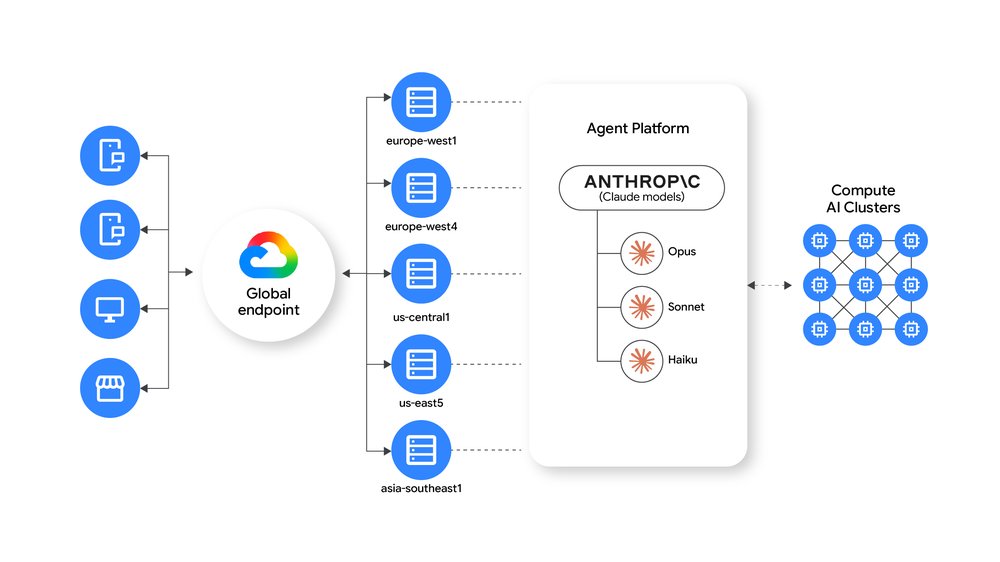
In our case, Claude brings the reasoning, and Google Cloud brings the managed infrastructure, global reach, and compliance posture that enterprises already run on. Calling Claude becomes operationally identical to calling any other Google Cloud service - same Identity and Access Management (IAM), same VPC Service controls , same observability - so teams are able to spend their time building features instead of running inference infrastructure. This post walks through what Claude on Google Cloud delivers in production across four areas: Managed infrastructure that gives engineers their time back Global endpoints that hold latency low, and uptime high for a worldwide user base Security and data-sovereignty controls inherited straight from Google Cloud Serving-layer features that keep cost and performance optimized at scale.
Managed infrastructure that frees engineering time Claude on Google Cloud runs on fully managed infrastructure, so enterprise teams ship features instead of building clusters. Compute provisioning, auto-scaling logic, load balancing, and failover at frontier-model scale are handled by the platform - work that would otherwise occupy multiple teams full-time. Claude is available through Agent Platform's Model Garden as a Model-as-a-Service offering, ready to use over standard REST / JSON over HTTP/1.1 or HTTP/2 endpoints.
Invoking Claude is operationally identical to invoking any other Google Cloud service: the same IAM policies , the same VPC controls, and the same observability stack via Cloud Logging and Cloud Monitoring . Serving Claude takes a few lines of Python using the AnthropicVertex client: The same AnthropicVertex client handles prompt caching, tool use, structured outputs, streaming, and adaptive thinking; for batch inference, use Vertex AI Batch Prediction . Authentication uses Application Default Credentials; requests automatically inherit your project's IAM and VPC configuration.
Global reach with consistent latency and built-in failover Serving a worldwide user base from a single endpoint produces high tail latency and a single point of failure. Most enterprises can't replicate inference infrastructure across continents while keeping performance consistent. Agent Platform exposes three endpoint types for Claude, each solving a different production requirement: Global endpoints route requests to a region with available AI compute capacity.
For example, if us-central1 is capacity-constrained, traffic redirects to europe-west1 or another region with available capacity. That's automatic failover and geographic load balancing without application-side routing logic. Global endpoints are ideal for maximum availability and lowest cost.
Regional endpoints like us-east5 or europe-west1 keep prompts, completions, and intermediate state inside a specific geographical boundary, making it ideal for low latency and data-residency requirements. Multi-region endpoints give U.S. or EU data residency without single-region dependency. They dynamically route across regional endpoints providing built-in resilience against regional outages and capacity constraints.
For more details please read the original article at Google Cloud AI.
Continue Learning
Comments
Comments appear only after moderation. Your email identifies your submission to the moderator and is never displayed here.
No approved comments yet.