Entry Level Interview Preparation: Crush Your First
Effective entry-level interview preparation requires more than passive content consumption and scattered note-taking. This guide emphasizes strategic, deliberate practice methods that actually build interview competency rather than just accumulating advice.
Key Takeaways
- Collecting advice through videos, Reddit threads, and prompts is not the same as practicing actual interview skills
- Passive content consumption creates a false sense of preparation without building real competency
- Structured, deliberate practice with feedback is essential for crushing entry-level product management interviews
- Most candidates fail to convert collected knowledge into practical interview performance
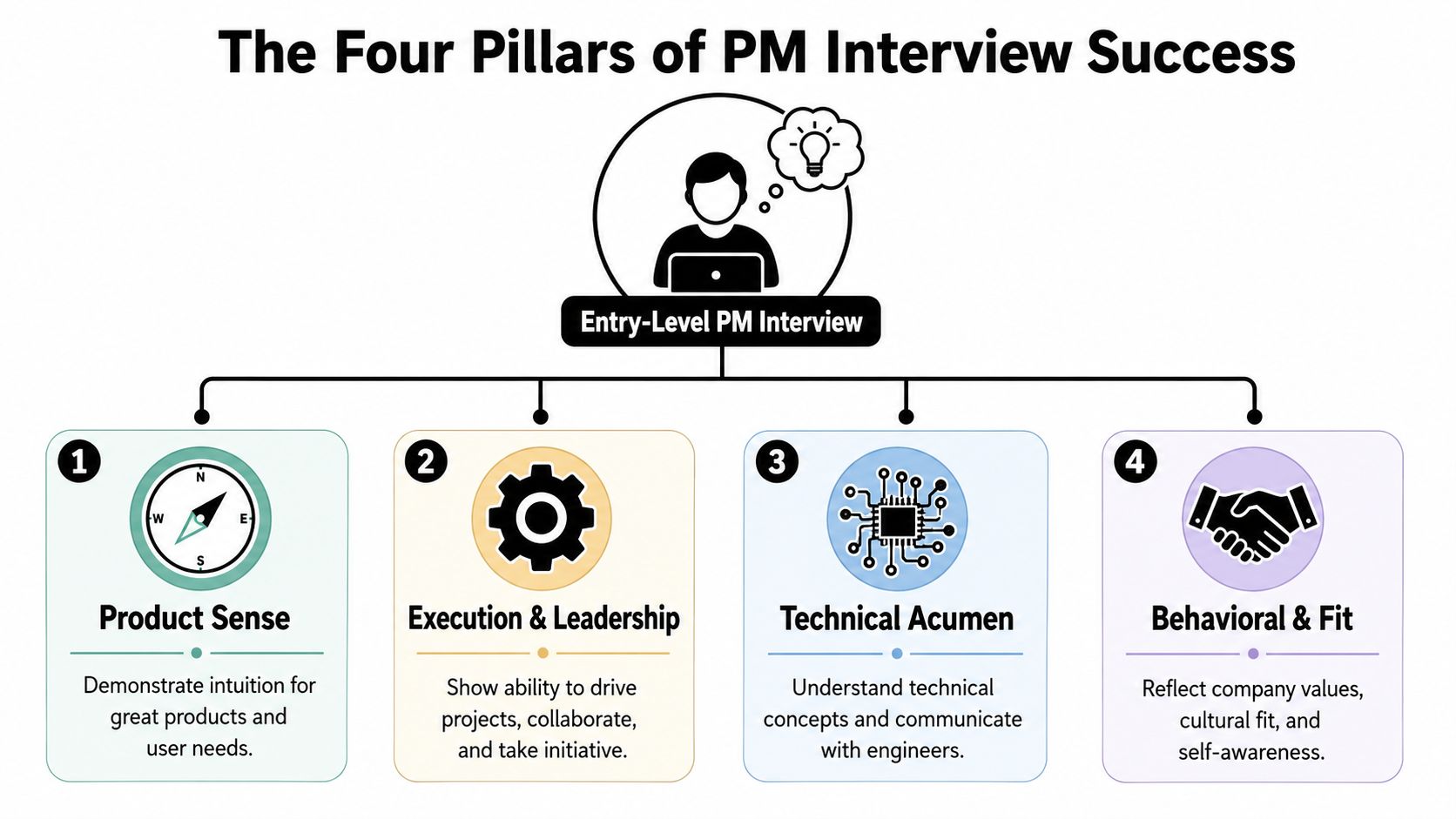
The Common Preparation Trap
Most entry-level candidates follow a similar but ineffective preparation pattern.
- ›Creating Notion documents full of product sense prompts without actually answering them under interview conditions
- ›Bookmarking Reddit threads and articles but rarely revisiting or applying the insights systematically
- ›Watching YouTube videos at 1.5x speed to save time, which reduces retention and prevents deep learning
- ›Assuming that passive content consumption translates directly into interview readiness
- ›Confusing the collection of advice with the development of actual interview skills
Why Passive Content Collection Fails
The disconnect between information gathering and skill development stems from how learning actually works.
- ›Passive viewing and reading activate different neural pathways than active problem-solving and verbal articulation
- ›Without real-time feedback, you cannot identify and correct your blind spots or weak areas
- ›Interview performance depends on comfort with ambiguity and rapid thinking, neither of which develops through passive consumption
- ›False confidence: accumulating resources creates the illusion of preparation without corresponding skill development
The brain requires active engagement to build lasting skills. Watching someone else solve a product case study teaches you their thought process, not how to develop your own under pressure. When you encounter a novel question in an actual interview, passive knowledge often fails to activate because you have not practiced retrieving and applying it in real time.
Preparation should involve teaching back what you learn, explaining your reasoning aloud, and receiving corrective feedback. Without this loop, you may feel knowledgeable but lack the ability to communicate ideas clearly or handle interviewer pushback.
Deliberate Practice Over Content Hoarding
Effective preparation focuses on building skills through structured, goal-oriented practice.
- ›Practice answering product sense prompts aloud, as if in a real interview, with strict time limits
- ›Record yourself and review your responses to identify filler words, unclear explanations, and logical gaps
- ›Seek feedback from people with interview experience-mentors, friends who have done interviews, or hiring managers if possible
- ›Do mock interviews with a structured rubric covering problem-solving approach, communication clarity, and business acumen
- ›Iterate on your answers based on feedback and re-practice until your explanations become natural and compelling
Deliberate practice means tackling interview questions under conditions that mirror the actual interview as closely as possible. This includes time pressure, the need to think out loud, and handling unexpected follow-up questions. Each practice session should have a specific learning objective rather than general familiarity with the topic.
Quality of practice matters far more than quantity. One hour of focused, feedback-driven practice beats five hours of scrolling through Reddit threads. The goal is to internalize patterns and develop muscle memory so that interview problems feel increasingly familiar and your responses feel increasingly natural.
Building a Targeted Preparation Plan
Strategic preparation requires clarity about what skills matter most and how to develop them systematically.
- ›Identify the specific interview format you will face: product sense, strategy, metrics, estimation, or a combination
- ›For each format, find or create 5 to 10 representative practice questions that match the company or role level
- ›Practice each question multiple times, spacing them out over several weeks to build long-term retention
- ›Track your progress on specific dimensions: clarity of framework, depth of analysis, communication quality, and handling of ambiguity
- ›Gradually increase difficulty or complexity of questions as your baseline performance improves
A targeted plan prevents the scattershot approach of jumping between different resources. Instead of passively consuming content on every possible interview topic, focus on mastery of core areas relevant to your target role. This focused approach builds depth and confidence.
Documentation of your practice is crucial. Keep notes on which types of questions challenge you, what feedback you receive repeatedly, and what improvements you make over time. This creates accountability and helps you identify patterns in your performance.
Feedback Loops and Iteration
Real skill development requires external validation and continuous refinement.
- ›Find a peer or mentor willing to conduct practice interviews and provide structured feedback on your framework and communication
- ›Ask specific questions: Did my answer address the core issue? Was my reasoning clear? Did I make unsupported assumptions?
- ›Implement feedback by re-practicing the same question or similar ones until you see measurable improvement
- ›Consider working with a coach or using platforms that offer structured feedback on interview responses
Self-assessment is notoriously unreliable. You may think you explained something clearly when an outside observer perceives it as confusing. Feedback creates the corrective mechanism needed to close this gap. Without it, you may internalize incorrect habits that persist into actual interviews.
The iteration cycle-practice, receive feedback, adjust, practice again-is where real learning happens. This is why one focused hour with a mentor beats days of solo video watching. The mentor identifies specific blind spots and redirects your effort toward high-impact improvements.
Converting Knowledge to Demonstrated Skill
The final step is ensuring that everything you learn translates into interview performance.
- ›Regularly do end-to-end mock interviews that simulate the actual interview experience, including introduction and closing
- ›Practice explaining your thinking process, not just arriving at an answer, since interviewers care about your reasoning
- ›Develop a personal framework or mental model that you can flexibly apply across different product questions
- ›Prepare a few compelling examples or stories from your background that illustrate your product thinking, even if entry-level
Interviewers are assessing not just what you think but how you think. They want to see your problem-solving process in action. This means practicing your ability to articulate your reasoning step by step, solicit feedback mid-answer, and adjust your approach based on interviewer cues. All of this requires live practice, not passive study.
The goal of preparation is to reach a state where you approach interview questions with genuine confidence and flexibility. You understand the underlying principles, you have practiced enough to feel comfortable with ambiguity, and you can communicate your ideas clearly under pressure. This state comes from deliberate, feedback-driven practice, not from accumulating bookmarks.
Action Steps to Start Preparing Effectively
Move from content collection to actual skill-building with these concrete next steps.
- ›Set a specific interview target date and work backward to create a 4 to 8-week preparation timeline
- ›Choose 3 to 5 core product sense questions and practice answering each one aloud, recording yourself to review later
- ›Reach out to 2 to 3 people who have recently interviewed at your target company or role level and ask to conduct a practice interview
- ›Commit to at least two full mock interviews with structured feedback before your actual interview date
- ›Track one specific area of improvement each week-such as reducing filler words, deepening market analysis, or improving metric fluency-and measure your progress
Frequently Asked Questions
How is deliberate practice different from watching interview prep videos?
Deliberate practice involves actively answering interview questions aloud under time constraints, recording yourself, and receiving feedback. Videos are passive consumption that teach you what good looks like but do not build the muscle memory or comfort needed for live performance. The difference is between learning about swimming and actually swimming.
How many practice interviews should I do before my actual interview?
Aim for at least two full mock interviews with structured feedback from someone experienced. Beyond that, the quality of feedback matters more than the quantity of practice. One mock interview with a skilled mentor beats five with a peer who offers no insight.
What should I track during my preparation?
Track your performance across specific dimensions: clarity of framework, depth of analysis, communication quality, and handling of ambiguity. Also note which question types trip you up and what feedback you receive repeatedly. This data reveals patterns and helps you focus improvement efforts where they matter most.
Can I prepare for an entry-level PM interview on my own without a mentor or coach?
Self-directed preparation is possible but harder because you lack external feedback. At minimum, find a peer willing to do mock interviews with you and give candid feedback. Even one or two conversations with someone who has successfully interviewed for the role can dramatically improve your preparation quality.
How long does it take to prepare effectively for an entry-level PM interview?
Most candidates benefit from 4 to 8 weeks of focused, deliberate practice if they dedicate 5 to 10 hours per week. The exact timeline depends on your starting skill level and interview timeline. Quality matters far more than duration-four weeks of deliberate practice beats three months of passive content consumption.
Transform your preparation by shifting from passive content collection to deliberate, feedback-driven practice that actually builds interview competency.
Continue Learning
Comments
Sign in to join the conversation