Fastest, Largest, Strongest: NVIDIA Blackwell Sweeps MLPerf Training 6.0
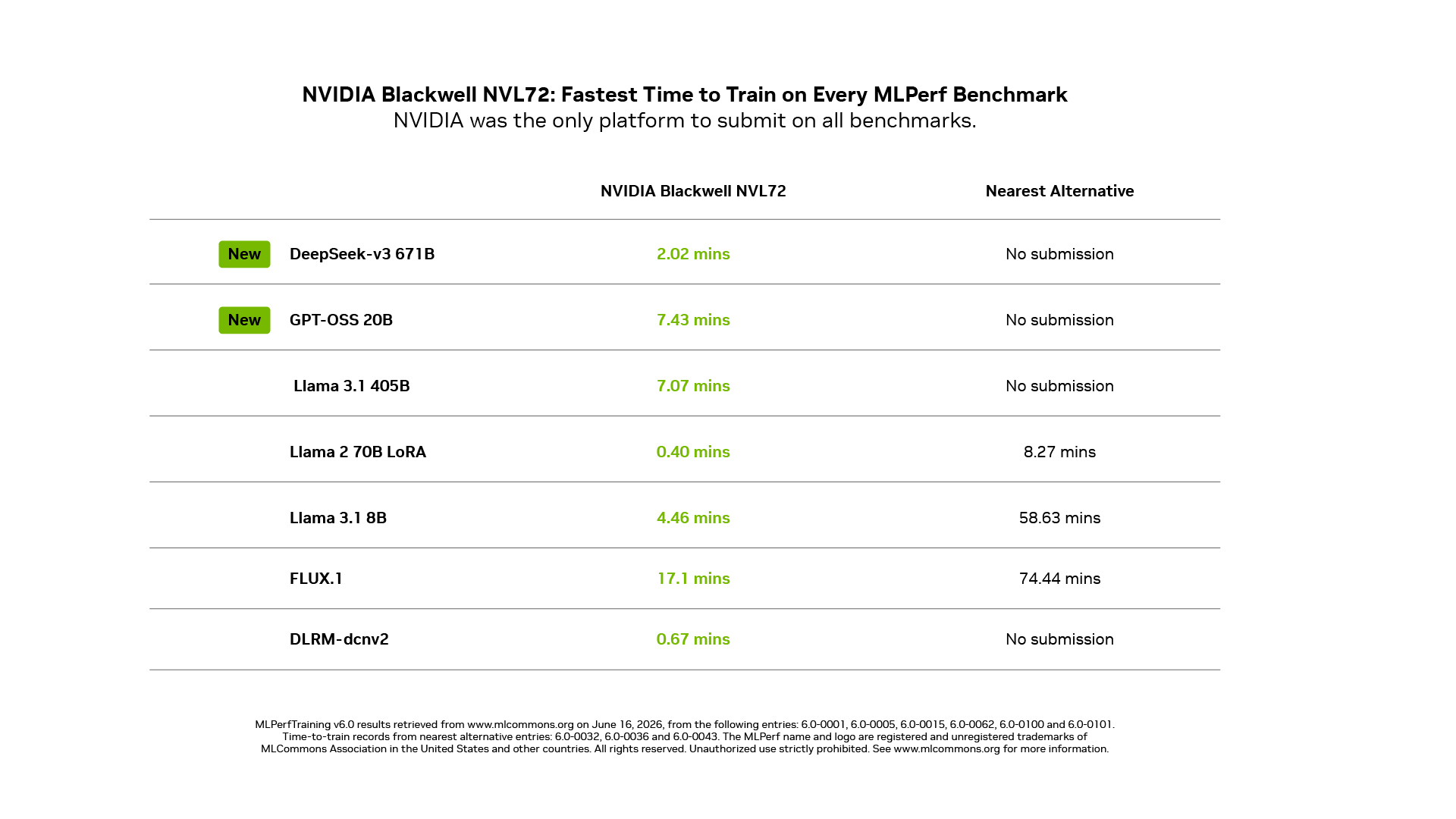
NVIDIA's Blackwell architecture has achieved dominant performance across MLPerf Training 6.0 benchmarks, setting records for speed, scale, and reliability in AI model training. The results demonstrate Blackwell's capability to handle increasingly large and complex models while enabling faster iteration cycles for AI research teams.
Key Takeaways
- Blackwell sweeps MLPerf Training 6.0 across multiple performance categories, establishing new speed records for training runs
- The architecture supports training at unprecedented scale, allowing researchers to build larger and more capable AI models
- Blackwell infrastructure delivers consistent reliability and performance, reducing iteration time for AI development teams
- Training infrastructure performance directly impacts how quickly teams can develop, test, and deploy breakthrough AI models
- As AI models grow in complexity and size, Blackwell addresses escalating demands on compute infrastructure
Stats & Key Facts
- #MLPerf Training 6.0 benchmark results across multiple performance categories
- #Record-setting training speed achieved by NVIDIA Blackwell architecture
The Critical Role of Training Infrastructure
The foundation of every advanced AI model lies in its training phase.
- ›Training infrastructure directly determines iteration speed for AI research teams
- ›The scale of available compute resources limits the maximum model size and complexity teams can develop
- ›Reliable, consistent performance during training runs prevents costly failures and delays
- ›As AI models grow more sophisticated, training demands increase exponentially
AI development is fundamentally constrained by the tools available to train models. Research teams depend on fast, scalable, and reliable infrastructure to test hypotheses, refine architectures, and push the boundaries of what AI systems can accomplish. When training infrastructure is slow or unreliable, entire projects stall. When it is fast and dependable, teams can iterate rapidly and explore more possibilities.
The relationship between infrastructure and model capability is symbiotic. Better infrastructure enables larger models; larger models require better infrastructure. This cycle has accelerated as the field has embraced scaling laws and discovered that model quality often improves with both size and compute investment. Teams now routinely run training jobs that consume enormous amounts of compute resources over days or weeks, making infrastructure performance a critical competitive advantage.
NVIDIA Blackwell's MLPerf Training 6.0 Results
NVIDIA's Blackwell architecture has achieved comprehensive dominance across MLPerf Training 6.0 benchmarks.
- ›Blackwell sets new speed records across multiple benchmark categories
- ›The architecture demonstrates superior performance in both single-model and multi-model training scenarios
- ›Results span diverse model types and training methodologies, showing broad applicability
- ›Performance gains compound when multiple Blackwell systems are combined into larger clusters
MLPerf Training benchmarks are industry-standard tests designed to measure how efficiently systems can train important AI models. These benchmarks include diverse workloads: computer vision models, natural language processing models, recommendation systems, and reinforcement learning tasks. NVIDIA Blackwell's sweep across these categories indicates the architecture's versatility and optimization for real-world training workloads.
The speed improvements matter directly to AI teams. Faster training means researchers can test more ideas in the same timeframe. They can experiment with different model architectures, hyperparameters, and data strategies without waiting weeks between iterations. For large-scale training runs that can cost hundreds of thousands of dollars, speed improvements translate directly to cost savings and accelerated time-to-value.
Scale and Reliability Advantages
Beyond raw speed, Blackwell excels at the two other critical dimensions of training infrastructure.
- ›Blackwell supports training larger models than previously feasible, enabling new AI capabilities
- ›The architecture maintains consistent performance and reliability across long training runs
- ›Scaling to multi-system configurations preserves efficiency and prevents performance bottlenecks
- ›Reliability prevents costly training failures and reduces time spent on infrastructure debugging
Model scale has emerged as one of the most important factors in AI capability. Larger models, when trained with sufficient data and compute, exhibit better reasoning, understanding, and generalization. However, training truly large models demands infrastructure that can handle enormous memory requirements and maintain coherent operation across many compute units for extended periods. Blackwell's architecture is purpose-built for this challenge.
Training at scale introduces complexity: distributed training across many GPUs, careful management of memory hierarchies, optimization of communication patterns, and resilience against hardware faults. Any of these can become a bottleneck or point of failure. Blackwell's design addresses these concerns through improvements to memory bandwidth, inter-GPU communication, and fault tolerance mechanisms. The result is infrastructure that teams can trust to complete demanding training jobs reliably.
Competitive Advantage in AI Development
Blackwell's training performance translates to tangible advantages for organizations developing AI systems.
- ›Faster training cycles enable more rapid experimentation and innovation in AI research
- ›Superior scale allows development of more capable models than competitors using less capable infrastructure
- ›Cost efficiency of Blackwell reduces the total compute expense required to develop state-of-the-art models
- ›Reliability reduces operational overhead and unexpected project delays from infrastructure failures
In the competitive AI landscape, infrastructure performance is a strategic differentiator. Organizations with access to faster, more scalable training systems can move faster through the research-to-deployment cycle. They can build and test more ambitious models. They can respond more quickly to emerging research findings and techniques. Over time, these incremental advantages compound, enabling organizations to develop more capable systems.
The economics of AI development also shift with infrastructure improvements. Training large models is expensive, and cost grows with model size and training time. More efficient infrastructure reduces this cost, making ambitious projects more feasible for a broader range of organizations. Blackwell's efficiency improvements have ripple effects throughout the AI ecosystem.
Implications for Future AI Development
The performance baseline established by Blackwell shapes expectations and possibilities for AI research going forward.
- ›Benchmark results set a new performance standard that competitors must match or exceed
- ›Faster training enables exploration of larger model scales and more complex architectures
- ›Improved infrastructure efficiency accelerates the timeline for deploying advanced AI capabilities
- ›Scaling advantages enable new research directions that were previously computationally infeasible
As AI models continue to grow in scale and capability, training infrastructure must evolve to keep pace. Blackwell's dominance in MLPerf Training 6.0 establishes a high bar for the industry. Future AI breakthroughs will likely depend on infrastructure that matches or exceeds Blackwell's capabilities across speed, scale, and reliability. This creates a virtuous cycle: better infrastructure enables better models, which drive demand for even better infrastructure.
The specific results from MLPerf Training 6.0 provide concrete evidence that Blackwell is optimized for the training workloads that matter most to AI teams. Whether developing foundation models, fine-tuning specialized systems, or training recommendation engines, Blackwell's demonstrated performance across diverse model types indicates it is a versatile platform for the full spectrum of AI development work.
Why Training Infrastructure Matters More Than Ever
The importance of training infrastructure has grown as AI systems have become more central to technology development.
- ›Training infrastructure quality directly affects the pace of AI capability advancement across the industry
- ›As models scale larger, training infrastructure becomes a more significant bottleneck and cost driver
- ›Reliable infrastructure reduces wasted compute resources and failed experiments
- ›Performance advantages in training infrastructure translate to competitive advantages in deployed AI systems
Every major AI breakthrough begins with a training run. GPT models, vision systems, multimodal models, and specialized AI agents all emerge from teams running training jobs on powerful infrastructure. The quality of that infrastructure shapes not just how quickly breakthrough arrive, but whether teams can even attempt certain research directions. Infrastructure that cannot handle certain model sizes or training approaches simply makes those avenues unavailable.
The industry-wide shift toward larger, more capable AI systems has made training infrastructure a critical competitive resource. Organizations investing in high-performance, reliable training platforms gain the ability to develop more ambitious systems. Blackwell's performance sweep across MLPerf Training 6.0 demonstrates that it is a platform purpose-built for this new era of AI development, where training capabilities and innovation speed are inextricably linked.
Frequently Asked Questions
What is MLPerf Training 6.0 and why does it matter?
MLPerf Training is an industry-standard benchmark suite that measures how efficiently systems can train important AI models across diverse workloads like computer vision, natural language processing, and recommendation systems. It matters because it provides objective, standardized comparisons of training infrastructure performance that the AI community can trust and use to guide purchasing and development decisions.
How does faster training infrastructure accelerate AI development?
Faster training allows research teams to test more ideas in the same timeframe, iterate quickly on model architectures and hyperparameters, and complete experiments more cheaply. This accelerated iteration cycle enables teams to innovate faster and explore more research directions than would be feasible with slower infrastructure.
Why is the scale capability of training infrastructure important?
Larger AI models tend to be more capable, but training them requires infrastructure that can handle enormous memory requirements and maintain coherent operation across many compute units. Blackwell's ability to scale enables researchers to develop larger, more capable models that would be infeasible on less capable infrastructure.
What competitive advantages does Blackwell's training performance provide?
Organizations with access to Blackwell can develop more capable models faster, reduce training costs, and respond more quickly to emerging research findings. Over time, these advantages compound, enabling organizations to develop more sophisticated AI systems than competitors using less capable infrastructure.
How do training infrastructure improvements affect the entire AI ecosystem?
Better infrastructure reduces the cost of developing advanced AI models, making ambitious projects feasible for more organizations. This broadens participation in AI research and development, accelerates the pace of innovation industry-wide, and creates a competitive pressure that drives continued infrastructure improvements.
Blackwell's comprehensive victory in MLPerf Training 6.0 demonstrates that the future of AI capability is tightly coupled with the evolution of training infrastructure.
Continue Learning
Comments
Sign in to join the conversation