Back to News Hub
🟧AWS Machine Learning
June 9, 2026
E-Commerce

Hands-free first notice of loss: Using Strands Agents and Amazon Bedrock AgentCore Browser Tool for intelligent claims intake

Overview

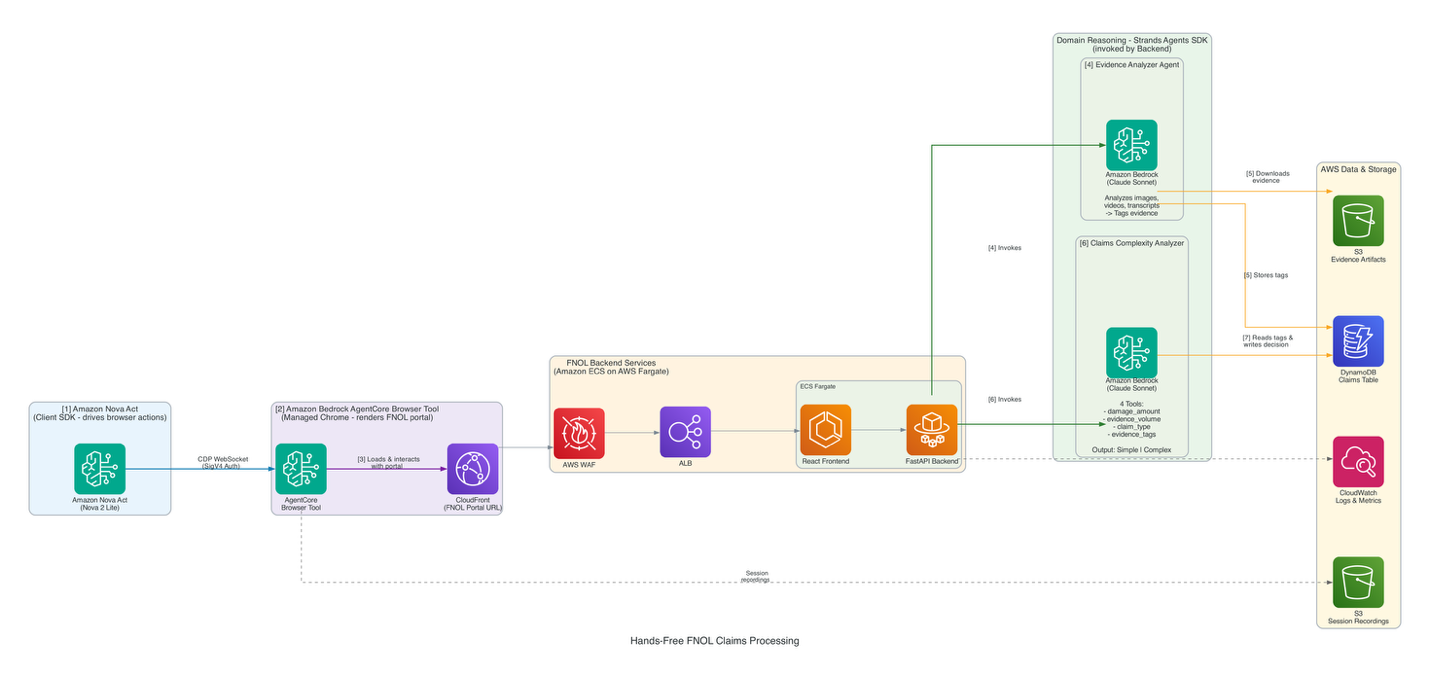
AWS published a technical walkthrough of a hands-free first notice of loss (FNOL) intake system that automates the opening step of an insurance claim. The design pairs domain-reasoning agents built on the open-source Strands Agents SDK with the Amazon Bedrock AgentCore Browser Tool, which drives a managed Chrome session to fill claim portals on its own. Instead of handing adjusters a pile of raw photos and recordings, the system tags and scores evidence at submission time so a person starts with pre-analyzed context.
Key Takeaways

  • FNOL is the moment unstructured evidence such as photos, video, and audio notes first enters the claims system, and AWS targets it because manual intake consumes large amounts of expert adjuster time on repetitive screen work.
  • Two specialized agents do the thinking: an Evidence Analyzer Agent interprets the multimodal files, and a Claims Complexity Analyzer Agent scores how hard a claim will be to settle.
  • Amazon Nova Act reads plain-language instructions and turns them into real clicks and typing inside a managed, recorded Chrome session, acting like a human reviewer rather than replaying a fixed script.
  • Claims split into two paths: simple ones auto-resolve without review, and complex ones move to a Needs Review queue with an auto-written note explaining the decision.
  • AWS positions the approach as a step past traditional robotic process automation because the agent reasons over the current screen state and adapts when the portal layout changes, with no rewrite needed.
  • Every action produces a timestamped screenshot and log, creating a built-in audit trail suited to regulated insurance work where explainability and traceability matter.

Stats & Key Facts

  • #3 evidence modalities are analyzed: images, video, and audio transcripts.
  • #2 specialized Strands agents work together: an Evidence Analyzer and a Claims Complexity Analyzer.
  • #2 routing outcomes per claim: auto-resolved Simple claims and Needs Review Complex claims.
  • #5 core AWS services support the stack: ECS on Fargate, S3, DynamoDB, CloudWatch, plus Bedrock AgentCore.
  • #The author brings more than two decades of enterprise IT project experience.
  • #1 isolated, timestamped folder of screenshots and logs is produced per run for audit and reproducibility.
Hands-free first notice of loss: Using Strands Agents and Amazon Bedrock AgentCore Browser Tool for intelligent claims intake

Why First Notice of Loss Is the Costly Bottleneck in Claims

FNOL is the intake step where messy real-world evidence meets the insurance system, and it eats expert time.

First notice of loss is the moment a customer reports a claim and unstructured evidence enters the pipeline: photos, video, scanned documents, and spoken notes. Before an adjuster applies any real judgment, that person spends time navigating portals, checking whether files are complete, and interpreting what each artifact shows.

AWS frames this manual handling as the bottleneck. During catastrophic events or seasonal surges in claims, the repetitive screen work creates backlogs that delay resolution. The system in this walkthrough aims to remove the repetitive part while keeping human expertise for the decisions that need it.

How the Two Strands Agents Split the Reasoning Work

The thinking is divided between two named agents built on the open-source Strands Agents SDK.

  • ›Evidence Analyzer Agent: interprets multimodal evidence across images, video, and transcripts, applies insurance-specific business rules, and tags what each artifact depicts, how usable it is, and what damage it shows.
  • ›Claims Complexity Analyzer Agent: combines that evidence with claim metadata to sort each claim as Simple or Complex and write a short note explaining the call.
  • ›Strands Agents SDK: an open framework for building generative AI agents with a model-driven design, here carrying the insurance domain logic.
  • ›The split keeps domain reasoning separate from browser control, so each part can evolve on its own.

Browser Automation Through Amazon Nova Act and a Managed Chrome Session

A client SDK called Amazon Nova Act does the actual portal work inside a managed browser.

The Amazon Bedrock AgentCore Browser Tool runs an isolated, recorded Chrome session with live-view and session-recording features. Inside it, Amazon Nova Act reads plain-language instructions and translates them into grounded actions on the screen, connecting through the Chrome DevTools Protocol over a WebSocket.

Nova Act reasons about the visible page in real time. It navigates claim queues, finds unprocessed evidence sections, triggers analysis, handles pop-up dialogs, and scrolls only when needed. At each step it captures a screenshot along with the prompt, a timestamp, and an action identifier, so it behaves like a person using the portal rather than following a frozen script.

Tagging Photos, Video, and Audio at Submission Time

Evidence is reviewed across three modalities, each with its own attributes.

  • ›Images: tagged by what they show such as vehicle damage, roof surface, siding, interior, or medical documentation, plus whether the angle is appropriate, whether the shot is clear and usable, and what damage is visible.
  • ›Video: assessed for whether it adds information beyond still photos, fills gaps in missing images, or backs up or contradicts other files, with its signals normalized to sit alongside other evidence.
  • ›Audio: processed through call transcripts to pull out material observations, reported conditions, and context, then correlated with the image and video tags.
  • ›The result is a set of pre-tagged signals an adjuster reads instead of raw files.

Routing Claims to Auto-Resolve or Needs Review

Once evidence is scored, each claim follows one of two paths.

Simple claims auto-resolve without manual intervention, clearing routine cases from the queue. Complex claims move to a Needs Review status, paired with structured notes the system writes automatically to explain why the case was flagged.

That handoff matters because the downstream adjuster begins with context rather than re-validating the intake from scratch. AWS says the design surfaces hard cases early, reduces handling time, and supports routing based on evidence-derived signals rather than coarse intake fields.

Why AWS Calls This More Than Robotic Process Automation

The key difference is reasoning over the live screen instead of replaying scripts.

Traditional robotic process automation relies on hard-coded selectors or pre-recorded scripts that break when a page changes. Here, decision-making is grounded in the current screen state, so the same logic handles new queue layouts, reordered columns, or changing row counts without modification.

Separating browser orchestration from domain reasoning lets each side change independently. AWS presents this as a more durable approach for portals that evolve over time, since the automation adapts rather than needing a rewrite.

The Supporting AWS Stack and Built-In Audit Trail

Standard AWS services run the prototype and supply the accountability regulated insurers need.

  • ›Amazon ECS on AWS Fargate hosts the containerized FNOL portal and backend services.
  • ›Amazon S3 stores the unstructured evidence artifacts; Amazon DynamoDB holds claim state, evidence references, and agent analysis.
  • ›Amazon CloudWatch captures operational logs, metrics, and execution traces.
  • ›Each run produces an isolated, timestamped folder of screenshots and logs, giving a natural audit trail without extra custom logging.
  • ›The author, enterprise architect Piyali Kamra, brings more than two decades of large-scale enterprise IT experience.

Frequently Asked Questions

What does FNOL mean in insurance?

FNOL stands for first notice of loss, the first step when a customer reports a claim and evidence such as photos, video, scanned documents, and audio notes enters the system. It is the intake point AWS automates in this design.

Does this system replace human adjusters?

No. It automates the repetitive intake and tagging work, then hands adjusters pre-analyzed evidence and routes complex claims to a Needs Review queue. Human expertise is preserved for the decisions that need judgment.

How is this different from traditional robotic process automation?

Traditional RPA replays hard-coded scripts that break when a page changes. This system reasons over the live screen state, so it adapts to new portal layouts or reordered columns without being rewritten.

What technologies power the automation?

Domain reasoning runs on the open-source Strands Agents SDK, while the Amazon Bedrock AgentCore Browser Tool provides a managed Chrome session. Amazon Nova Act turns plain-language instructions into real clicks and typing through the Chrome DevTools Protocol.

How does the system stay auditable for regulators?

Every action captures a screenshot, prompt, timestamp, and action identifier, producing an isolated, timestamped folder of logs per run. This creates a transparent, reviewable trail without additional custom logging.

AWS presents the system as a working prototype that pairs reasoning agents with a managed browser to cut repetitive claims intake work while keeping a clear audit trail. The takeaway for business readers is that agentic automation now reasons over live screens, adapting to change in a way older script-based tools cannot.

Continue Learning

Originally published by AWS Machine Learning
Read the original

Comments

Sign in to join the conversation