How NVIDIA's Inference Software Stack Powers the Lowest Token Cost
As organizations move from AI pilots to production AI factories, infrastructure decisions have shifted from peak chip specifications to cost per token: how many useful tokens they can deliver per dollar, per watt and within required latency targets. Codesigned with NVIDIA GPUs, CPUs, networking and systems, and strengthened by a broad open source ecosystem, NVIDIA's [...] Baseten, Cognition, Deep Infra, Together AI and Cursor are seeing compounding value from NVIDIA's software and open source ecosystem.
Key Takeaways
- Codesigned with NVIDIA GPUs, CPUs, networking and systems, and strengthened by a broad open source ecosystem, NVIDIA's full-stack inference software continuously improves hardware performance.
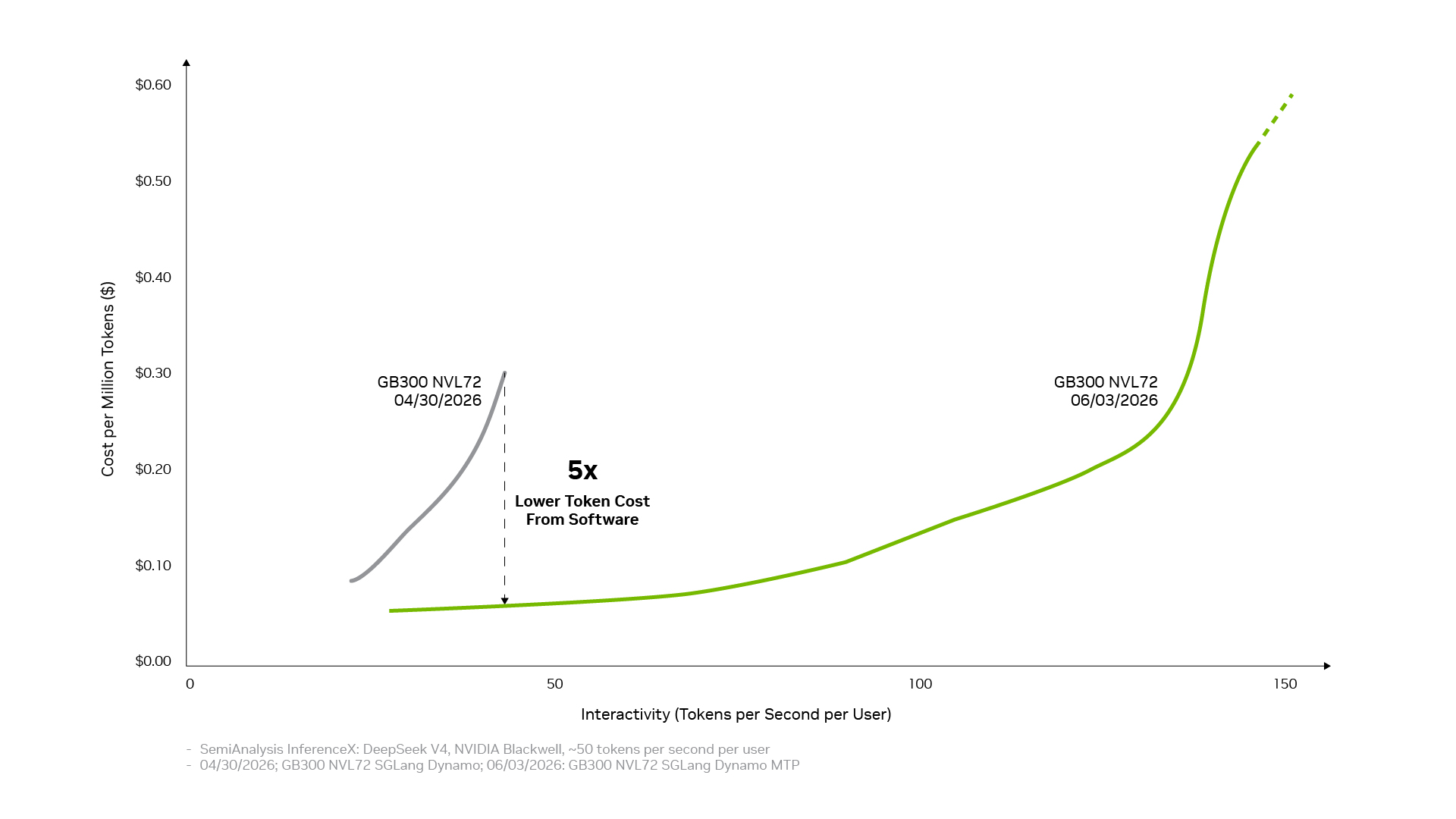
On the NVIDIA Blackwell platform, the software stack has already reduced token costs by up to 5x on the DeepSeek V4 model in just one month.
- Together AI used NVIDIA TensorRT-LLM on Blackwell to help Cursor accelerate the path from model optimizations to production endpoints for its real-time coding experience.
Why Software Matters for Inference Economics Traditional web, search and software-as-a-service workloads were relatively predictable: A user might load a page, refresh a feed or update a business record.
- The software stack determines whether that complexity turns into wasted capacity or lower cost per token .
Lower cost per token comes from turning individual optimizations into system-level performance.
- When these layers work as one system, individual optimizations compound.
Disaggregated serving, large expert parallelism over NVIDIA NVLink interconnect technology, NVFP4 precision and multi-token prediction each deliver meaningful gains on their own.
- Open Source Amplifies the Full-Stack Advantage That same full-stack foundation is amplified by the open source ecosystem.
Stats & Key Facts
- #On the NVIDIA Blackwell platform, the software stack has already reduced token costs by up to 5x on the DeepSeek V4 model in just one month.
- #Leading companies and inference providers are already seeing the compounding value of NVIDIA's inference software stack on Blackwell: Baseten used the NVIDIA TensorRT-LLM open source library to serve DeepSeek V4 Pro on Blackwell GPUs for reasoning, coding and long-context workloads, applying proprietary runtime optimizations to deliver up to 50% more tokens per second.
Baseten, Cognition, Deep Infra, Together AI and Cursor are seeing compounding value from NVIDIA's software and open source ecosystem. As organizations move from AI pilots to production AI factories, infrastructure decisions have shifted from peak chip specifications to cost per token : how many useful tokens they can deliver per dollar, per watt and within required latency targets. Codesigned with NVIDIA GPUs, CPUs, networking and systems, and strengthened by a broad open source ecosystem, NVIDIA's full-stack inference software continuously improves hardware performance.
On the NVIDIA Blackwell platform, the software stack has already reduced token costs by up to 5x on the DeepSeek V4 model in just one month. Leading companies and inference providers are already seeing the compounding value of NVIDIA's inference software stack on Blackwell: Baseten used the NVIDIA TensorRT-LLM open source library to serve DeepSeek V4 Pro on Blackwell GPUs for reasoning, coding and long-context workloads, applying proprietary runtime optimizations to deliver up to 50% more tokens per second. Cognition is using the NVIDIA Dynamo inference framework to manage inference GPUs, giving its team a ready-made path to scale reinforcement learning workloads without needing to build that infrastructure from scratch.
Deep Infra uses the NVIDIA inference software stack to serve frontier open source models performantly on Blackwell from day zero, including DeepSeek V4. Together AI used NVIDIA TensorRT-LLM on Blackwell to help Cursor accelerate the path from model optimizations to production endpoints for its real-time coding experience. Why Software Matters for Inference Economics Traditional web, search and software-as-a-service workloads were relatively predictable: A user might load a page, refresh a feed or update a business record.
These requests typically followed similar software paths, reading from or writing to a database, and scaled by adding more of the same servers. Agents can reason, plan, call tools, spin up specialist subagents and manage massive context across multi-turn workflows. They turn a single request into a distributed computing problem that can span hundreds of subagents, thousands of tasks and multiple large language models, running across GPUs, CPUs, DPUs and storage systems.
The software stack determines whether that complexity turns into wasted capacity or lower cost per token . Lower cost per token comes from turning individual optimizations into system-level performance. NVIDIA's inference software stack does this by connecting three layers: Production Operation: Coordinates distributed serving, orchestration, autoscaling and memory management so inference can run across the right compute and storage resources.
Application Acceleration: Runs models with high performance while giving developers room to tune and customize, using runtime optimizations such as overlapping compute and communication and kernel fusion. Infrastructure Access: Exposes NVIDIA GPU, networking, memory and system capabilities without requiring developers to manage every device instruction set or data-transfer protocol directly. When these layers work as one system, individual optimizations compound.
Capturing that gain in production is complex, requiring coordination across the full inference stack - from production operations and model runtimes to kernels, communication libraries and hardware access. NVIDIA's inference software stack is designed to make those layers work together so each optimization can build on the others. Open Source Amplifies the Full-Stack Advantage That same full-stack foundation is amplified by the open source ecosystem.
For more details please read the original article at NVIDIA Blog.
Continue Learning
Comments
Comments appear only after moderation. Your email identifies your submission to the moderator and is never displayed here.
No approved comments yet.