How Trustpilot built a real-time architecture for data enrichment using Gemma
Google Cloud describes how Trustpilot built a real-time architecture to enrich millions of user reviews using fine-tuned Gemma models. Rather than relying on a closed frontier model, Trustpilot fine-tuned open-weight google/gemma-2-9b into a suite of specialized models for tasks like named entity recognition, topic classification, and sentiment extraction. The streaming pipeline runs on Dataflow and Agent Platform endpoints, decoupling business logic from raw LLM inference.
Key Takeaways
- Processing millions of user reviews in real-time, under strict latency and cost constraints, is no easy task.
Trustpilot has been doing exactly that with custom machine learning since long before large language models (LLMs) were cool.
- These models excel at parsing messy, human-written text to run named entity recognition (NER), categorize business domains, score sentiment, and pinpoint customer intent.
But while prompting an LLM for a few reviews is easy, processing millions in real-time without blowing up costs is a massive engineering hurdle.
- Predictable economics: Shifting from a variable per-token pricing model to fixed infrastructure costs makes running millions of predictions financially viable and optimizable.
Expanding MLOps capabilities: Building these models in-house enables Trustpilot to bake in the "secret sauce" of its review intelligence while building competencies on open-weight models.
- This process generated high quality training datasets for specialized tasks like topic classification, NER, and sentiment extraction.
The datasets were subsequently used to fine-tune a targeted lineup of custom models that considerably outperformed the legacy solution and delivered accuracy just a couple percentage points lower than the teacher models' consensus.
- Performance tuning To get the most out of the vLLM-based Agent Platform endpoints, Trustpilot focused on squeezing every bit of performance out of the entire pipeline, especially from the A2 VMs using A100 GPUs.
Processing millions of user reviews in real-time, under strict latency and cost constraints, is no easy task. Trustpilot has been doing exactly that with custom machine learning since long before large language models (LLMs) were cool. Now, as the company transitions its core stack to generative AI, here is a look at how we teamed up to build a high-volume streaming pipeline using fine-tuned Gemma models.
Powering deep review intelligence at scale Trustpilot's core business relies on delivering deep, actionable review intelligence. As a platform championing transparency and genuine feedback, it must safeguard data integrity and maximize value. This means extracting every drop of metadata from incoming reviews - making LLMs the perfect tool for the job.
These models excel at parsing messy, human-written text to run named entity recognition (NER), categorize business domains, score sentiment, and pinpoint customer intent. But while prompting an LLM for a few reviews is easy, processing millions in real-time without blowing up costs is a massive engineering hurdle. When pursuing such a big task, why isn't just plugging into a powerful, off-the-shelf, frontier model like Gemini the right approach?
For a pipeline this critical to the core business, closed models are rarely the best option. Instead, by fine-tuning open-weight models like Gemma, Trustpilot takes full ownership of their AI strategy. Here's how: Total model independence: By owning its models, Trustpilot ensures it controls the retraining lifecycle, completely freeing it from a third-party vendor's update schedule or sudden API changes.
Predictable economics: Shifting from a variable per-token pricing model to fixed infrastructure costs makes running millions of predictions financially viable and optimizable. Expanding MLOps capabilities: Building these models in-house enables Trustpilot to bake in the "secret sauce" of its review intelligence while building competencies on open-weight models. Architectural continuity: Standardizing on an open-weight lineage preserves the company's ability to leverage the future iterations of the base model.
This enables performance gains with minimal engineering overhead. Rather than deploying one massive model, Trustpilot built a suite of highly specialized models using the lightweight google/gemma-2-9b as a base. To get heavy-weight performance from a small footprint, the company employed a consensus annotation over a stratified sample of the Trustpilot review corpus, using a selection of teacher models from the Gemini 2.0/2.5 Pro/Flash family.
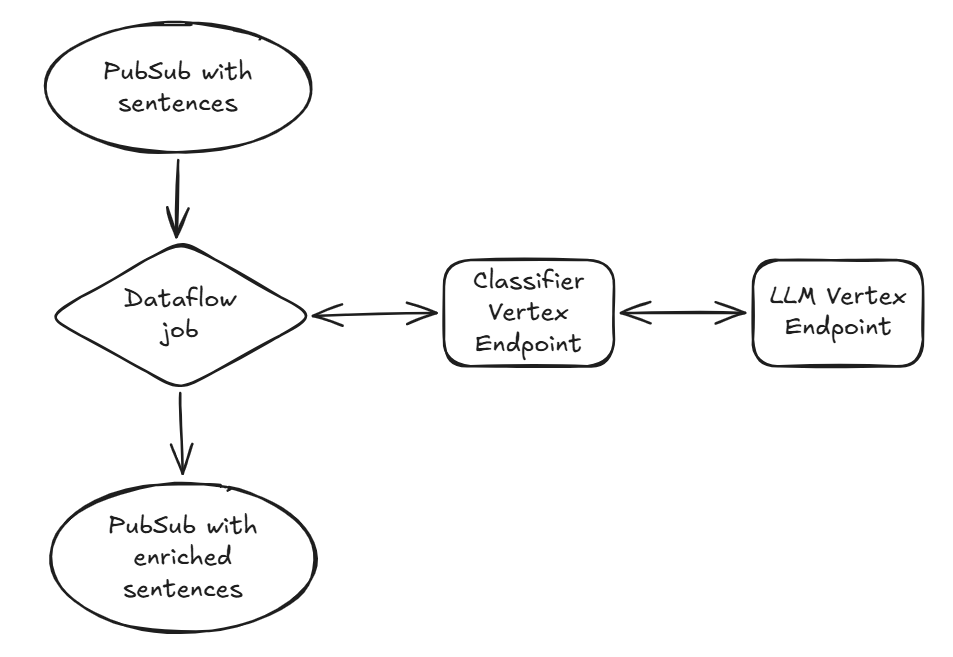
This process generated high quality training datasets for specialized tasks like topic classification, NER, and sentiment extraction. The datasets were subsequently used to fine-tune a targeted lineup of custom models that considerably outperformed the legacy solution and delivered accuracy just a couple percentage points lower than the teacher models' consensus. System architecture This architecture was built on top of Dataflow and Gemini Enterprise Agent Platform Endpoints, which play together very nicely because of the out-of-the-box VertexAIModelHandlerJSON .
We decoupled business logic and raw LLM inference by creating two separate endpoints: The classifier: a FastAPI-based endpoint that handles the messy stuff, pre/post-processing, prompt templating, and chaining. The LLM: A separate Agent Platform endpoint dedicated strictly to serving the Gemma model via vLLM. This approach keeps the Dataflow job clean and ensures the LLM endpoint sticks to what it does best: generating text.
For more details please read the original article at Google Cloud AI.
Why It Matters for Business
Real business deployments are the most reliable signal of where AI is generating measurable ROI. Watching which sectors operationalize AI, what they pay for it, and how it changes their P&L tells you more than any vendor demo. These case studies are what serious buyers and investors triangulate on.
Continue Learning
Comments
Comments appear only after moderation. Your email identifies your submission to the moderator and is never displayed here.
No approved comments yet.