IBM's enterprise AI strategy makes trust and control the production test
This SiliconANGLE feature examines IBM's enterprise AI strategy, which centers on trust, governance, and control rather than chasing frontier models. As companies move from pilots to production, the test is whether platforms can bring automation, trusted data, and operational control into complex environments. theCUBE Research analyst John Furrier frames watsonx, hybrid cloud, and governance as IBM's path to becoming a trusted execution layer. IBM's Red Hat foundation supports its hybrid cloud approach.
Key Takeaways
- IBM is focusing on governed, trusted enterprise AI rather than winning the frontier model race.
- Analyst John Furrier says the test is whether IBM becomes the system of record for enterprise AI or just another layer.
- watsonx sits at the center of IBM's orchestration, governance, and hybrid deployment strategy.
- IBM bets that most enterprise value comes from applied AI on proprietary data, not greenfield labs.
- The Red Hat acquisition gave IBM a hybrid cloud foundation before AI became the defining workload.
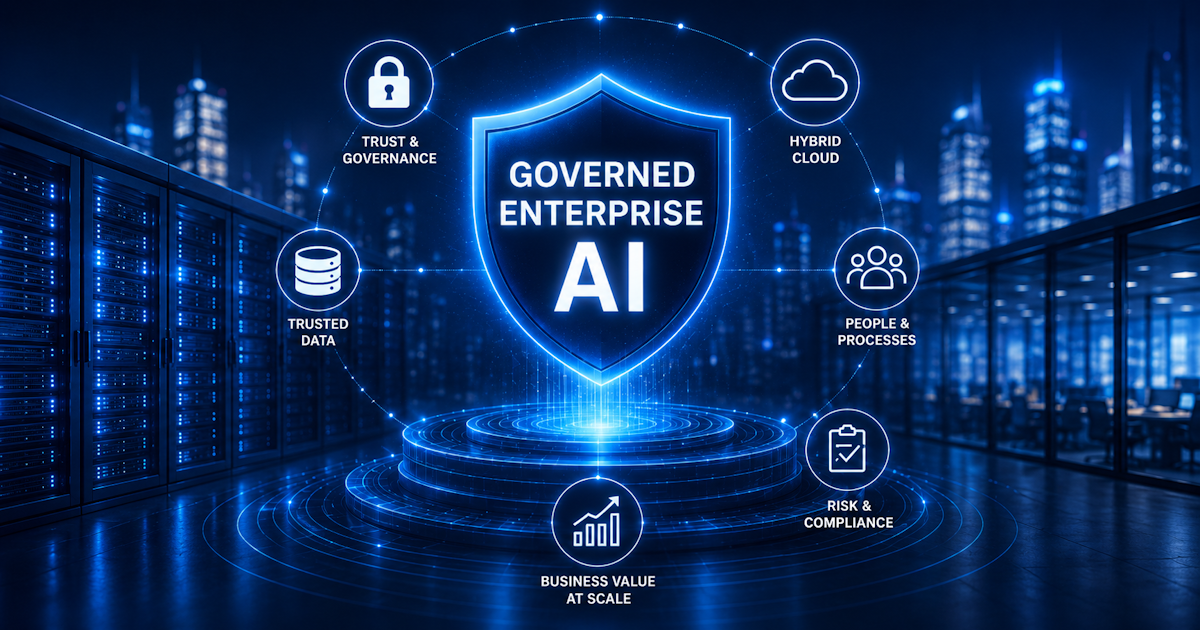
From pilots to production
Enterprise AI has entered a more demanding phase.
- ›Companies want agents, automation, and generative AI but also need auditability, cost controls, and trusted data.
- ›The real test is whether platforms bring control into messy business environments without creating more risk than value.
- ›Furrier says IBM's opportunity is to make governed enterprise AI a production model rather than a compliance layer.
Furrier framed the open question coming out of IBM Think as whether IBM becomes the system of record for enterprise AI or just another layer in the stack.
IBM's positioning
IBM is betting on trusted AI in production.
- ›Furrier said IBM is not trying to win the AI hype cycle but to win enterprise reality.
- ›While others chase frontier models, IBM bets on trusted AI in production, which Furrier calls harder.
- ›IBM positions around orchestration, governance, and hybrid deployment with watsonx at the center.
Furrier added that this is not about chasing OpenAI or Anthropic on frontier models, since IBM's bet is that most enterprise value comes from applied AI on proprietary data.
watsonx at the center
watsonx anchors IBM's strategy.
- ›IBM aims to turn watsonx, hybrid cloud, and governance into a trusted execution layer for enterprise AI.
- ›The challenge is making those capabilities feel operationally essential, not bolted on after deployment.
- ›IBM is building a stack designed to plug into messy, regulated, real-world environments.
Hybrid cloud advantage
IBM's hybrid cloud gives it a practical opening.
- ›Its hybrid strategy spans public clouds, private systems, mainframes, and edge locations.
- ›The broader ecosystem includes Red Hat, watsonx, consulting services, and technology partners.
- ›Furrier said IBM's differentiation hinges on the idea that AI will not live in a single cloud.
The Red Hat-driven hybrid model positions IBM to orchestrate AI across on-prem, private, and public environments, which Furrier said would be a real advantage for large, regulated enterprises.
The Red Hat foundation
The Red Hat deal continues to matter for IBM.
- ›The deal gave IBM a hybrid cloud foundation before enterprise AI became the defining workload.
- ›As AI shifts from copilots to agentic systems touching data, infrastructure, and business logic, a consistent control plane becomes more valuable.
- ›CFO Jim Kavanaugh said the Red Hat acquisition was predicated on three things.
The feature is part of SiliconANGLE Media's exploration of IBM's AI strategy, hybrid cloud foundation, and governance priorities.
Frequently Asked Questions
What is the focus of IBM's enterprise AI strategy?
IBM focuses on governed, trusted enterprise AI with automation, trusted data, and operational control, rather than chasing frontier models.
What role does watsonx play?
watsonx sits at the center of IBM's orchestration, governance, and hybrid deployment strategy, intended as a trusted execution layer for enterprise AI.
How does IBM differentiate, according to Furrier?
Furrier says IBM's differentiation hinges on the idea that AI will not live in a single cloud, using its Red Hat-driven hybrid model to orchestrate AI across on-prem, private, and public environments.
Why does the Red Hat acquisition still matter?
It gave IBM a hybrid cloud foundation before enterprise AI became the defining workload, providing a consistent control plane as AI shifts to agentic systems.
What is the key question about IBM's strategy?
Whether IBM becomes the system of record for enterprise AI or just another layer in the stack.
IBM is betting that trusted, governed AI in production will define its place in the enterprise market.
Continue Learning
Comments
Sign in to join the conversation