Introducing Google AI Threat Defense to help you outpace the adversary
Google is launching Google AI Threat Defense, an automated security system meant to continuously monitor for and stop AI-powered threats before they affect a business. The company says AI has changed the threat landscape, letting attackers find security gaps faster than teams can fix them manually. The system combines Gemini and other frontier models with the risk prioritization of Wiz, the code remediation of Gemini and CodeMender, and the frontline expertise of Mandiant.
Key Takeaways
- aside_block AI-powered cyber threats have been receiving a lot of attention lately.
AI has changed the threat landscape ; cybercriminals are using it to find security cracks faster than cybersecurity teams can manually fix them.
- And you need a solution that can analyze your systems, prioritize the most significant threats, patch vulnerabilities quickly, and continuously monitor for new attacks.
That's why we're launching Google AI Threat Defense - an automated security system designed to help you continuously monitor for and stop AI-powered threats before they can impact your business.
- And to help enterprises manage an avalanche of threat data, we created Google Security Operations .
- By connecting real-world exposure directly to autonomously creating and prioritizing patching, AI Threat Defense helps organizations actively predict attack paths, prioritize the most significant threats, and deploy verified fixes faster than adversaries can exploit them.
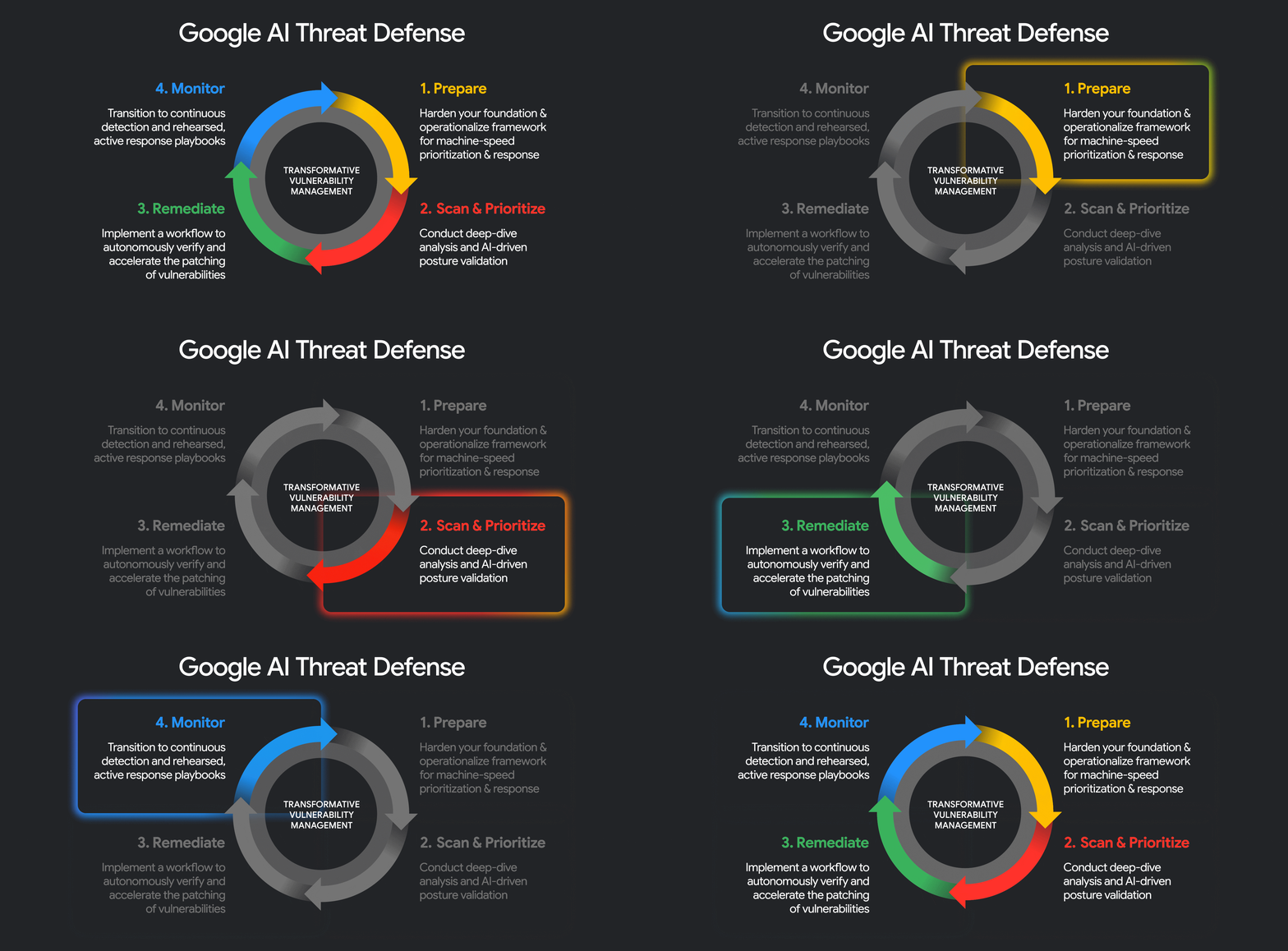
AI Threat Defense is based on Google's own approach to combating today's threats and transforming vulnerability management across a four-step framework: Prepare : Harden your foundation, and operationalize your framework for machine-speed prioritization and response.
- Sensitive assets should not be reachable from the internet or exposed through untrusted paths, regardless of patch status.
Stats & Key Facts
- #Our secure-by-default architecture automatically blocks 10 million spam emails every minute, and protects billions of users and customers across our broad portfolio.
aside_block AI-powered cyber threats have been receiving a lot of attention lately. AI has changed the threat landscape ; cybercriminals are using it to find security cracks faster than cybersecurity teams can manually fix them. Attacks that used to take weeks to carry out can now happen in mere hours or days.
Organizations need to be able to keep pace and protect themselves against AI agent-driven, high-speed attacks - but they can no longer rely on legacy, manual methods. To defend against this range of threats, organizations need more than one model or agent. No single model will catch everything, you want to use a collection of models for multiple passes.
And you need a solution that can analyze your systems, prioritize the most significant threats, patch vulnerabilities quickly, and continuously monitor for new attacks. That's why we're launching Google AI Threat Defense - an automated security system designed to help you continuously monitor for and stop AI-powered threats before they can impact your business. Built on a decade of security leadership Security isn't just a layer of Google's tech stack; it's the part of the foundation.
Our secure-by-default architecture automatically blocks 10 million spam emails every minute, and protects billions of users and customers across our broad portfolio. But protecting the modern enterprise requires constant evolution. When we needed an architecture built on trust, we pioneered Zero Trust .
By combining the expertise of Mandiant and Wiz with the advanced reasoning and code-generation capabilities of Gemini, we're automating defense at scale for customers. We're deploying LLM-powered analysis to help autonomously discover software flaws, and AI agents across Wiz and CodeMender to validate risk, generate fixes, and support remediation workflows before vulnerabilities can be exploited. Unlike other model providers that simply hand security teams a massive, unprioritized list of AI-generated alerts, we deliver prioritized fixes to accelerate remediation and secure the Defender's Advantage.
Introducing Google AI Threat Defense Google AI Threat Defense fuses the reasoning power of Gemini and other frontier models, the contextual risk prioritization of Wiz , the code remediation capabilities of Gemini and CodeMender , and the frontline expertise of Mandiant . By connecting real-world exposure directly to autonomously creating and prioritizing patching, AI Threat Defense helps organizations actively predict attack paths, prioritize the most significant threats, and deploy verified fixes faster than adversaries can exploit them. AI Threat Defense is based on Google's own approach to combating today's threats and transforming vulnerability management across a four-step framework: Prepare : Harden your foundation, and operationalize your framework for machine-speed prioritization and response.
Scan and prioritize : Conduct deep-dive analysis and AI-driven posture validation. Remediate : Implement a workflow to autonomously verify and accelerate the patching of vulnerabilities. Monitor : Transition to continuous detection and rehearsed, active response playbooks.
Google AI Threat Defense can help transform vulnerability identification and remediation. Prepare: Harden the foundation for machine-speed response As more vulnerabilities are discovered and exploitation accelerates, the first priority is to reduce unnecessary exposure. Sensitive assets should not be reachable from the internet or exposed through untrusted paths, regardless of patch status.
For more details please read the original article at Google Cloud AI.
Continue Learning
Comments
Comments appear only after moderation. Your email identifies your submission to the moderator and is never displayed here.
No approved comments yet.