NVIDIA AI Supercomputer Comes Online at Naval Postgraduate School
NVIDIA founder and CEO Jensen Huang today visited the Naval Postgraduate School in Monterey, California, to commission an NVIDIA DGX GB300 system - bringing one of the world's most powerful AI platforms fully online for the students, researchers and faculty at the U.S. military's flagship graduate university. "Our nation depends on our men and women [...] NVIDIA founder and CEO Jensen Huang joined school leadership in Monterey, California, to commission the system, which will fuel AI education and research at the US military's premier technical graduate university.
Key Takeaways
- "Our nation depends on our men and women who fight on the front lines.
Nothing is more valuable to you than information and insight, and information and insight in a timely way, and to understand its impact and consequence," Huang said at the event.
- "As we modernize our technology, we must also modernize how we educate our leaders," said Admiral Samuel Paparo, commander of the U.S. Pacific Command.
"Access to advanced computing capability means NPS students and faculty understand the opportunities and responsibilities that come with these technologies."
- You're in service of your mission," Huang said to attendees.
- NVIDIA has also expanded the collaboration through its Deep Learning Institute , putting instructor toolkits in the hands of NPS faculty so AI is woven through graduate curricula across departments.
- Researchers are using AI to model sea conditions, predict atmospheric changes and build digital twins of complex environments - work that feeds directly into the scientific domains where NPS has deep expertise.
Stats & Key Facts
- #The DGX GB300 supercomputer with NVIDIA Mission Control software gives NPS's more than 1,500 in-resident students and 600 faculty on-premises access to large-scale AI computing, including model training and inference capability for applications spanning weather prediction, cybersecurity, and disaster resilience and response planning.
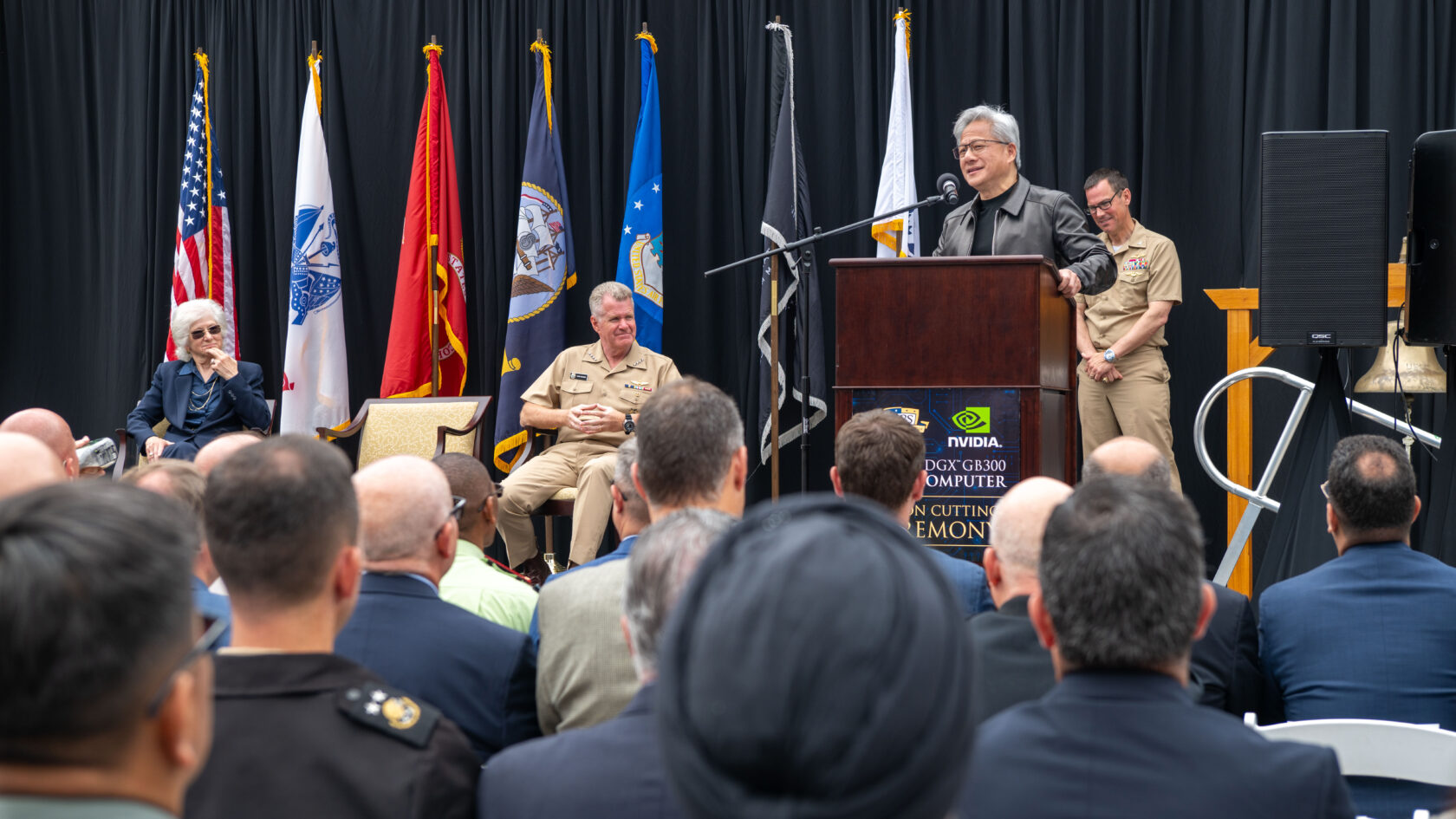
NVIDIA founder and CEO Jensen Huang joined school leadership in Monterey, California, to commission the system, which will fuel AI education and research at the US military's premier technical graduate university. NVIDIA founder and CEO Jensen Huang today visited the Naval Postgraduate School in Monterey, California, to commission an NVIDIA DGX GB300 system - bringing one of the world's most powerful AI platforms fully online for the students, researchers and faculty at the U.S. military's flagship graduate university. "Our nation depends on our men and women who fight on the front lines.
Nothing is more valuable to you than information and insight, and information and insight in a timely way, and to understand its impact and consequence," Huang said at the event. "I can't imagine anything more important." The DGX GB300 supercomputer with NVIDIA Mission Control software gives NPS's more than 1,500 in-resident students and 600 faculty on-premises access to large-scale AI computing, including model training and inference capability for applications spanning weather prediction, cybersecurity, and disaster resilience and response planning.
The commissioning, which took place during the school's three-day Converge @ NPS event, marks the latest chapter in an ongoing collaboration to develop AI-based technologies at NPS for education and real-world applications. It's built based on an NVIDIA AI Technology Center on the Monterey campus - a dedicated hub for AI research and graduate instruction, now anchored by the DGX GB300. "As we modernize our technology, we must also modernize how we educate our leaders," said Admiral Samuel Paparo, commander of the U.S. Pacific Command.
"Access to advanced computing capability means NPS students and faculty understand the opportunities and responsibilities that come with these technologies." Training Leaders to Build With AI NPS educates active-duty officers and international partners across disciplines - from space operations to ocean science - awarding graduate degrees while centering each program on applied research with direct relevance to real-world problems. "Leadership is about being in service of something else.
You're in service of your team. You're in service of your country. You're in service of your mission," Huang said to attendees.
"And all of this technology is just tools to help you." The DGX GB300 gives those programs new technical depth: the ability to train foundation models in house, run high-fidelity simulations at scale and develop AI tools with immediate applicability. Huang told attendees that even if they aren't experts in computer science, today's computers running AI make it easy.
"The most important advice that I would give to someone is to engage the technology," Huang said. "It's not as hard as you think it is, and the reason for that is because, on first principles, technology is supposed to get smarter and smarter over time." NVIDIA has also expanded the collaboration through its Deep Learning Institute , putting instructor toolkits in the hands of NPS faculty so AI is woven through graduate curricula across departments.
"Many of you will command in AI-enabled environments. Information will move at lightning speeds, compressing response times," Paparo said. "Our advantage will come from leaders, like you, who can use the technology to see, understand, decide and act faster while exercising the judgment, experience and leadership that machines cannot provide.
That education is happening here at NPS." From Ocean Models to Digital Twins NPS runs a regular cadence of hackathons that have produced advances in autonomy, ocean research and operations planning - applied work that demands serious computing to scale. Researchers are using AI to model sea conditions, predict atmospheric changes and build digital twins of complex environments - work that feeds directly into the scientific domains where NPS has deep expertise.
For more details please read the original article at NVIDIA Blog.
Continue Learning
Comments
Comments appear only after moderation. Your email identifies your submission to the moderator and is never displayed here.
No approved comments yet.