Nvidia bets on agentic AI to turbocharge biotech discovery
Artificial intelligence played a prominent role at this week's Bio International Convention in San Diego, the largest biotech event with vendors spanning the full ecosystem of companies in this industry. Today in a special address, Kimberly Powell (pictured), vice president and general manager of healthcare and life sciences at Nvidia Corp. , made the case that agentic AI [...
Key Takeaways
- SiliconANGLE UPDATED 19:52 EDT / JUNE 23 2026 AI Nvidia bets on agentic AI to turbocharge biotech discovery GUEST COLUMN by Zeus Kerravala Artificial intelligence played a prominent role at this week's Bio International Convention in San Diego, the largest biotech event with vendors spanning the full ecosystem of companies in this industry.
Today in a special address, Kimberly Powell (pictured), vice president and general manager of hea lthcare and life sciences at Nvidia Corp.
- She compared AI to the microscope, X-ray crystallography, and gene sequencing, calling them a new class of scientific instruments.
This time, the instrument doesn't just see or measure; it reasons, plans and acts.
- On the other hand, Nvidia has been building the infrastructure to operationalize that research: GPUs, networking, CUDA-X libraries and domain platforms such as MONAI , Parabricks , cuEquivariance and BioNeMo.
What has changed in the last 12 to 18 months is the emergence of agentic AI, systems in which a large language model "brain" is wrapped in a harness that manages tools, memory, security policies and multistep workflows.
- " That's a very different framing than "just another model.
" It says the next application tier in biotech won't be GUIs and pipelines, but rather networks of specialized agents coordinating work across digital and physical labs.
- Powell specifically addressed the historical cost-performance trade-off.
Stats & Key Facts
- #SiliconANGLE UPDATED 19:52 EDT / JUNE 23 2026 AI Nvidia bets on agentic AI to turbocharge biotech discovery GUEST COLUMN by Zeus Kerravala Artificial intelligence played a prominent role at this week's Bio International Convention in San Diego, the largest biotech event with vendors spanning the full ecosystem of companies in this industry.
- #From generative to agentic AI for science Powell's core thesis is that the life sciences, a $300 billion annual pharmaceutical budget (global R&D is reaching $3.
- #What has changed in the last 12 to 18 months is the emergence of agentic AI, systems in which a large language model "brain" is wrapped in a harness that manages tools, memory, security policies and multistep workflows.
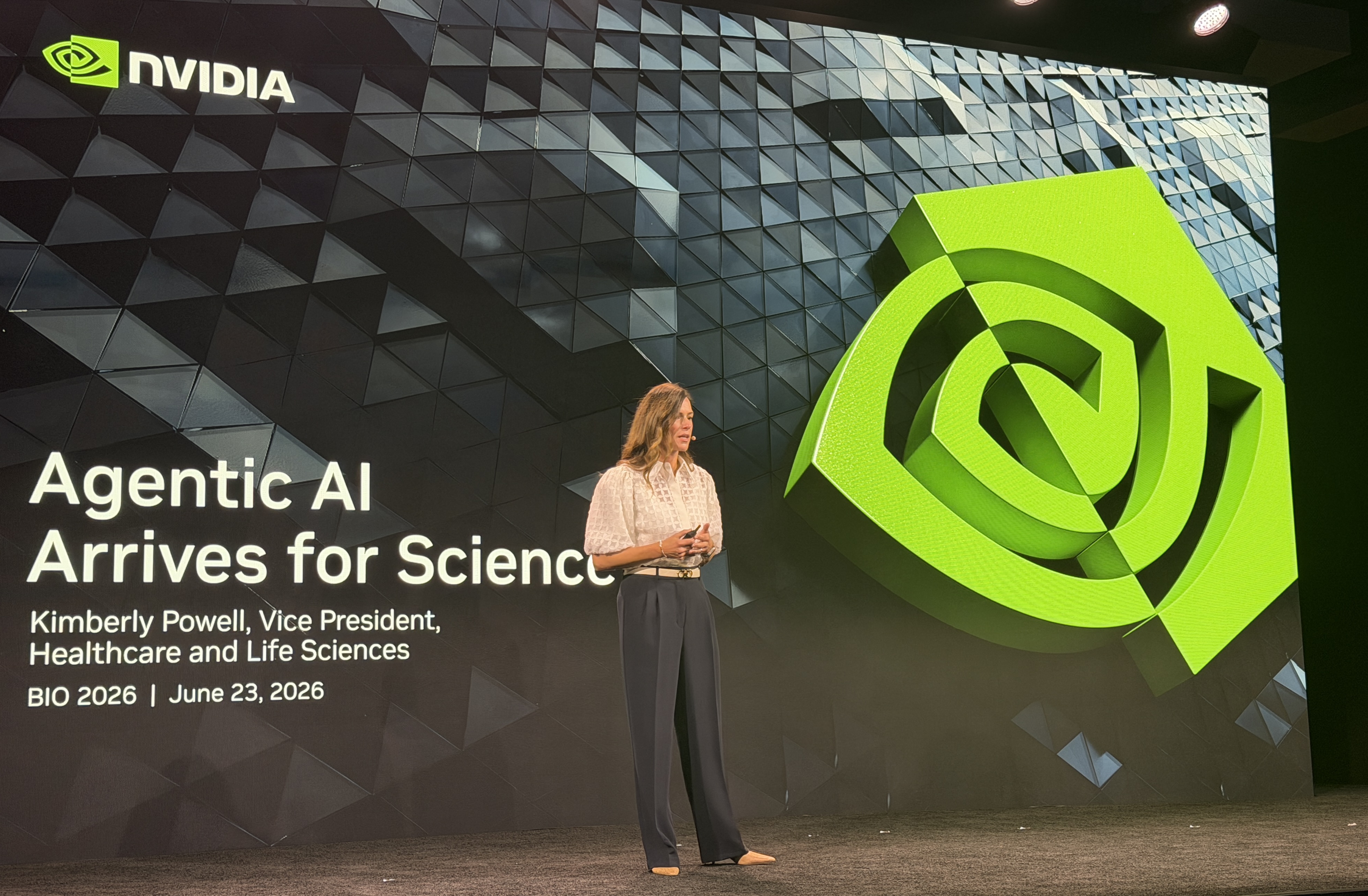
SiliconANGLE UPDATED 19:52 EDT / JUNE 23 2026 AI Nvidia bets on agentic AI to turbocharge biotech discovery GUEST COLUMN by Zeus Kerravala Artificial intelligence played a prominent role at this week's Bio International Convention in San Diego, the largest biotech event with vendors spanning the full ecosystem of companies in this industry. Today in a special address, Kimberly Powell (pictured), vice president and general manager of hea lthcare and life sciences at Nvidia Corp. , made the case that agentic AI is about to do for biotech what it just did for software - and the company's BioNeMo is the stack that turns generic large language models into working "AI scientists" that are both faster and cheaper to run.
Nvidia wants to make 'AI scientists' mainstream in biotech Powell opened her presentation by outlining where the industry is now. "We are witnessing the fastest platform shift the life sciences industry has ever seen," she said. She compared AI to the microscope, X-ray crystallography, and gene sequencing, calling them a new class of scientific instruments.
This time, the instrument doesn't just see or measure; it reasons, plans and acts. At the event, Nvidia announced its BioNeMo Agent Toolkit , a software stack that turns large language models into domain-specific AI agents capable of executing end-to-end biology and chemistry workflows - from literature review to protein design to lab automation - while optimizing for performance and cost. From generative to agentic AI for science Powell's core thesis is that the life sciences, a $300 billion annual pharmaceutical budget (global R&D is reaching $3.
For more details please read the original article at SiliconANGLE AI.
Continue Learning
Comments
Sign in to join the conversation