Back to News Hub
🟧AWS Machine Learning
June 11, 2026
E-Commerce

Optimize blueprint extraction accuracy in Amazon Bedrock Data Automation

Overview

Amazon has added a feature to Bedrock Data Automation that automatically sharpens how its document extraction tool reads business paperwork. Called blueprint instruction optimization, it takes three to ten sample documents plus their correct answers and rewrites the extraction instructions to lift accuracy in minutes rather than weeks. No separate model training or fine-tuning is required, and the work runs through either the Amazon Bedrock console or an API.
Key Takeaways

  • Blueprint instruction optimization automatically refines the plain-language instructions that tell Bedrock Data Automation which fields to pull from a document, such as invoice totals or contract dates.
  • Users supply three to ten representative documents along with verified correct values (ground truth), and the system compares its results to those answers and rewrites the instructions accordingly.
  • The feature changes only the wording of field instructions, leaving the data type and inference settings untouched, so existing blueprints keep their structure.
  • Accuracy improvements that once took weeks of manual trial and error now complete in minutes, with no model fine-tuning needed.
  • The tool runs through the Amazon Bedrock console for non-coders or through the Boto3 API for developers who want to automate it.
  • Cleaner extraction feeds downstream Amazon services including Bedrock Knowledge Bases, Bedrock Agents, and Bedrock Guardrails, reducing errors across connected workflows.

Stats & Key Facts

  • #3 to 10 sample documents are needed to run an optimization, including edge cases where extraction has struggled.
  • #3 to 5 examples are enough to achieve significant accuracy gains, per the AWS best-practice guidance.
  • #Aggregate exact-match accuracy rose from 90% to 92% in the purchase-order example AWS demonstrated.
  • #Optimization finishes in minutes, replacing a manual process that ran weeks per document type.
  • #3 accuracy metrics are reported after each run: exact match rate, overall F1 score, and confidence score.
  • #0 model fine-tuning or separate training steps are required to apply the refinements.
Optimize blueprint extraction accuracy in Amazon Bedrock Data Automation

What blueprint instruction optimization actually does

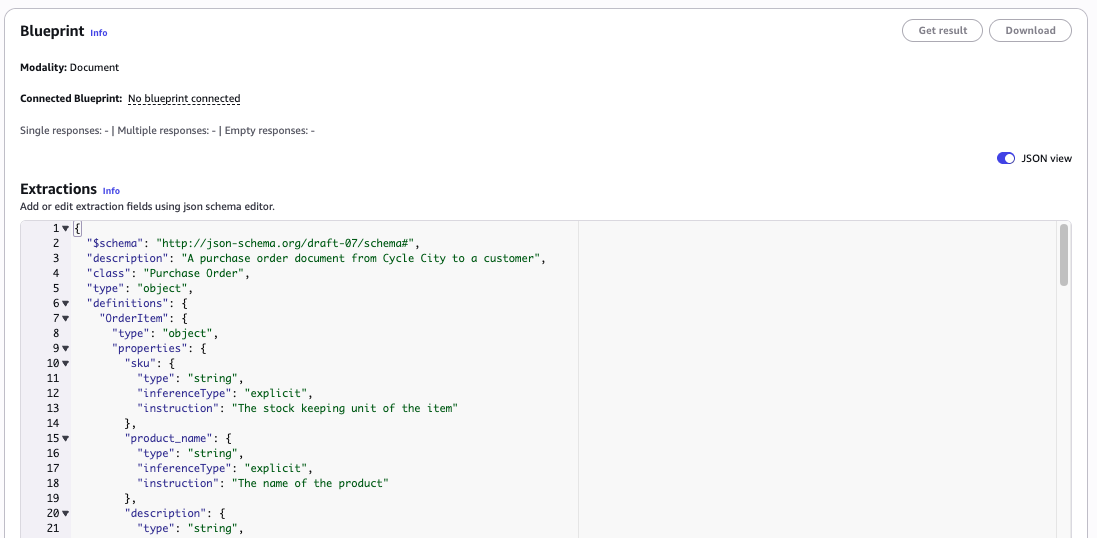
The feature targets the natural-language instructions inside a blueprint, the file that defines what to extract.

In Bedrock Data Automation, a blueprint lists the fields you want pulled from a document and gives each one a plain-language instruction describing what the value looks like and where to find it. When extraction comes back wrong, the usual fix is rewriting those instructions by hand and re-testing, an effort that runs for weeks per document type.

Blueprint instruction optimization automates that loop. It studies the gap between what the system extracted and the correct answers you supply, then rewrites the instruction wording for each field to close the gap. The data type and inference settings stay exactly as they were, so only the guidance language changes.

How the optimization workflow runs step by step

The process follows four clear stages from upload to a saved, improved blueprint.

  • ›Upload three to ten representative documents drawn from your real workload, including the tricky cases.
  • ›Supply ground truth, meaning the verified correct value for each field in those documents.
  • ›Run the optimization, which compares results against ground truth and rewrites instructions.
  • ›Review accuracy metrics and the new instructions, then save the optimized blueprint once results meet your needs.

Console for non-coders, API for automation

Amazon offers two paths to run the same workflow depending on your team's skills.

Through the Amazon Bedrock console, a user creates a blueprint, defines its fields by hand or by uploading a sample, runs an initial extraction to set a baseline, then adds more sample documents and ground-truth files before saving the improved version. This visual path suits teams without engineering resources.

For developers, the same steps run through the Boto3 SDK using calls named CreateBlueprint, InvokeBlueprintOptimizationAsync, GetBlueprintOptimizationStatus, and GetBlueprint. The API route lets a business wire optimization into an automated pipeline rather than clicking through a screen each time.

The accuracy problems it is built to fix

Document extraction breaks in predictable ways that the feature directly addresses.

  • ›Field labels that vary across document versions, so the same value hides under different names.
  • ›Look-alike labels that confuse the system, such as subtotal versus total on an invoice.
  • ›Different layouts between vendors or across time periods that move fields around the page.
  • ›Edge cases that need specific guidance the original instructions never covered.

How AWS measures the improvement

Each run returns three numbers so you can judge whether the new instructions are better.

After optimization, the results page reports an exact match rate, the share of fields that match ground truth exactly; an overall F1 score, a combined measure of precision and recall; and a confidence score reflecting how certain the system is about each value.

In the worked purchase-order example, aggregate exact-match accuracy moved from 90 percent to 92 percent. The feature handles unstructured documents broadly, with AWS naming invoices, contracts, tax forms, and enrollment applications as common targets.

Best practices for examples and ground truth

The quality of what you feed in shapes the quality of what you get back.

  • ›Pick examples that reflect the variety in your real workload, including documents that failed before.
  • ›Verify ground-truth values carefully, because their accuracy directly drives the result.
  • ›Start with three to five examples, which AWS says is enough for meaningful gains.
  • ›Include challenging cases rather than only clean, easy documents.
  • ›Re-optimize over time if accuracy drifts as your documents change.

Why this matters for connected AI workflows

Better extraction does not stop at the document; it improves everything downstream.

Because so many AI workflows start by reading a document, errors at extraction ripple outward. Cleaner fields strengthen Amazon Bedrock Knowledge Bases by improving the vector embeddings used for semantic search, and they reduce the error-handling logic that Bedrock Agents otherwise need to write around bad data.

Optimized output also helps Bedrock Guardrails verify content more reliably, since the inputs are more trustworthy to begin with. The feature is available in AWS Regions where Bedrock Data Automation runs and bills at standard inference costs based on the number of pages in your example documents.

Frequently Asked Questions

What is a blueprint in Amazon Bedrock Data Automation?

A blueprint is the file that defines which fields to extract from a document, such as invoice number or contract date. It lists each field, the data format expected, and a plain-language instruction telling the system how to find that value.

How many example documents do I need to optimize a blueprint?

You need three to ten representative documents, ideally including the edge cases where extraction has struggled. AWS notes that three to five examples are often enough to see significant accuracy improvements.

Does this require training or fine-tuning an AI model?

No. Blueprint instruction optimization refines the natural-language instructions rather than retraining a model, so it skips the separate fine-tuning step. That is why results arrive in minutes instead of weeks.

What kinds of documents does the feature work with?

It handles unstructured business documents broadly. AWS lists invoices, contracts, tax forms, and enrollment applications, and the published walkthrough uses purchase orders.

Do I need to be a developer to use it?

No. You can run the full workflow through the visual Amazon Bedrock console, or through the Boto3 API if you prefer to automate it inside a larger pipeline.

Blueprint instruction optimization turns a weeks-long manual tuning chore into a minutes-long automated run, giving non-technical teams a practical way to raise document extraction accuracy. By improving the data at the source, it also steadies the Amazon Bedrock services that depend on those extracted fields.

Continue Learning

Originally published by AWS Machine Learning
Read the original

Comments

Sign in to join the conversation