Product Vision Statement: A 2026 Guide
A product vision statement articulates what a company aims to become, not just what features it will build. Many teams fail at vision work by confusing activity with strategic direction, leading to misaligned roadmaps and unclear priorities. This guide explores how to craft and communicate an effective vision statement for 2026 and beyond.
Key Takeaways
- A vision statement must answer 'What are we trying to become?' - not just list features or quarterly goals
- Confusing motion (busy activity) with direction (strategic clarity) is the primary reason product vision efforts fail
- An effective vision statement aligns team priorities, guides roadmap decisions, and connects daily work to long-term purpose
- Vision statements should be memorable, forward-looking, and distinct from mission statements and OKRs
- Regular review and refinement of your vision ensures it remains relevant as market conditions and company capabilities evolve
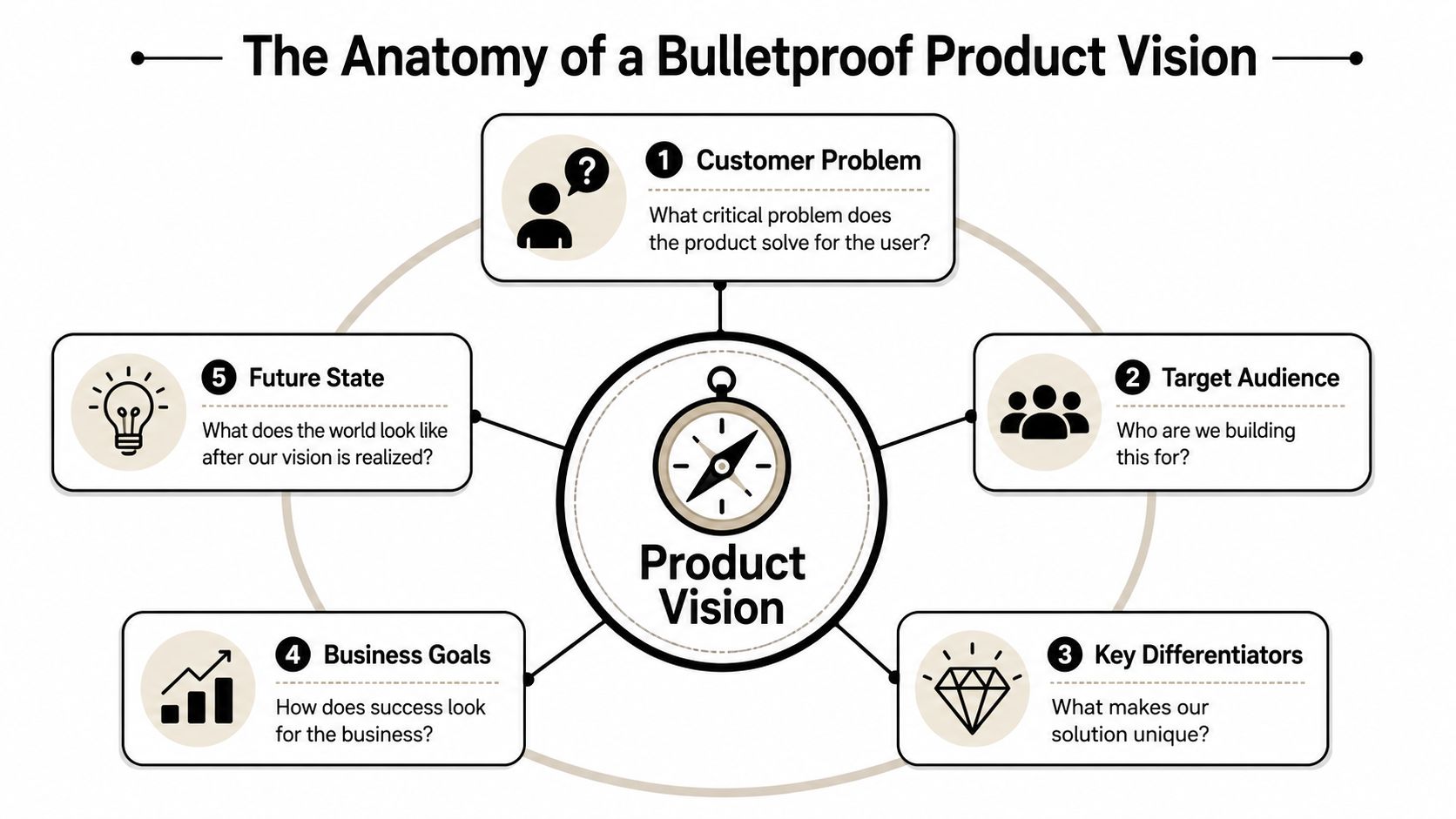
Why Product Vision Matters
A clear product vision prevents teams from getting lost in tactical execution.
- ›Provides strategic north star that unites engineering, design, marketing, and leadership
- ›Prevents feature bloat by filtering requests through a consistent lens
- ›Helps retain talent by connecting individual work to meaningful long-term purpose
- ›Simplifies prioritization during uncertain times or resource constraints
When a VP asked 'What are we trying to become?' in that roadmap meeting, the silence revealed a critical gap. Teams had built an impressive backlog of features, but lacked a unifying answer about where the product was headed. Without this clarity, every decision defaults to short-term thinking: What can we ship next quarter? What will impress investors? What are competitors doing? These questions have merit, but they cannot substitute for strategic vision.
Vision work is uncomfortable because it requires specificity and commitment. It's easier to say 'we're expanding our feature set' than to declare 'we are becoming the platform that makes X possible for Y users.' The former allows endless pivots; the latter forces accountability. Yet that accountability is precisely what transforms scattered effort into compound progress.
Distinguishing Vision from Mission and OKRs
Clarity requires understanding how these three strategic tools complement each other.
- ›Mission: Why your company exists and the fundamental problem it solves (timeless)
- ›Vision: What you want the product and company to become (forward-looking, 3-10 year horizon)
- ›OKRs: Specific, measurable outcomes you will achieve in a defined period (quarterly or annual)
A mission statement describes your North Star purpose and usually remains stable for years. A vision statement describes the world or customer experience you are building toward - it has a time horizon (often 3 to 5 years) and may evolve as you get closer to it. OKRs are tactical milestones that move you toward your vision within a specific timeframe. A company might have a mission to 'democratize access to information,' a vision to 'be the platform where anyone can find verified answers instantly,' and OKRs like 'grow verified expert contributors by 50% in Q2.' Each layer serves a distinct purpose, and confusion between them creates misalignment.
Many teams skip the vision because it feels abstract or because they assume everyone shares an intuitive sense of where they are headed. This assumption almost always proves false. A 50-person startup may naturally align on informal vision; a 500-person organization almost certainly needs it written and regularly referenced. Vision statements act as a common language, especially when teams are distributed or when company leadership changes.
Crafting Your Vision Statement
A strong vision statement balances aspiration with clarity.
- ›Describe the world or experience you are creating, not the internal mechanics of your product
- ›Make it specific enough to guide decisions, but flexible enough to adapt as you learn
- ›Involve your core team and stakeholders; unilateral vision rarely gains adoption
- ›Keep it memorable - ideally one or two sentences that people can recall and repeat
Start by asking: Who are we serving? What transformation do we enable? What will be different about their world if we succeed? These questions help you move beyond feature lists. For example, 'Build the best email client' is a feature focus; 'Enable people to spend less time managing email and more time on what matters' points toward a vision. It invites questions like: How do we know when we've succeeded? What trade-offs will we make to prioritize this vision?
Involve your leadership team and key product stakeholders in the drafting process. Solicit input from sales, support, and engineering - they have frontline insights about customer needs and technical feasibility. A vision imposed top-down without engagement rarely sticks. Once drafted, pressure-test it: Does this guide our roadmap decisions? Would we make the same calls if we did not have this vision? If the answer is no, either your vision is too vague or your roadmap is misaligned.
Expect to iterate on your vision statement. Your first version will likely be too broad or too feature-specific. Write it down, live with it for a few weeks, and refine it based on how it influences conversations and decisions. A vision that actually shapes behavior is worth the effort to get right.
Communicating Your Vision
A vision trapped in a document is just busywork.
- ›Embed vision in recurring forums: all-hands, product reviews, roadmap planning, and hiring conversations
- ›Tell stories that illustrate what achieving your vision looks like for customers
- ›Connect each quarter's OKRs explicitly to your vision - show the path
- ›Model how you use vision to make tough trade-off decisions
The most dangerous artifact is a beautifully written vision statement that lives in a shared drive and is mentioned once per year. For vision to shape behavior, it must be woven into how teams think and talk every day. When evaluating a feature request, ask: 'Does this move us toward our vision or away from it?' When hiring, ask candidates if they understand and buy into your vision. When facing a resource constraint, use your vision to determine what to cut.
Stories are powerful tools for vision communication. Instead of saying 'Our vision is to make design accessible to everyone,' describe a specific customer: a small business owner with no design background who built a stunning website in an afternoon using your product, and how that changed their business. Paint the picture of success so vividly that teams remember it and feel its pull.
Common Vision Pitfalls
Even well-intentioned vision work can derail.
- ›Vision creep: Expanding the vision to include too many customer segments or use cases, diluting focus
- ›Vagueness: Aspirational language that does not actually constrain decisions (e.g., 'Be the leader in innovation')
- ›Misalignment: Leadership and execution teams have different understandings of the vision
- ›Stagnation: Vision becomes outdated as markets shift, and teams ignore it because it no longer feels relevant
Vision creep is seductive. Early success with one customer segment creates pressure to expand. A vision that initially served a narrow market beautifully can become muddled when stretched to serve everyone. Protect your vision by being honest about trade-offs. You cannot be the best for everyone; clarify who you are building for and who you are explicitly not targeting.
Vagueness often stems from trying to please too many stakeholders. If your vision could apply equally to three different product strategies, it is not a vision - it is a truism. Refine until it is specific enough to create disagreement. If no one objects to your vision, it probably is not bold enough to matter.
Reviewing and Evolving Your Vision
A vision is not static; it should be revisited annually or when major market shifts occur.
- ›Schedule a vision review at least once per year, separate from roadmap planning
- ›Assess whether your vision still reflects customer needs and company capabilities
- ›Gather feedback from customers, employees, and market data
- ›Be willing to evolve your vision, but change it rarely and with clear reasoning
As your company matures and your understanding of the market deepens, your vision may need refinement. A startup's vision to 'Bring AI to healthcare' might evolve into 'Enable clinicians to diagnose rare diseases 30 percent faster' once you have real customer data. This is healthy evolution, not failure. The key is to be intentional about it and to communicate the shift clearly so teams understand the new boundaries.
When reviewing your vision, look at the gap between where you are and where you want to be. Is that gap still achievable in a reasonable timeframe? Are there new technologies or market dynamics that change your path? Have customer needs shifted? Use this review as a forcing function to align leadership and ensure your strategic bets are sound.
Vision and 2026 Planning
As you plan for the next few years, vision work becomes especially critical.
- ›Use vision as your filter for 2026 roadmap: What capabilities and customer experiences are essential?
- ›Define 2-3 year milestones that mark progress toward your vision
- ›Identify the biggest assumptions you are making about achieving your vision and build learning into your roadmap
- ›Create a simple artifact that shows how current projects ladder up to your vision
The next few years will bring new technologies, market entrants, and customer demands. A clear vision acts as your anchor, helping you say yes to opportunities that align and no to distractions that do not. When you review potential partnerships, new markets, or acquisitions, your vision is the filter. Does this move us closer to our vision or does it dilute our focus?
Consider sketching out a three-year roadmap in vision-focused terms. Rather than listing features, describe the capabilities and customer experiences you will have built by end of 2026. This creates a bridge between your long-term aspiration and near-term execution, making the vision feel tangible and achievable.
Frequently Asked Questions
How long should a product vision statement be?
Ideally one to three sentences. If your vision requires a paragraph to explain, it is likely too complex or vague. The goal is memorability and clarity - something your team can recall and repeat.
Should our vision change if the market shifts?
Not frequently. However, if a fundamental shift in customer needs or competitive dynamics occurs, your vision may need evolution. Review annually and change deliberately, with clear communication about why.
How do we get buy-in from the team if they disagree with the vision?
Involve them in drafting it. Many disagreements stem from teams not understanding the reasoning behind the vision. Create space for debate during the drafting phase, and once the vision is locked, remind everyone that strategy requires alignment even when individuals have different preferences.
Can a vision statement be too ambitious?
Ambition is good, but a vision must be grounded in some path to reality. If your vision is so far from your current capabilities that it demoralizes teams, rephrase it to show interim steps. The vision is the destination; the roadmap is the journey.
What happens if we do not have a clear product vision?
Teams confuse motion with progress, roadmaps become feature lists without coherence, and decision-making becomes reactive. You end up building more but moving less purposefully toward a defensible future.
A product vision statement is not a nice-to-have artifact - it is the foundation that transforms scattered effort into strategic progress.
Why It Matters for Business
Real business deployments are the most reliable signal of where AI is generating measurable ROI. Watching which sectors operationalize AI, what they pay for it, and how it changes their P&L tells you more than any vendor demo. These case studies are what serious buyers and investors triangulate on.
Continue Learning
Comments
Sign in to join the conversation