Production AI Playbook: Complex Agent Patterns
A new engineering guide from n8n argues that production AI agents break down from missing architecture, not from inherent complexity. It lays out repeatable patterns for the moment a single working agent grows into a tangled multi-agent system that nobody can debug. The four focus areas are orchestrator-to-specialist delegation, sub-workflow composition, memory management across sessions, and structured failure handling, each aimed at keeping growing systems modular, testable, and affordable.
Key Takeaways
- An orchestrator agent routes each request to a specialist agent (such as billing, technical support, or account management), and the wording of each tool description drives where the request goes.
- n8n advises extracting a sub-workflow once a single flow passes 15 to 20 nodes, so each part is tested in isolation, version-controlled, and shared across a team.
- Memory has two layers: window buffer memory holds a single conversation, while database stores in Postgres, Redis, or MongoDB keep context across sessions, with session IDs controlling who reads whose history.
- Failure handling uses structured error responses with fallbacks: retry with a simpler prompt, drop to a simpler model, escalate to a human, or return a safe default.
- Self-correcting loops are capped at 2 to 3 iterations, because a confused agent without a cap loops indefinitely and burns tokens.
- The recommended path is to start flat, extract sub-workflows at the 15 to 20 node mark, and add multi-agent coordination only when the project genuinely needs it.
Stats & Key Facts
- #15 to 20 nodes: the size threshold at which n8n recommends extracting a sub-workflow for easier navigation
- #3 database options for persistent cross-session memory: Postgres, Redis, and MongoDB
- #2 to 3 iterations: the recommended cap on self-correcting agent loops to control cost
- #30 seconds: a reasonable starting timeout for most API-backed agents
- #3 to 5 steps: the linear sequence size where keeping a workflow flat still makes sense
- #5 cost-management strategies outlined, from scoping context per agent to monitoring token spend

The Complexity Cliff: Why Adding Agents Breaks Working Systems
The guide opens with a failure mode many teams hit after early success.
The core problem is what n8n calls the complexity cliff. A first AI agent works well, then a team adds three more, and the whole system turns into something nobody can debug. The argument is that this collapse comes from a lack of architecture, not from complexity itself.
The fix is a small set of patterns that keep agent systems testable and predictable as they grow. The guide frames each pattern around a decision point, so teams know not only how to build a structure but when adding one is worth the cost.
Orchestrator and Specialist Agents for Task Routing
The first pattern delegates incoming work to focused agents.
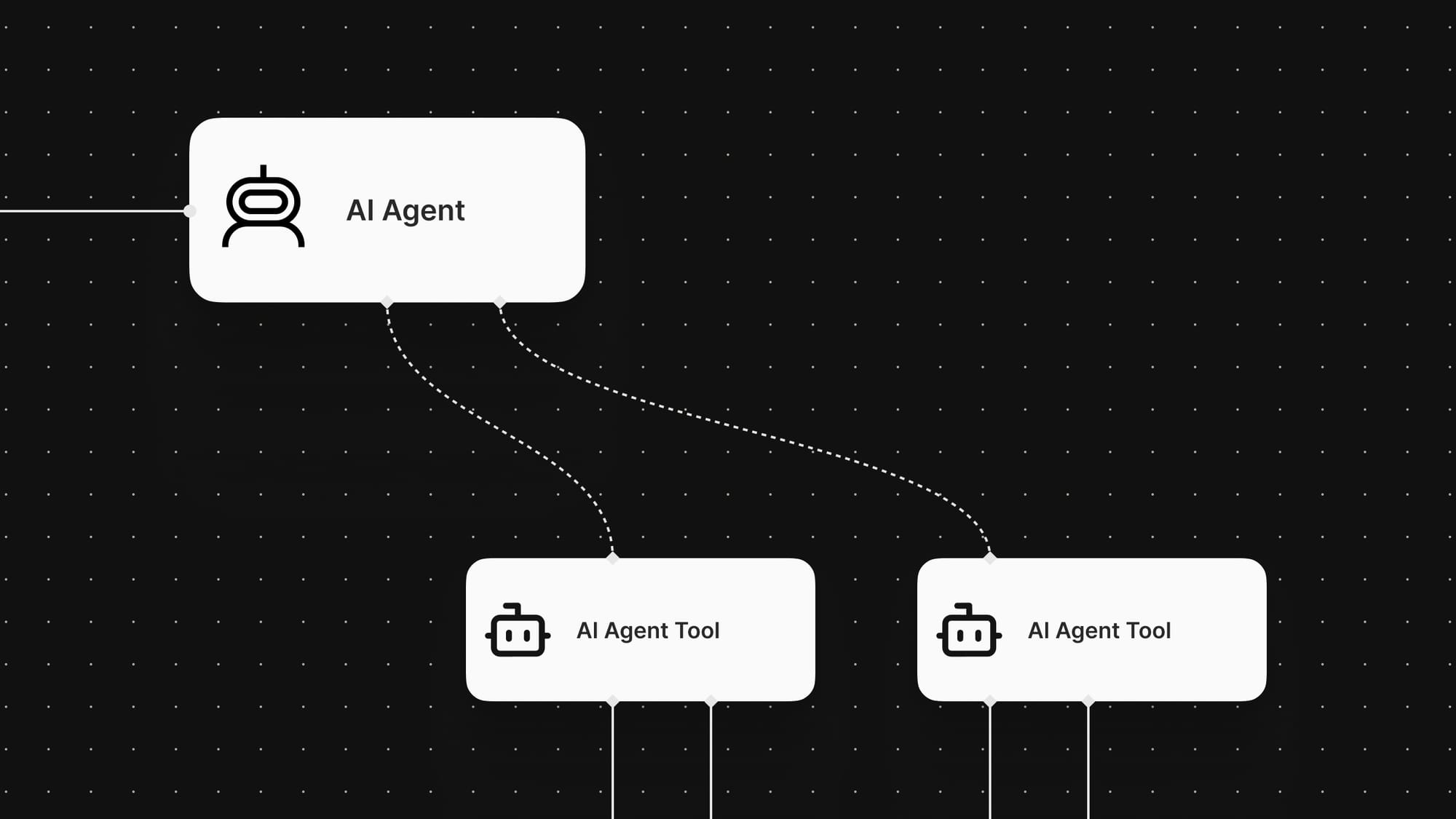
- ›An orchestrator agent receives the request and routes it to a specialist such as billing, technical support, or account management.
- ›Each specialist has its own system prompt, tools, and model, and stays focused on a single domain.
- ›Tool descriptions act like routing instructions, so they should read like API documentation rather than vague labels.
- ›A weak description such as handles billing stuff misroutes work; a precise one listing inputs, outputs, and scope routes it correctly.
- ›Logging the orchestrator's routing decisions alongside the triggering input gives an audit trail and helps catch misroutes.
Sub-Workflow Composition and the 15 to 20 Node Rule
The second pattern packages independent flows as reusable building blocks.
Sub-workflows turn parts of a system into tools that are tested on their own, version-controlled, and owned by different people on a team. A research, writer, and reviewer pipeline, for example, becomes three separate sub-workflows, each with its own agent and tools.
The trigger for extraction is concrete. n8n suggests pulling logic into a sub-workflow once a flow passes 15 to 20 nodes, since a canvas that large grows hard to navigate. The same move makes sense when identical logic is copied across workflows or when one section needs isolated testing or failure containment.
Memory Layers and Session ID Scoping
The third area governs what each agent remembers and from whom.
- ›Window buffer memory stores the last N messages and suits a single conversation where recent context matters most.
- ›Persistent memory in Postgres, Redis, or MongoDB lets an agent recall earlier interactions with a specific user across sessions.
- ›A shared session ID lets the orchestrator and specialists read the same history; isolated IDs keep each agent's context separate.
- ›Using a customer ID as the session ID lets an agent remember past dealings with that exact user.
- ›Rather than relying on memory, the guide advises pulling key facts like customer tier or account status fresh from source systems at the start of each interaction.
Structured Failure Handling and Self-Correcting Loops
The fourth area keeps one broken agent from taking down the system.
The guide recommends structured error responses that record the failure type, attempt count, last output, and a chosen fallback. Fallback options include retrying with a simpler prompt, dropping to a simpler model or a single LLM call, escalating to a human, or returning a safe default response.
Explicit timeouts stop agents from waiting indefinitely, with 30 seconds suggested as a starting point for API-backed agents. Self-correcting loops let an agent revise output after validation feedback, but the loop is capped at 2 to 3 iterations. If an agent cannot produce a valid response in three tries, the guide says the real problem is the prompt or the task definition, not the agent.
Controlling Token Cost as Agents Multiply
More agents mean more model calls, so cost management is built in.
- ›Scope context per agent: a billing specialist does not need troubleshooting history, so pass only relevant context.
- ›Match the model to the task, using lightweight models for routing, classification, and extraction and stronger ones for complex reasoning.
- ›Always cap loop iterations, since an uncapped confused agent loops indefinitely and consumes tokens.
- ›Attach fewer tools per agent, because more tool descriptions raise token costs.
- ›Track token usage per workflow, agent, and tool call, and set alerts for abnormal spikes.
Deterministic Routing Versus Agent Delegation
The guide pushes teams toward the simpler option whenever it fits.
Prompt chaining runs a fixed linear pipeline where steps are known in advance and always execute in the same order, giving maximum predictability and lower token cost. Agent delegation handles dynamic input where the path varies per request and the agent reasons about what to do next.
The rule of thumb is to use deterministic routing when you can and agent routing when you must, since switch nodes are faster, cheaper, and never misroute. A hybrid approach uses chaining for predictable parts like extraction and formatting, and reserves agent delegation for genuinely ambiguous requests.
The Recommended Progression for Non-Technical Teams
The closing advice is a staged path rather than a leap to complexity.
- ›Start flat, with a linear sequence of 3 to 5 steps and a single maintainer, while still prototyping.
- ›Extract sub-workflows once a flow passes 15 to 20 nodes or when logic is reused across workflows.
- ›Add multi-agent coordination only when input is ambiguous, sub-tasks need different models or tools, or a single context window would overflow.
- ›Test specialists in isolation before connecting them, because debugging an unknown failing component is far harder later.
Frequently Asked Questions
What is the complexity cliff the n8n guide describes?
It is the point where a single AI agent works well, but adding more agents turns the system into something nobody can debug. The guide argues this breakdown comes from missing architecture rather than from complexity itself.
When should a workflow be split into a sub-workflow?
n8n recommends extracting a sub-workflow once a flow passes 15 to 20 nodes, or when the same logic is copied across workflows. Doing so lets each part be tested in isolation, version-controlled, and maintained by different team members.
How does the memory setup handle multiple agents?
Window buffer memory holds a single conversation, while Postgres, Redis, or MongoDB stores keep context across sessions. Session IDs control scope, so a shared ID lets agents read the same history while isolated IDs keep separate domains apart.
How does the guide keep one agent's failure from crashing the system?
Each agent handles its own errors and returns a structured response with a fallback such as retrying with a simpler prompt, escalating to a human, or returning a safe default. Explicit timeouts, suggested at around 30 seconds, stop agents from waiting indefinitely.
Why limit self-correcting loops to 2 to 3 iterations?
An uncapped loop lets a confused agent retry indefinitely and burn through tokens. The guide notes that if an agent cannot produce a valid answer in three attempts, the prompt or task definition is the real problem.
The n8n guide treats production AI agents as an architecture problem with known answers, not a complexity problem without solutions. Its message for teams is to start simple, add structure only at clear thresholds, and design every agent failure to have a predictable, contained outcome.
Continue Learning
Comments
Sign in to join the conversation