Repurposing Protein Folding Models for Generation with Latent Diffusion
PLAID is a multimodal generative model that produces a protein's 1D sequence and 3D structure at the same time by learning the latent space of protein folding models. It accepts compositional function and organism prompts and can be trained on sequence databases, which are 2 to 4 orders of magnitude larger than structure databases. The method trains a diffusion model over the latent space of a folding model and, at inference, decodes both sequence and structure from a sampled embedding using frozen folding-model weights.
Key Takeaways
- PLAID is a multimodal generative model that simultaneously generates protein 1D sequence and 3D structure, by learning the latent space of protein folding models.
The awarding of the 2024 Nobel Prize to AlphaFold2 marks an important moment of recognition for the of AI role in biology.
- From structure prediction to real-world drug design Though recent works demonstrate promise for the ability of diffusion models to generate proteins, there still exist limitations of previous models that make them impractical for real-world applications, such as: All-atom generation : Many existing generative models only produce the backbone atoms.
To produce the all-atom structure and place the sidechain atoms, we need to know the sequence.
- Generating "useful" proteins Simply generating proteins is not as useful as controlling the generation to get useful proteins.
- Training using sequence-only training data Another important aspect of the PLAID model is that we only require sequences to train the generative model!
Generative models learn the data distribution defined by its training data, and sequence databases are considerably larger than structural ones, since sequences are much cheaper to obtain than experimental structure.
- During training, only sequences are needed to obtain the embedding; during inference, we can decode sequence and structure from the sampled embedding.
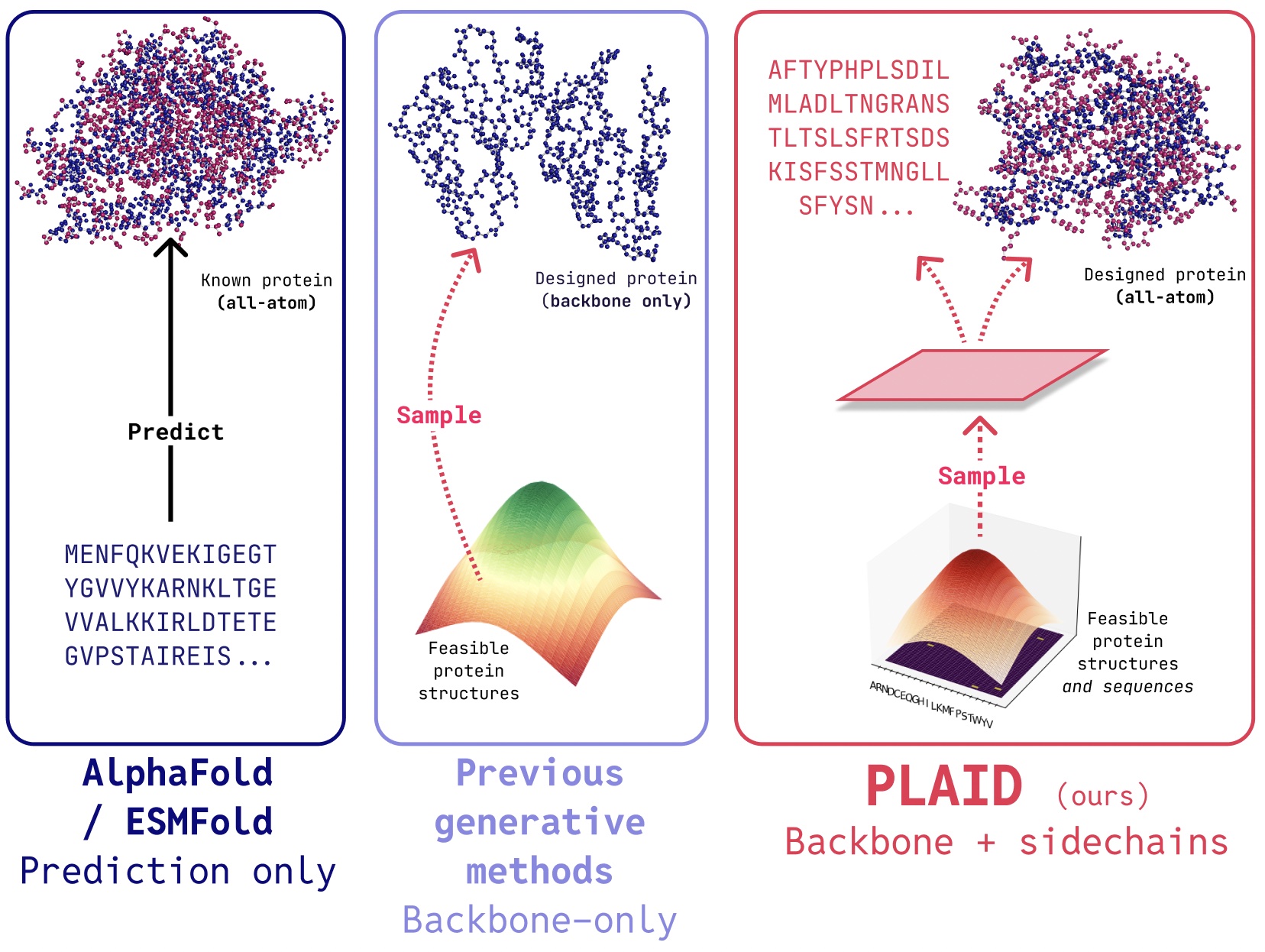
PLAID is a multimodal generative model that simultaneously generates protein 1D sequence and 3D structure, by learning the latent space of protein folding models. The awarding of the 2024 Nobel Prize to AlphaFold2 marks an important moment of recognition for the of AI role in biology. What comes next after protein folding?
In PLAID , we develop a method that learns to sample from the latent space of protein folding models to generate new proteins. It can accept compositional function and organism prompts , and can be trained on sequence databases , which are 2-4 orders of magnitude larger than structure databases. Unlike many previous protein structure generative models, PLAID addresses the multimodal co-generation problem setting: simultaneously generating both discrete sequence and continuous all-atom structural coordinates.
From structure prediction to real-world drug design Though recent works demonstrate promise for the ability of diffusion models to generate proteins, there still exist limitations of previous models that make them impractical for real-world applications, such as: All-atom generation : Many existing generative models only produce the backbone atoms. To produce the all-atom structure and place the sidechain atoms, we need to know the sequence. This creates a multimodal generation problem that requires simultaneous generation of discrete and continuous modalities.
For more details please read the original article at Berkeley BAIR.
Continue Learning
Comments
Comments appear only after moderation. Your email identifies your submission to the moderator and is never displayed here.
No approved comments yet.