RL without TD learning
A new reinforcement learning (RL) algorithm based on a divide and conquer approach is proposed as an alternative to traditional temporal difference (TD) learning methods. This new paradigm aims to address scalability issues in long-horizon tasks and offers a more flexible off-policy RL framework.
Key Takeaways
- The divide and conquer approach in RL allows for logarithmic reduction in Bellman recursions, enhancing scalability for long-horizon tasks.
- Off-policy RL is more flexible than on-policy RL, allowing the use of various data sources, including old experiences and demonstrations.
- Traditional TD learning suffers from error accumulation, making it less effective for long-horizon tasks.
- The divide and conquer method eliminates the need for tuning hyperparameters like 'n' in n-step TD learning, reducing variance and improving performance.
- Current off-policy RL algorithms struggle with scalability, highlighting the need for innovative solutions like divide and conquer.
Stats & Key Facts
- #As of 2025, no scalable off-policy RL algorithm has been established for complex tasks.
- #Q-learning is the most recognized off-policy RL algorithm.

Understanding Off-Policy RL
Off-policy reinforcement learning (RL) provides a broader framework for learning from diverse data sources.
- ›On-policy RL requires fresh data from the current policy, limiting its flexibility.
- ›Off-policy RL can utilize old data and human demonstrations, making it suitable for expensive data collection scenarios.
In reinforcement learning, there are two primary classes of algorithms: on-policy and off-policy. On-policy algorithms, such as PPO and GRPO, can only learn from data generated by the current policy, which often leads to inefficient use of available data. In contrast, off-policy methods allow the incorporation of a wider range of data, including past experiences and external sources, thus enhancing learning efficiency.
Challenges of Temporal Difference Learning
Temporal difference (TD) learning faces significant hurdles in long-horizon tasks.
- ›TD learning relies on bootstrapping, which can lead to error accumulation over time.
- ›The Bellman update rule used in TD learning can propagate errors through the value function.
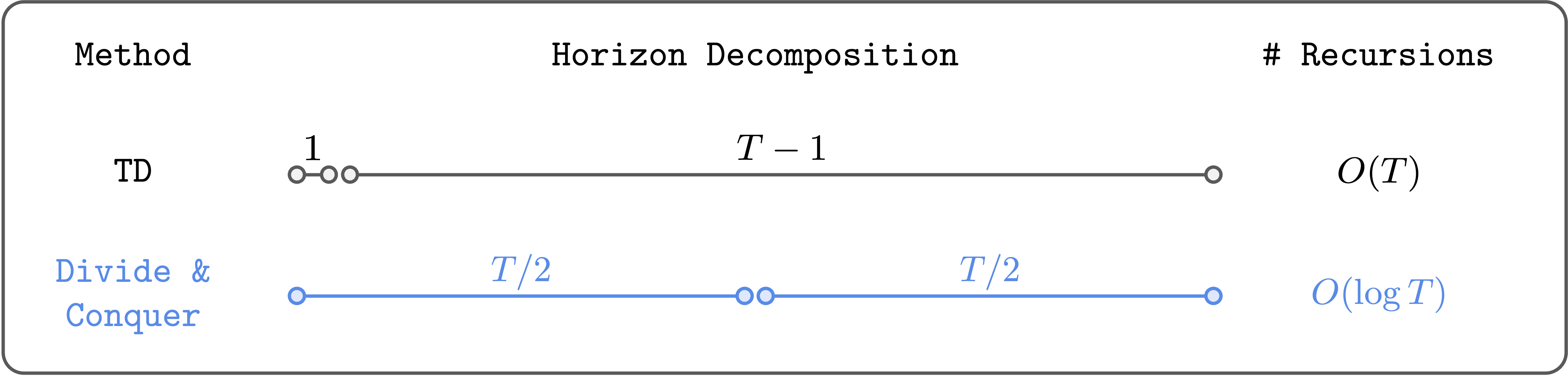
TD learning, particularly in the context of off-policy RL, employs a Bellman update rule that can cause errors to accumulate across the entire horizon. This issue arises because the value of the current state is updated based on the estimated value of future states, leading to a compounding effect of errors. As a result, TD learning struggles to maintain accuracy over long sequences of actions.
The Limitations of N-Step TD Learning
N-step TD learning attempts to mitigate TD learning's shortcomings but introduces its own challenges.
- ›N-step TD learning reduces the number of Bellman recursions but does not eliminate error accumulation.
- ›Increasing 'n' can lead to high variance and suboptimal performance.
N-step TD learning offers a compromise by using a combination of actual returns and bootstrapped values. While this approach reduces the frequency of Bellman recursions, it does not fundamentally address the underlying issue of error propagation. Additionally, as the parameter 'n' increases, the method becomes susceptible to high variance, complicating its application across different tasks.
Introducing the Divide and Conquer Paradigm
Divide and conquer presents a novel solution to the challenges faced by traditional RL methods.
- ›This approach divides trajectories into segments, allowing for logarithmic reduction in Bellman recursions.
- ›It avoids the pitfalls of high variance and the need for hyperparameter tuning.
The divide and conquer paradigm in value learning proposes a fresh approach to off-policy RL. By segmenting trajectories into equal parts, it enables a logarithmic reduction in the number of required Bellman recursions. This innovative method not only simplifies the learning process but also enhances the algorithm's robustness against issues like high variance, which are commonly associated with traditional TD learning methods.
Conclusion and Future Directions
The divide and conquer approach could reshape the landscape of off-policy RL.
- ›Further research is needed to validate the effectiveness of this paradigm in various domains.
- ›The flexibility of off-policy RL can significantly benefit applications in robotics and healthcare.
As the field of reinforcement learning continues to evolve, the divide and conquer approach offers promising avenues for future exploration. Its potential to streamline learning processes and improve scalability could lead to breakthroughs in complex applications such as robotics and healthcare, where data collection is often a significant challenge. Continued research will be essential to fully realize its capabilities and refine its implementation.
Frequently Asked Questions
What is the main advantage of off-policy RL?
Off-policy RL allows the use of diverse data sources, including past experiences and external demonstrations, enhancing learning efficiency.
How does divide and conquer improve RL scalability?
By reducing the number of Bellman recursions logarithmically, divide and conquer enhances scalability for long-horizon tasks.
What are the challenges associated with TD learning?
TD learning struggles with error accumulation due to bootstrapping, making it less effective for long sequences of actions.
Why is n-step TD learning not a complete solution?
While n-step TD learning reduces recursions, it does not eliminate error propagation and can introduce high variance.
What future research directions are suggested for divide and conquer in RL?
Further research is needed to validate its effectiveness across various domains, particularly in complex applications like robotics and healthcare.
The divide and conquer approach could redefine the future of reinforcement learning.
Continue Learning
Comments
Sign in to join the conversation