Scaling Up Reinforcement Learning for Traffic Smoothing: A 100-AV Highway Deployment
Berkeley BAIR researchers deployed 100 reinforcement learning-controlled cars into rush-hour highway traffic to smooth congestion and reduce fuel consumption. The work targets stop-and-go waves, the slowdowns and speedups that cause congestion and energy waste. The team trained controllers in fast, data-driven simulations built from real highway data collected on Interstate 24 near Nashville.
Key Takeaways
- Training Diffusion Models with Reinforcement Learning We deployed 100 reinforcement learning (RL)-controlled cars into rush-hour highway traffic to smooth congestion and reduce fuel consumption for everyone.
Our goal is to tackle "stop-and-go" waves , those frustrating slowdowns and speedups that usually have no clear cause but lead to congestion and significant energy waste.
- If you drive, you've surely experienced the frustration of stop-and-go waves, those seemingly inexplicable traffic slowdowns that appear out of nowhere and then suddenly clear up.
These waves are often caused by small fluctuations in our driving behavior that get amplified through the flow of traffic.
- These waves move backward through the traffic stream, leading to significant drops in energy efficiency due to frequent accelerations, accompanied by increased CO 2 emissions and accident risk.
- Fundamental diagram of traffic flow.
The number of cars on the road (density) affects how much traffic is moving forward (flow).
- To achieve this, we leveraged experimental data collected on Interstate 24 (I-24) near Nashville, Tennessee, and used it to build simulations where vehicles replay highway trajectories, creating unstable traffic that AVs driving behind them learn to smooth out.
Stats & Key Facts
- #Training Diffusion Models with Reinforcement Learning We deployed 100 reinforcement learning (RL)-controlled cars into rush-hour highway traffic to smooth congestion and reduce fuel consumption for everyone.
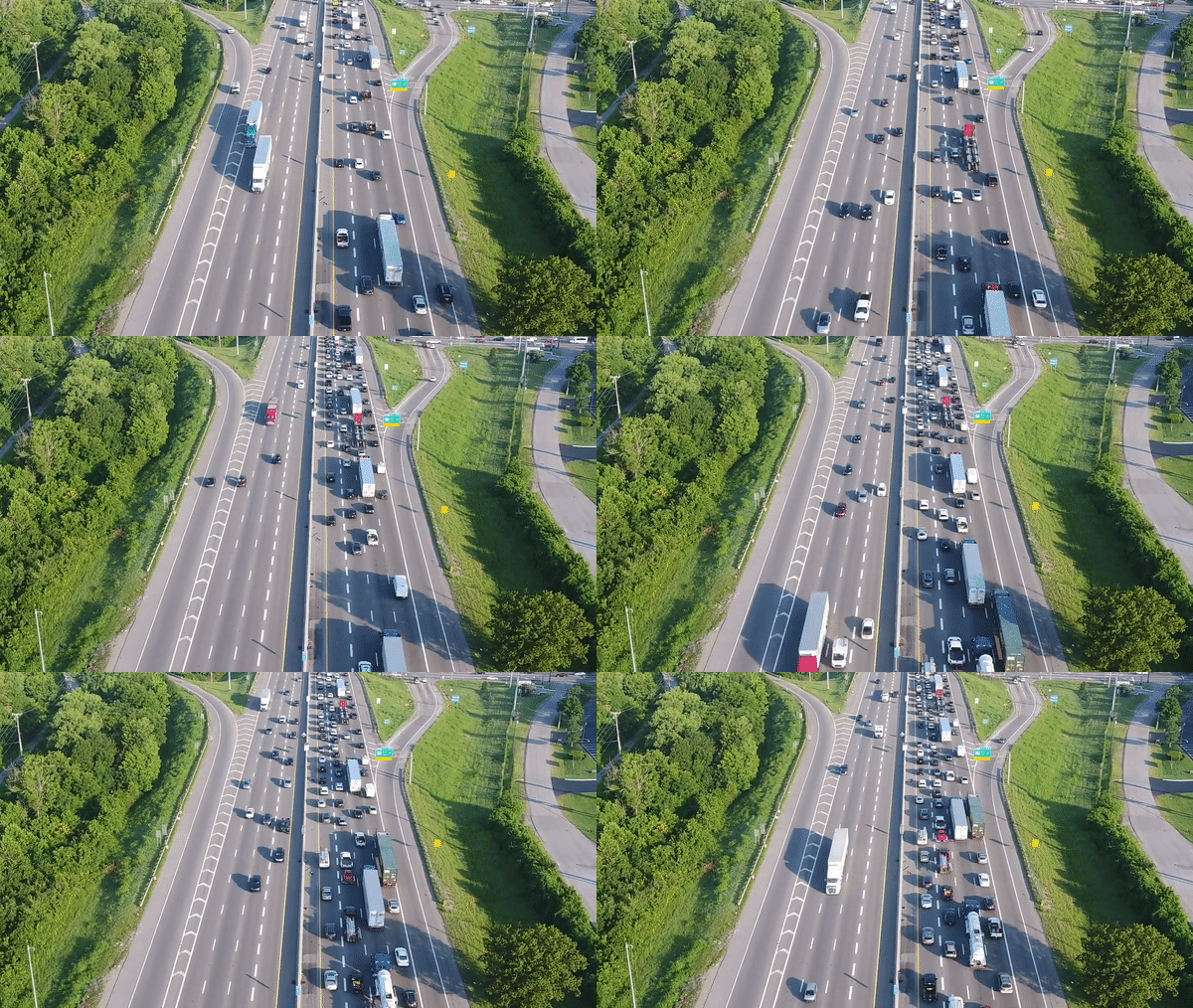
Training Diffusion Models with Reinforcement Learning We deployed 100 reinforcement learning (RL)-controlled cars into rush-hour highway traffic to smooth congestion and reduce fuel consumption for everyone. Our goal is to tackle "stop-and-go" waves , those frustrating slowdowns and speedups that usually have no clear cause but lead to congestion and significant energy waste. To train efficient flow-smoothing controllers, we built fast, data-driven simulations that RL agents interact with, learning to maximize energy efficiency while maintaining throughput and operating safely around human drivers.
Overall, a small proportion of well-controlled autonomous vehicles (AVs) is enough to significantly improve traffic flow and fuel efficiency for all drivers on the road. Moreover, the trained controllers are designed to be deployable on most modern vehicles, operating in a decentralized manner and relying on standard radar sensors. In our latest paper , we explore the challenges of deploying RL controllers on a large-scale, from simulation to the field, during this 100-car experiment.
The challenges of phantom jams A stop-and-go wave moving backwards through highway traffic. If you drive, you've surely experienced the frustration of stop-and-go waves, those seemingly inexplicable traffic slowdowns that appear out of nowhere and then suddenly clear up. These waves are often caused by small fluctuations in our driving behavior that get amplified through the flow of traffic.
For more details please read the original article at Berkeley BAIR.
Continue Learning
Comments
Comments appear only after moderation. Your email identifies your submission to the moderator and is never displayed here.
No approved comments yet.