Stop hand-tuning kernels: How Neuron Agentic Development accelerates AWS Trainium optimizations
AWS released Neuron Agentic Development, an open-source set of AI agents and skills that lets developers write, debug, and profile high-performance kernels for AWS Trainium and Inferentia chips using plain language instead of deep hardware expertise. The tools plug into agentic coding environments such as Claude Code and Kiro and walk a developer through the full kernel workflow, from authoring code to finding performance bottlenecks. The aim is to close the long-standing gap between what the hardware promises and what most teams reach in practice.
Key Takeaways
- Neuron Agentic Development is a free, open-source collection of AI agents and skills that automate kernel work on AWS Trainium and Inferentia chips, removing the need for hand-tuning by specialists.
- Five skills cover the full pipeline: writing NKI code from PyTorch, NumPy, or plain language, debugging errors, profiling execution, querying profiles, and navigating documentation.
- Five matching agents orchestrate multi-step tasks, including a debugging agent that runs up to 10 automated fix attempts before simplifying the problem.
- The tools run inside agentic coding environments such as Claude Code and Kiro, so a developer describes the goal in natural language and the agent produces and validates the kernel code.
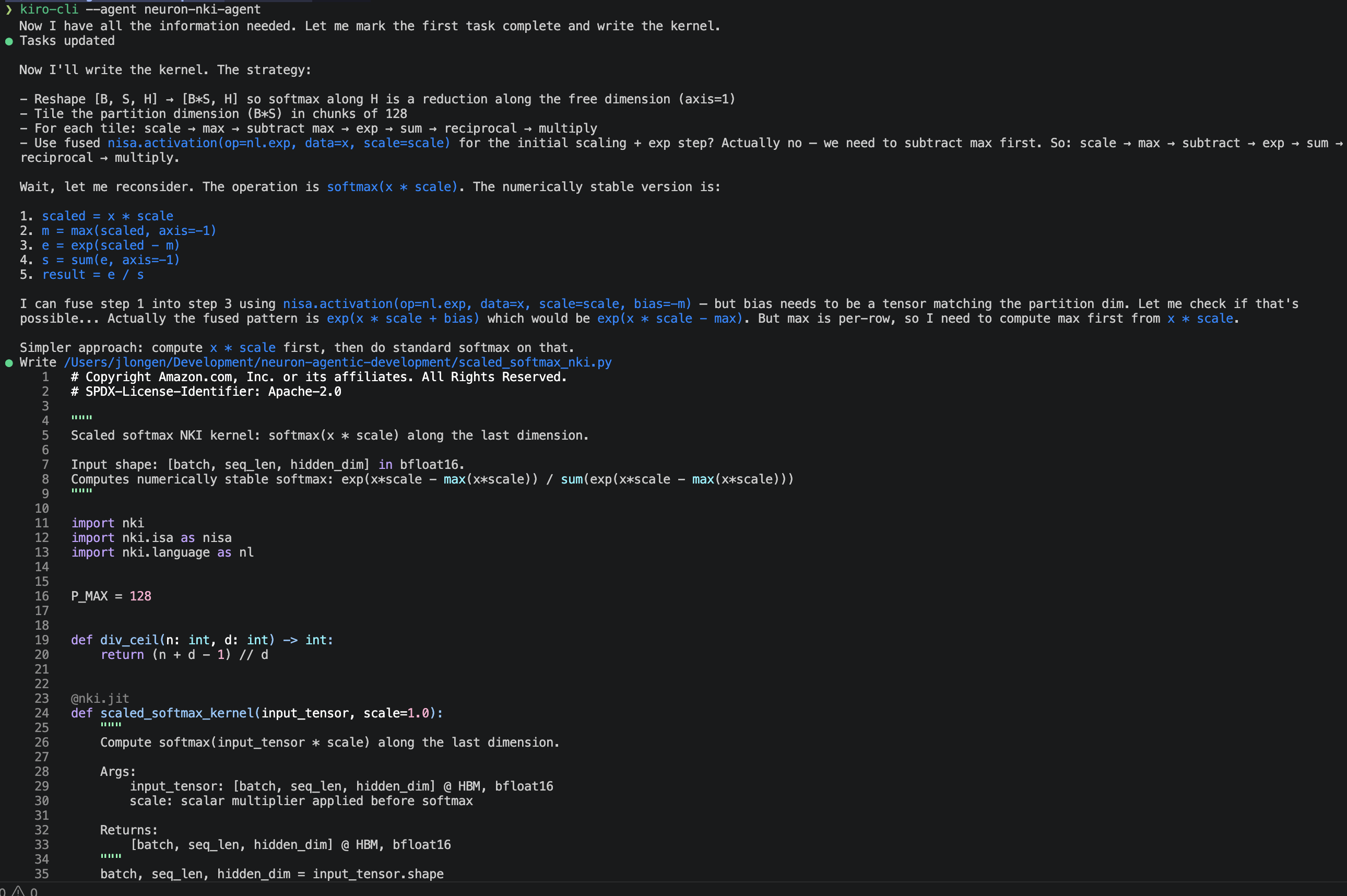
- Worked examples show the agents building a softmax kernel within tight numerical tolerances and spotting concrete inefficiencies in a SwiGLU kernel, such as redundant data reloads.
- AWS plans to extend the system toward autonomous kernel tuning against performance targets and broader model-level optimization.
Stats & Key Facts
- #5 specialized skills cover the kernel development pipeline from authoring to profiling.
- #5 AI agents orchestrate multi-step kernel workflows, including a unified entry-point agent.
- #28 NCC error codes are covered by the debugging skill for resolving compilation and execution failures.
- #10 maximum automated debugging iterations run before the agent simplifies the problem.
- #8x redundant input reloads were identified by the profiling agent in a SwiGLU kernel example.
- #0.000004 to 0.000061 maximum numerical error was recorded across the softmax kernel test cases, within tolerance.

What Neuron Agentic Development Does for Trainium and Inferentia Kernels
The release targets a narrow but costly bottleneck in AI infrastructure work.
A kernel is a small, hand-optimized program that tells a chip exactly how to run a math operation, such as the softmax step inside a model. Writing one well for AWS Trainium or Inferentia has required deep knowledge of the chip's architecture and slow manual profiling, so few teams reach the hardware's full speed.
Neuron Agentic Development packages that expertise into AI agents and skills. A developer describes what they want in plain English, and the agent writes the Neuron Kernel Interface (NKI) code, fixes errors, runs profiles, and points to the lines causing slowdowns. The goal is to let ordinary engineering teams, not only chip specialists, get strong performance from the hardware.
The Five Skills That Cover Writing, Debugging, and Profiling
Each skill maps to one stage of the kernel workflow.
- ›neuron-nki-writing translates PyTorch, NumPy, or natural language into NKI code while respecting hardware limits such as the 128 partition dimension.
- ›neuron-nki-debugging resolves compilation and execution errors and covers all 28 NCC error codes.
- ›neuron-nki-profiling captures execution profiles using the neuron-explorer tool and NEFF profile files.
- ›neuron-nki-profile-querying runs SQL queries against profile files to pinpoint bottlenecks.
- ›neuron-nki-docs acts as a documentation navigator for API signatures, error codes, and architecture guides.
The Five Agents and the 10-Iteration Debugging Loop
Agents tie the skills together into automated, multi-step work.
- ›neuron-nki-agent is the unified entry point that picks the right workflow automatically.
- ›neuron-nki-writing-agent focuses on authoring new kernels.
- ›neuron-nki-debugging-agent resolves errors on its own, running up to 10 fix attempts before simplifying the problem.
- ›neuron-nki-docs-agent handles documentation navigation.
- ›neuron-nki-profile-analysis-agent combines profiling and querying to find performance bottlenecks.
A Worked Softmax Kernel Built and Validated by the Agent
AWS shared a step-by-step example to show the agents in action.
For a softmax operation, the agent generated a three-pass kernel using hardware-accelerated exponential math and float32 accumulation for numerical stability. It then caught a tensor broadcast issue during debugging and applied a fix on its own.
The agent validated the result across four test shapes. The maximum numerical error ranged from 0.000004 to 0.000061, which sits within the expected tolerance for the bfloat16 precision used on these chips. The example shows the agent not only writing code but confirming it produces correct output.
Profiling a SwiGLU Kernel to Find Hidden Slowdowns
The profiling agent turned raw execution data into specific fixes.
In a second example, the agent profiled a SwiGLU kernel, a common building block in modern models. It found that the chip's Tensor Engine sat idle for long stretches and that data transfers were undersized, with input data reloaded 8 times more than needed.
More useful for a developer, the agent traced these problems to three specific lines in the NKI source code. Instead of a vague performance score, the team gets a clear list of what to change and where.
How Developers Run It Inside Claude Code and Kiro
The tools live inside agentic coding environments rather than as a separate product.
- ›The agents and skills run inside agentic IDEs such as Claude Code and Kiro, invoked through natural language.
- ›Skills install into a project's .claude/skills or .kiro/skills directory.
- ›Work runs on Trainium-based EC2 instances, with the example using a trn2.3xlarge instance and the AWS Neuron Deep Learning AMI.
- ›The code is open source and published in the aws-neuron/neuron-agentic-development GitHub repository.
- ›Supported Trainium generations include Trainium 1, Trainium 2, and Trainium 3, alongside Inferentia.
Why This Matters for Non-Technical Teams
The shift is about who gets access to chip-level speed.
For a business running AI workloads, the cost of training and serving models tracks closely with how efficiently code uses the hardware. Until now, squeezing out that efficiency on AWS custom chips meant hiring or renting scarce low-level engineers.
By moving that expertise into AI agents that work from plain-language requests, AWS lowers the skill barrier and the time involved. AWS has also signaled a roadmap toward agents that tune kernels automatically against a performance target and optimize whole models, not single operations, which would push the savings further.
Frequently Asked Questions
What is a kernel and why does it need tuning?
A kernel is a small program that tells a chip exactly how to carry out a math operation inside an AI model. Hand-tuning it for specific hardware like Trainium produces faster, cheaper execution, but it has traditionally required rare low-level expertise.
Do I need to be a hardware expert to use Neuron Agentic Development?
No. The point of the release is to let developers describe what they want in plain language while the AI agents handle the chip-specific NKI code, debugging, and profiling. The tools encode the expertise that used to require a specialist.
Where do these agents run?
They run inside agentic coding environments such as Claude Code and Kiro, and the actual kernel work happens on Trainium-based EC2 instances. The agents and skills are open source and available in the aws-neuron GitHub repository.
What chips does it support?
It supports AWS Trainium and AWS Inferentia, including Trainium generations 1 through 3. The kernels it produces use the Neuron Kernel Interface, AWS's programming layer for these chips.
How does the debugging work without human input?
The debugging agent reads compilation and execution errors, covering all 28 NCC error codes, and applies fixes on its own. It runs up to 10 automated attempts and then simplifies the problem if it has not resolved the issue.
Neuron Agentic Development moves specialized chip-tuning work into AI agents that respond to plain-language requests, giving more teams access to the speed AWS Trainium and Inferentia hardware was built to deliver. With a roadmap toward fully autonomous tuning, AWS is positioning agentic development as the standard way to optimize for its custom AI chips.
Continue Learning
Comments
Sign in to join the conversation