Subscription Pricing Models: The PM's Guide to 2026
This guide addresses product managers tasked with developing subscription pricing strategies, covering the frameworks, considerations, and cross-functional dynamics they need to navigate. It provides practical guidance for PMs who find themselves unexpectedly responsible for pricing decisions despite lacking formal training in the discipline.
Key Takeaways
- PMs are often assigned pricing responsibility without adequate training or preparation, requiring them to quickly learn frameworks and best practices.
- Successful subscription pricing requires collaboration across finance, sales, growth, and engineering teams with different priorities and constraints.
- Understanding pricing models, customer segmentation, and value perception is essential for making informed pricing decisions in 2026.
- PMs must balance competing objectives: revenue maximization, customer acquisition, retention, and organizational financial goals.
Why PMs Own Pricing (Whether They're Ready or Not)
Pricing responsibility often lands on PMs by default, creating a knowledge gap that can lead to suboptimal decisions.
- ›PMs are typically closest to product usage patterns, customer feedback, and feature adoption metrics that inform pricing decisions.
- ›Senior leadership expects PMs to take the first pass at pricing strategy because of their holistic product understanding.
- ›Unlike specialized functions, pricing is often treated as an ad-hoc responsibility rather than a dedicated domain.
- ›This creates pressure to rapidly acquire pricing expertise while managing other core PM responsibilities.
Key Stakeholders and Their Competing Priorities
Pricing decisions involve multiple teams with fundamentally different success metrics and constraints.
- ›Finance cares about revenue targets, churn prediction, lifetime value models, and margin requirements.
- ›Sales focuses on deal velocity, win rates against competitors, and removing price as a barrier to closing deals.
- ›Growth teams prioritize customer acquisition cost efficiency, conversion rates, and funnel optimization.
- ›Engineering raises technical debt and scalability concerns that affect pricing structure feasibility.
These stakeholders rarely agree on pricing priorities. Finance wants to maximize revenue per customer; sales wants to maximize conversion; growth wants to minimize friction; engineering wants to minimize operational complexity. A PM's job is to synthesize these competing interests into a coherent pricing strategy that advances the business without sacrificing long-term health.
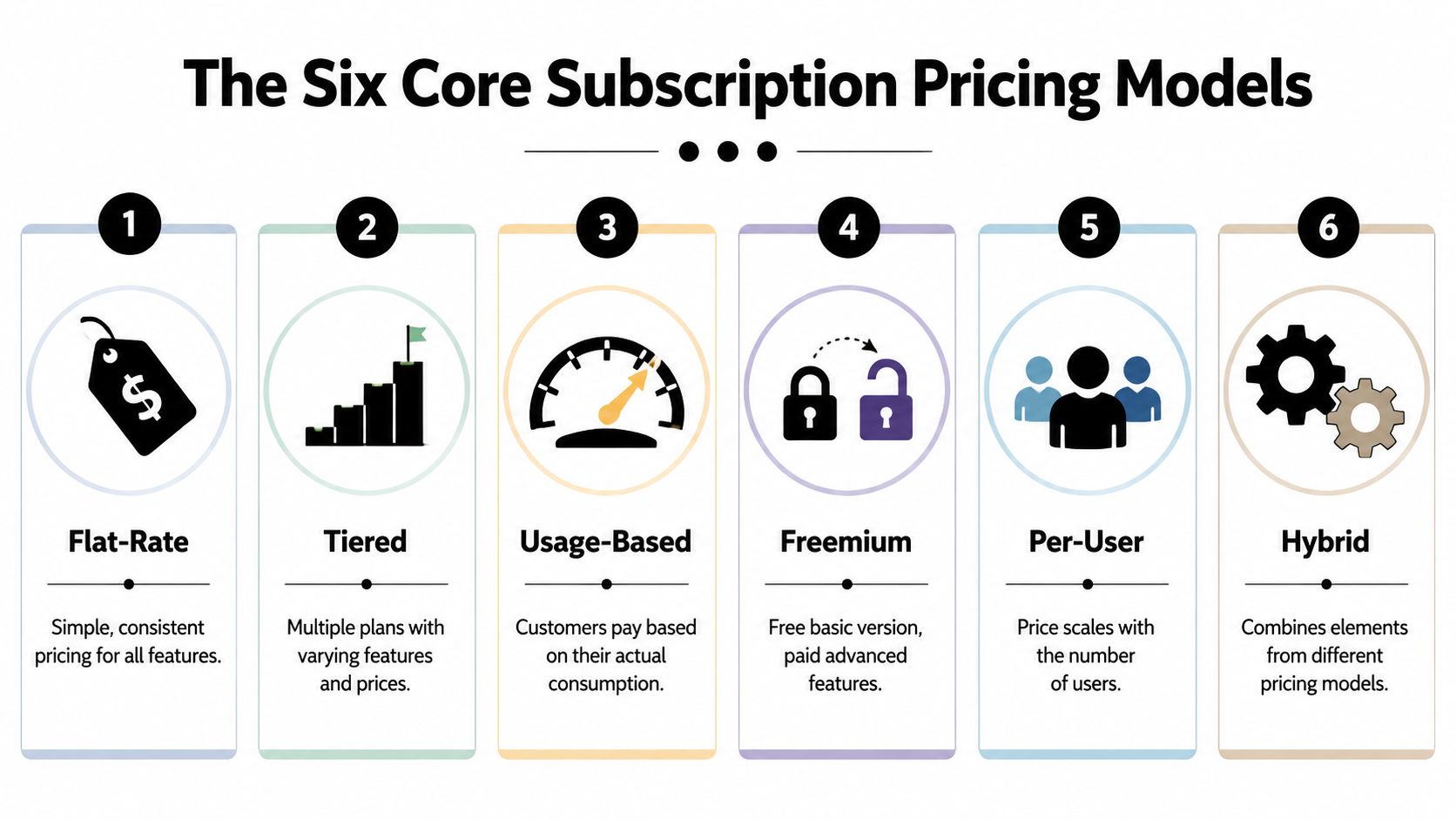
Core Subscription Pricing Models for 2026
Modern subscription businesses typically employ one or more of these foundational pricing approaches.
- ›Flat-rate pricing offers simplicity and predictability but may leave money on the table from power users.
- ›Tiered pricing (basic, pro, enterprise) segments customers by willingness to pay and feature access, balancing revenue and accessibility.
- ›Per-unit pricing charges based on usage (seats, API calls, storage) and aligns costs with customer value but creates unpredictability.
- ›Hybrid models combine fixed and variable components to capture base revenue while rewarding high-value usage patterns.
- ›Value-based pricing anchors pricing to customer outcome or saving rather than costs or usage, requiring strong understanding of ROI.
Critical Pricing Considerations and Trade-offs
PMs must navigate multiple strategic decisions that significantly impact business outcomes.
- ›Customer segmentation determines whether a single pricing model serves all users or if different tiers serve different personas with different needs.
- ›Annual versus monthly billing affects cash flow, churn visibility, and customer commitment levels.
- ›Free tier or freemium strategy influences acquisition volume and conversion rates but may cannibalize paid users.
- ›Expansion revenue opportunities come from upsells, add-ons, and overage charges, extending customer lifetime value beyond initial purchase.
- ›Competitive positioning requires understanding competitor pricing while articulating unique value that justifies price premiums.
Each decision involves trade-offs. A lower price accelerates acquisition but reduces per-customer revenue. A steep free-to-paid step increases conversion but shrinks your addressable market. Annual billing improves cash flow and retention but creates large price barriers. PMs must quantify the impact of each choice using available data and customer research to optimize for both short-term growth and long-term business health.
Data-Driven Pricing Validation and Testing
Before locking pricing into the product, PMs should validate assumptions through experimentation and customer research.
- ›Price sensitivity analysis surveys reveal customer willingness to pay across different segments and use cases.
- ›A/B testing different price points, packaging, or positioning measures impact on conversion rates and revenue.
- ›Cohort analysis tracks how pricing changes affect retention, expansion, and churn for different customer segments.
- ›Competitor benchmarking and win/loss analysis inform pricing competitiveness and identify feature parity gaps.
Many pricing decisions are made with incomplete information, leading to regret. Building a testing mindset helps reduce this risk. Start with your best hypothesis, validate it with 10-20 target customers, run A/B tests on landing pages or sign-up flows, measure impact on key metrics, and iterate. This approach transforms pricing from a one-time decision into an ongoing optimization lever.
Communicating Pricing to Finance, Sales, and Growth
A solid pricing strategy means nothing if cross-functional teams don't understand or support it.
- ›Finance needs clear modeling of revenue projections, churn assumptions, expansion rates, and sensitivity analysis across scenarios.
- ›Sales requires positioning talking points, competitive comparisons, discount guardrails, and escalation procedures for special pricing requests.
- ›Growth teams need funnel-level impact forecasts: how pricing changes affect conversion, activation, and acquisition efficiency.
- ›Engineering needs clarity on implementation scope, technical requirements, and ongoing operational support for the pricing model.
Document your pricing rationale in a one-page executive summary that explains the model, target segments, competitive positioning, and expected business impact. Share detailed models and assumptions separately. Hold structured review sessions with each stakeholder to surface concerns early and build buy-in. This transparency reduces friction during rollout and ensures alignment on success metrics.
Common Pitfalls and How to Avoid Them
Many PMs repeat predictable mistakes when designing subscription pricing.
- ›Pricing too low or too high based on intuition rather than customer research and testing leaves revenue on the table or throttles growth unnecessarily.
- ›Overcomplicating pricing tiers confuses customers and increases sales friction; simplicity often outperforms feature-rich complexity.
- ›Ignoring churn and expansion dynamics focuses on initial revenue while missing the compounding impact of retention on lifetime value.
- ›Failing to communicate pricing changes or rationale to customers and teams creates perception of unfairness and internal friction.
- ›Neglecting to revisit pricing quarterly or annually allows it to drift away from market conditions and customer value delivery.
Frequently Asked Questions
Should I charge per-user or per-usage for my subscription product?
Per-user pricing is simpler to understand and predict, making it better for B2B tools with clear user counts. Per-usage pricing aligns better with customer value and captures upside from growing customers, but creates unpredictability that some buyers dislike. Hybrid models often work best: charge per-user up to a threshold, then per-unit beyond it.
How often should I adjust pricing?
Review pricing quarterly to stay aligned with market conditions, competitive positioning, and unit economics. Major pricing changes (new tiers, model shifts) should happen annually or less frequently to avoid customer confusion and churn. Use smaller levers like discounts or add-on pricing for more frequent optimization.
What metrics should I track to measure pricing success?
Monitor monthly recurring revenue (MRR), customer acquisition cost (CAC), churn rate, expansion rate, net retention rate, and win rate versus competitors. Compare these metrics before and after pricing changes to quantify impact. Cohort analysis helps isolate the effect of pricing from other variables.
How do I get sales and finance to agree on pricing?
Align them around shared metrics: revenue targets, customer acquisition efficiency, and retention rates. Show sales how pricing affects deal velocity and win rates. Show finance how expansion revenue and retention amplify the impact of pricing changes. Facilitate agreement on trade-offs explicitly rather than letting them fester as unspoken disagreements.
Pricing is both an art and a discipline; invest in learning the frameworks and maintain an experimental mindset as you navigate this critical PM responsibility.
Continue Learning
Comments
Sign in to join the conversation