Unlocking AI flexibility in Europe: A guide to cross-region inference for EU data processing and model access
Amazon Web Services published a guide explaining how cross-Region Inference (CRIS) on Amazon Bedrock lets European customers run generative AI workloads with more capacity while keeping data inside the European Union. The feature automatically routes model requests across several EU AWS Regions, such as Frankfurt, Ireland, Paris, and Stockholm, so a request starting in Europe is only ever processed in Europe. Traffic stays on the encrypted AWS network and never crosses the public internet, which helps businesses meet data residency and GDPR obligations. For some models the EU cross-Region option also costs less than calling a single Region directly.
Key Takeaways
- Cross-Region Inference (CRIS) on Amazon Bedrock spreads AI requests across multiple AWS data center Regions so a single Region running short on capacity does not slow or block your application.
- The EU version of CRIS restricts routing so that any request originating in Europe is processed only in European AWS Regions, supporting data residency and GDPR compliance.
- All routed traffic stays encrypted on the private AWS network and does not travel over the public internet.
- To use it, developers swap a plain model ID for a CRIS profile ID such as eu.amazon.nova-2-lite-v1:0 in their code; no infrastructure changes are required.
- Several models cost less through EU cross-Region inference than through direct single-Region calls, and there are no extra routing charges.
- CloudTrail logs record both the source and destination Region for each request, giving businesses an audit trail of where data was processed.
Stats & Key Facts
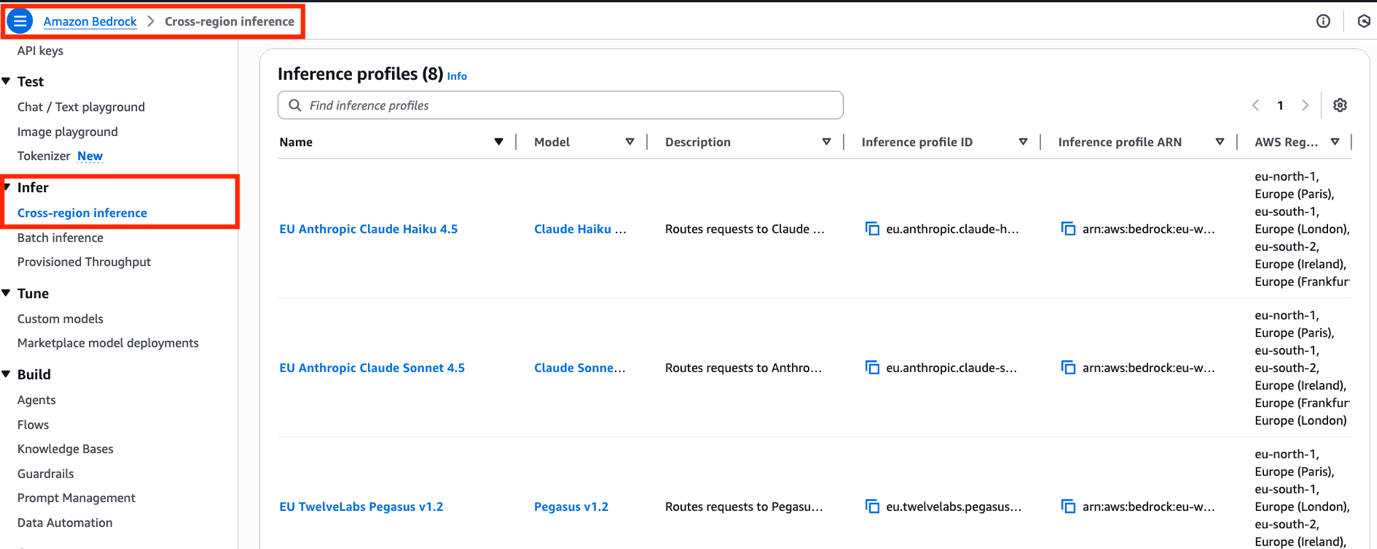
- #EU cross-Region inference profiles cover at least four AWS Regions inside the European Union: Frankfurt, Ireland, Paris, and Stockholm.
- #London (eu-west-2), Milan (eu-south-1), and Frankfurt (eu-central-1) are named as example EU Regions in the routing pool.
- #Charges are based solely on the source Region of the request, meaning zero additional routing cost for cross-Region traffic.
- #Several models are offered at a discounted price through EU global CRIS compared with direct in-Region invocation.
- #Amazon Bedrock is in scope for the CISPE Data Protection Code of Conduct, a third-party verification framework for GDPR compliance.

What cross-Region Inference does on Amazon Bedrock
CRIS is a routing layer built into Amazon Bedrock, the AWS service for running foundation models.
The latest generative AI models and the specialized chips that run them are in high global demand, so a single AWS Region sometimes lacks the spare capacity to handle a spike in requests. Cross-Region Inference solves this by automatically sending a request to another AWS Region that has room, all within a predefined geographic boundary.
The behavior is controlled by an inference profile, a setting that defines which Regions are allowed to receive routed requests. The application keeps talking to one endpoint, and Bedrock decides behind the scenes which Region actually processes each call based on available capacity.
How EU routing keeps data inside Europe
The EU profile adds a hard geographic limit on where requests travel.
- ›A request that starts in an EU Region is only ever routed to other AWS Regions inside the European Union.
- ›Named EU Regions in the pool include Frankfurt, Ireland, Paris, Stockholm, London, and Milan.
- ›A request originating outside the EU that uses the EU profile is optimized only across the source Region and EU Regions.
- ›This design supports data residency rules that require European data to stay on European soil.
Security and GDPR compliance for European businesses
Keeping data in Europe is paired with network and certification safeguards.
All cross-Region traffic stays on the AWS private network and never touches the public internet, and the data is encrypted in transit. For a non-technical owner, this means the routing happens inside Amazon's own secured pipes rather than over the open web.
Amazon Bedrock falls in scope for the CISPE Data Protection Code of Conduct, an independently verified framework that helps demonstrate alignment with the EU General Data Protection Regulation. Together these points give compliance and legal teams a clearer story about where and how European data is handled.
Capacity, throughput, and resilience benefits
The main practical payoff is steadier performance under load.
- ›Spreading requests across several Regions increases resilience when one Region hits a capacity shortage during peak hours.
- ›Geographic cross-Region inference delivers higher throughput than calling a single Region on its own.
- ›Destination Regions are picked automatically to match available model capacity, with the source Region prioritized to keep latency low.
- ›Applications stay responsive without the customer manually managing which Region serves each request.
Cost and how it differs from single-Region calls
Cross-Region routing is positioned as a cost-neutral or cost-saving option.
Pricing is tied to the source Region of the request, so moving work to another Region adds no separate routing fee. The customer pays the same rate regardless of which EU Region ends up doing the processing.
On top of that, several models are offered at a discounted price through EU global CRIS compared with invoking them directly in a single Region. For high-volume workloads, choosing the cross-Region profile can lower the per-request cost while improving reliability.
How developers turn it on and audit it
Enabling CRIS is a small code change, not a migration.
- ›In code, developers replace the plain model ID with a CRIS profile ID, for example eu.amazon.nova-2-lite-v1:0 for an Amazon Nova model.
- ›AWS provides Boto3 (Python SDK) examples that show the swap when invoking a model.
- ›CloudTrail logs capture each API call with the source and destination Region, plus an inferenceRegion field showing where processing actually occurred.
- ›Those logs stay in the source Region only, giving a single, consistent place to audit activity.
Frequently Asked Questions
What is cross-Region Inference on Amazon Bedrock?
It is a feature that automatically routes a generative AI request to whichever AWS Region within an allowed geography has available capacity. The application sees one endpoint while Bedrock balances the work across Regions behind the scenes.
Does using EU cross-Region inference keep my data in Europe?
Yes. With the EU inference profile, a request that starts in a European AWS Region is only routed to other AWS Regions inside the European Union, such as Frankfurt, Ireland, Paris, or Stockholm. This supports data residency and GDPR requirements.
Does cross-Region routing cost extra?
No. Charges are based on the source Region of the request, so there is no additional routing fee. Several models are also available at a discounted price through EU cross-Region inference compared with direct single-Region calls.
What does a business have to change to use it?
Very little on the infrastructure side. A developer swaps the plain model ID in the code for a CRIS profile ID, such as eu.amazon.nova-2-lite-v1:0, and Bedrock handles the routing.
How can a company prove where its data was processed?
AWS CloudTrail logs record the source and destination Region for each call, plus an inferenceRegion field that shows where the request was actually processed, providing an audit trail for compliance teams.
Cross-Region Inference gives European businesses a way to scale generative AI on Amazon Bedrock without trading away data residency or compliance. The result is steadier capacity, optional cost savings, and an audit trail that keeps EU data inside the EU.
Continue Learning
Comments
Sign in to join the conversation