User Research Methodologies: PM's Guide to Actionable
Product teams often rush into building features based on anecdotal requests without validating whether the problem is real or if the proposed solution is correct. This guide explores user research methodologies that help product managers make data-driven decisions and avoid costly mistakes driven by pressure from stakeholders and sales input.
Key Takeaways
- Stakeholder urgency and sales requests alone are insufficient signals for feature prioritization without underlying user research.
- User research methodologies provide evidence to validate whether a problem is real and whether your proposed solution addresses it effectively.
- Multiple research approaches exist-from interviews and surveys to usability testing-each suited to different questions and decision timelines.
- Establishing a research discipline early prevents wasted engineering effort and misaligned product investments.
- Documentation of research findings creates institutional knowledge and reduces reliance on gut feelings in product decisions.
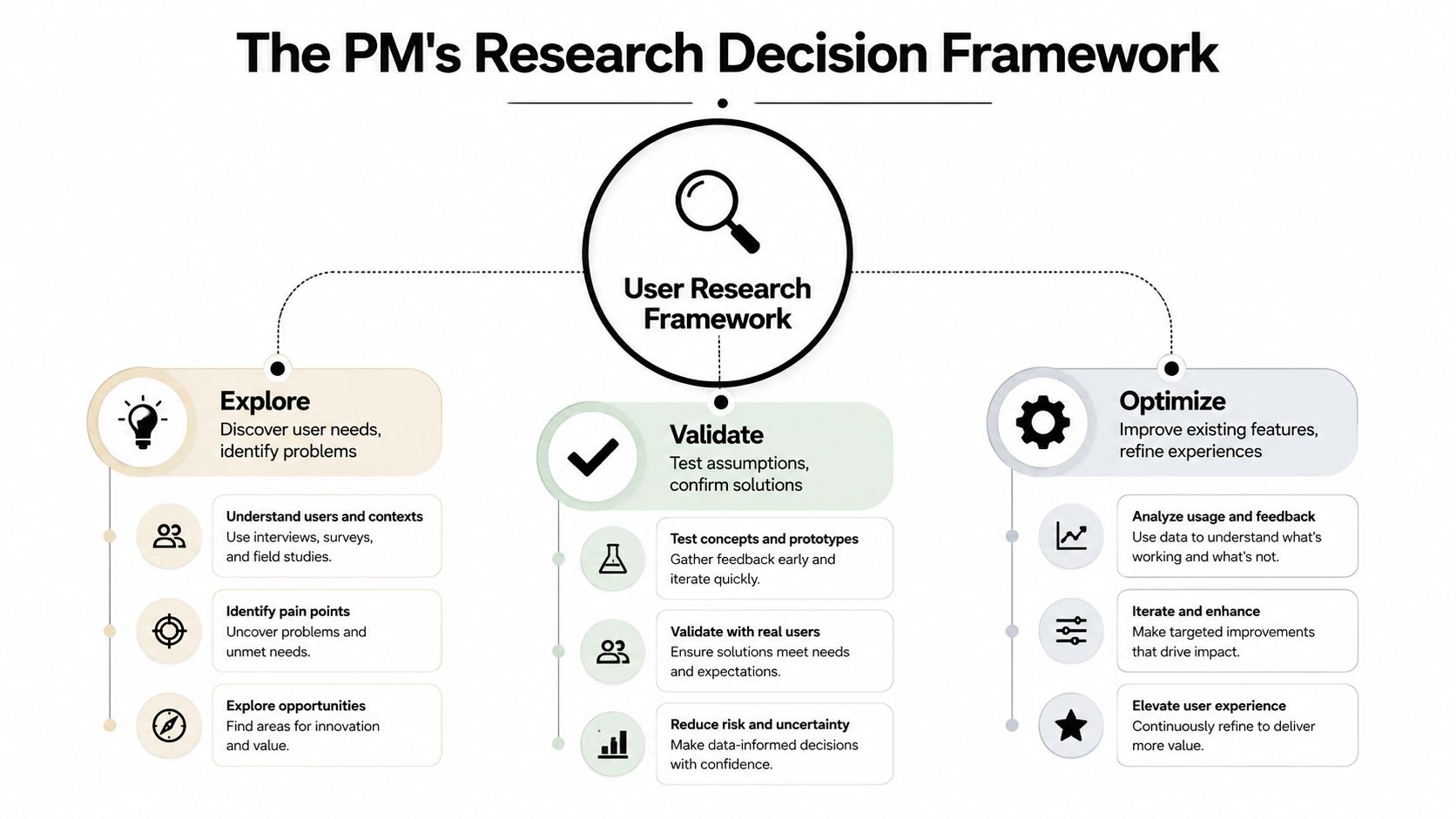
The Problem: Decision-Making Without Evidence
Many product organizations face a common challenge where urgency drives decisions rather than data.
- ›Executives, sales teams, and stakeholders apply pressure to build features based on limited anecdotal feedback.
- ›Multiple departments operate on different timelines-design moves fast, engineering needs sprint commitments, sales wants quick wins-creating misalignment.
- ›Without research, teams cannot distinguish between a single customer's nice-to-have request and a widespread user pain point.
- ›Building on assumptions wastes engineering resources and often results in features that solve the wrong problem or solve it inadequately.
The scenario described-VP requesting a feature Monday, design mocking it up Tuesday, engineering needing a decision Thursday-represents a common pattern where speed overrides validation. Sales mentioning three prospects asked for something can feel like evidence, but it reveals nothing about whether those prospects represent a broader market need, whether they would actually use the feature if built, or whether alternative solutions might better serve them.
This pressure-driven approach creates organizational debt. Teams invest weeks or months building features that ultimately see minimal adoption. Users may not engage with the solution because it missed the core pain point, solved only part of the problem, or introduced unnecessary complexity. The cost isn't just wasted engineering time-it's also opportunity cost, as capacity that could have addressed higher-impact problems gets consumed.
Why User Research Matters for Product Decisions
User research provides the foundation for confident decision-making and resource allocation.
- ›Research answers three critical questions: Is the problem real? Does it affect enough users? Will the proposed solution actually solve it?
- ›Early-stage research prevents costly mistakes by validating assumptions before significant engineering investment.
- ›Research creates a shared understanding across teams-executives, design, engineering, and sales all align on the same evidence.
- ›Documented research findings reduce organizational dependency on individual voices or opinions and establish objective criteria for prioritization.
User research serves as the connective tissue between business intuition and validated product decisions. When a PM can show research data demonstrating that 40 percent of target users struggle with a specific workflow, the conversation shifts from 'we have a cool idea' to 'here is evidence that solving this problem matters.' This distinction changes how teams approach the work and who gets a voice in decision-making.
Different types of research answer different questions. Exploratory research helps you understand whether a problem exists and how widespread it is. Evaluative research tests whether a proposed solution actually addresses the problem. Validation research confirms that users would adopt and benefit from the solution at scale. By choosing the right methodology for your current question, you gather the right evidence without over-investing in unnecessary research.
Core User Research Methodologies
Product managers can draw from multiple research approaches, each with distinct advantages and timelines.
- ›User interviews (1-2 weeks): Structured or semi-structured conversations with 5-15 users reveal deep context, motivations, and unmet needs; qualitative but time-intensive.
- ›Surveys (1-2 weeks): Quantitative data from 50+ respondents validates whether patterns from interviews hold across a broader population; fast feedback but limited depth.
- ›Usability testing (2-3 weeks): Observing users interact with a prototype or mockup reveals whether proposed solutions are intuitive and effective; catches UX problems early.
- ›Analytics review (1 week): Analyzing existing user behavior data identifies where friction exists and which features see adoption; requires no participant recruitment.
- ›Contextual inquiry (2-4 weeks): Observing users in their natural environment shows how they work and what tools or workarounds they currently use.
User interviews remain one of the most valuable research methods for product teams. A well-structured 30-minute conversation with a target user can surface pain points, mental models, and workarounds that no amount of survey data captures. The key is asking open-ended questions and listening for the story behind the behavior. When a user describes their current process in detail, PMs often discover unexpected complexity or competing priorities that should influence the proposed solution.
Surveys provide statistical confidence that patterns from interviews apply beyond a small sample. If you interview five users and three mention struggling with reporting, a survey of 100 users lets you confirm whether that struggle affects 50 percent or only 5 percent of your audience. This quantitative validation is essential for prioritization, especially when competing against other feature ideas.
Usability testing with prototypes or mockups catches fundamental design problems before engineering builds. Watching a user attempt to use your proposed solution often reveals misunderstandings about how they will interact with it. This approach is particularly valuable when the proposed solution is novel or when you're uncertain about specific interaction patterns.
Rapid Research for Time-Constrained Environments
Not every feature decision requires weeks of research, but even fast-moving teams can validate assumptions efficiently.
- ›Lean research combines quick interviews (3-5 users) with analytics review to validate or invalidate an assumption within days.
- ›Landing page tests or concept validation with 50-100 users show whether a solution concept resonates before design commitment.
- ›Quick polls or Slack surveys of existing user communities provide rapid quantitative signals when you need directional data.
- ›Existing customer feedback, support tickets, and help documentation analysis often surface opportunities without additional recruitment.
When stakeholders demand answers Thursday, research isn't off the table-it's just more focused. Instead of comprehensive discovery, ask: What is the one assumption that, if wrong, would change our decision? Design research to test that assumption quickly. If the assumption is whether the problem is real, conduct 3-5 rapid interviews with target users focused on that specific question. If it's whether a concept resonates, test the concept with a landing page and measure click-through or signup rates.
Many product teams overlook the research already available within their organization. Customer support tickets often mention pain points and requests explicitly. Feature usage analytics show which tools users rely on and which they ignore. Existing NPS comments and feedback contain unstructured but valuable insights. A PM who spends two hours synthesizing this existing data often finds sufficient evidence to make a confident decision, or at least to identify which assumption requires new research.
Structuring Research to Influence Decisions
Well-designed research is only useful if it actually influences how teams prioritize and build.
- ›Frame research questions around decisions, not exploration-clarity about what you're deciding makes research focused and actionable.
- ›Document research findings in accessible formats (one-page summaries, recorded highlights, persona sketches) that stakeholders will actually consume.
- ›Establish research findings before soliciting opinions from stakeholders or sales; present data first, discussion second.
- ›Create a shared research repository so teams reference findings rather than relying on anecdotal memory of customer conversations.
Research quality depends partly on methodology and partly on how clearly the PM frames the research question. 'What do users need?' is too broad; research answering that question produces interesting insights but may not drive a specific decision. 'Do users need automated reporting, manual export templates, or scheduled email delivery of reports?' is specific. Research answering that question directly informs whether to build feature A, B, or C.
Presentation of research matters as much as rigor. A 40-page research report gathering dust on a shared drive influences no decisions. A one-page summary with three key findings and three representative quotes influences everyone. Include direct quotes from users whenever possible-they carry more persuasive weight than a PM's summary. Consider video clips of users describing their problems or attempting to use prototypes; watching a user struggle is more convincing than hearing about it.
Building a Research Practice Into Product Workflows
Establishing research as a standard part of decision-making requires cultural and procedural changes.
- ›Allocate 10-15 percent of sprint capacity to research activities rather than treating research as a side activity.
- ›Establish research review gates-no feature moves to engineering without documented research supporting the decision.
- ›Rotate research responsibilities so multiple team members build research skills rather than centralizing in a single researcher role.
- ›Create templates for research plans and findings documentation to reduce overhead and increase consistency.
Organizations that successfully embed research into product workflows treat it as non-negotiable. When leadership enforces that decisions above a certain threshold require research evidence, behavior changes. Sales learns to provide research documentation when requesting features. Executives understand why a feature that 'seemed obvious' requires validation. Engineers appreciate that time spent understanding the problem prevents rework.
This shift doesn't require massive investment. A PM spending 20 hours interviewing customers is more valuable than the same PM in a meeting defending why they haven't started building. A design team that tests a concept with users before high-fidelity mocking prevents wasted design cycles. The goal is reorienting time and effort toward activities that generate evidence rather than consuming time in meetings and emails.
Moving Forward: Next Steps for Your Team
Implementing research practices doesn't require revolution-it requires intention.
- ›Start with one decision on this week's roadmap and conduct rapid research to inform it-make it tangible.
- ›Identify which research methodology best answers your current core question about the feature under discussion.
- ›Document the research you already have-existing feedback, support tickets, analytics-and synthesize findings.
- ›Share research findings with stakeholders and sales, establishing a pattern that decisions reference evidence rather than intuition.
The scenario described-VP requesting a feature, multiple departments exerting pressure-is solvable. Research provides the grounding needed to answer the core question: Should we actually build this? By implementing even lightweight research methods, product teams move away from pressure-driven decisions toward evidence-based prioritization. The organization benefits through fewer wasted features, faster decision-making once evidence is gathered, and stronger alignment between what teams build and what users actually need.
Frequently Asked Questions
How can we conduct research when we only have three days before engineering needs a decision?
Conduct lean research focusing on your core assumption. Interview 3-5 target users specifically about that assumption, review existing customer feedback and support tickets for related insights, or run a quick landing page test with your target audience. This targeted approach can provide directional confidence within days without requiring comprehensive research.
What is the difference between exploratory and evaluative research?
Exploratory research investigates whether a problem exists and how widespread it is-it answers 'What do users struggle with?' Evaluative research tests whether a proposed solution actually solves the problem-it answers 'Does this solution work?' Use exploratory research early to validate problem assumptions, and evaluative research when you have a specific solution to test.
How many users do I need to interview to have confident research findings?
For qualitative research like interviews, 5-10 users often reveals 80 percent of major patterns and pain points. Diminishing returns set in after 10-15 interviews unless you're studying diverse user segments. For quantitative validation, you need at least 30-50 survey respondents to claim statistical confidence, though sample size depends on your population size and desired confidence level.
How do I convince my team to invest time in research when we are moving fast?
Frame research as time-saving rather than time-consuming. A two-week research investment that prevents building the wrong feature saves months of wasted engineering effort. Show the cost of past features that saw low adoption due to unclear problem validation, and establish that research gates are non-negotiable for decisions above a certain threshold.
What should I do with research findings after the initial decision is made?
Document findings in an accessible format and store them in a shared repository that the team references throughout the feature development cycle. Share key insights with stakeholders and sales. Use findings to inform design direction, success metrics, and rollout strategy. This ensures research influences the entire development process, not just the initial go/no-go decision.
By establishing user research as a standard part of product decision-making, teams move from pressure-driven feature requests to evidence-based prioritization that delivers real user value.
Continue Learning
Comments
Sign in to join the conversation