Veeam's big pivot on display at VeeamON 2026
At VeeamON 2026 in New York City, Veeam Software Group used the event to mark its shift from a backup company to a data and AI trust platform for what it calls the agentic era. CEO Anand Eswaran and President of Products and Technology Rehan Jalil argued that the next decade of enterprise infrastructure will be defined by how confidently companies can let AI act on their data. The centerpiece is the new Veeam DataAI Command Platform, built in part on the December 2025 acquisition of Securiti.
Key Takeaways
- Veeam is repositioning from a backup vendor to a data and AI trust platform for the agentic era.
- The company framed its history as three eras: assume restore, assume breach, and now assume autonomy.
- Veeam research indicates autonomous AI agents outnumber human employees by 82 to 1 on average.
- The new DataAI Command Platform combines Veeam's recovery capabilities with the acquired Securiti technology.
- The platform spans production and backup systems to show what AI agents can access, what they did, and how to undo it.
Stats & Key Facts
- #More than 550,000 customers in more than 150 countries
- #82 of the Fortune 500 are customers
- #More than $2 billion in annual recurring revenue
- #AI agents outnumber human employees 82 to 1 on average
- #More than 250,000 non-human identities per organization
- #97% of agents have excessive privileges
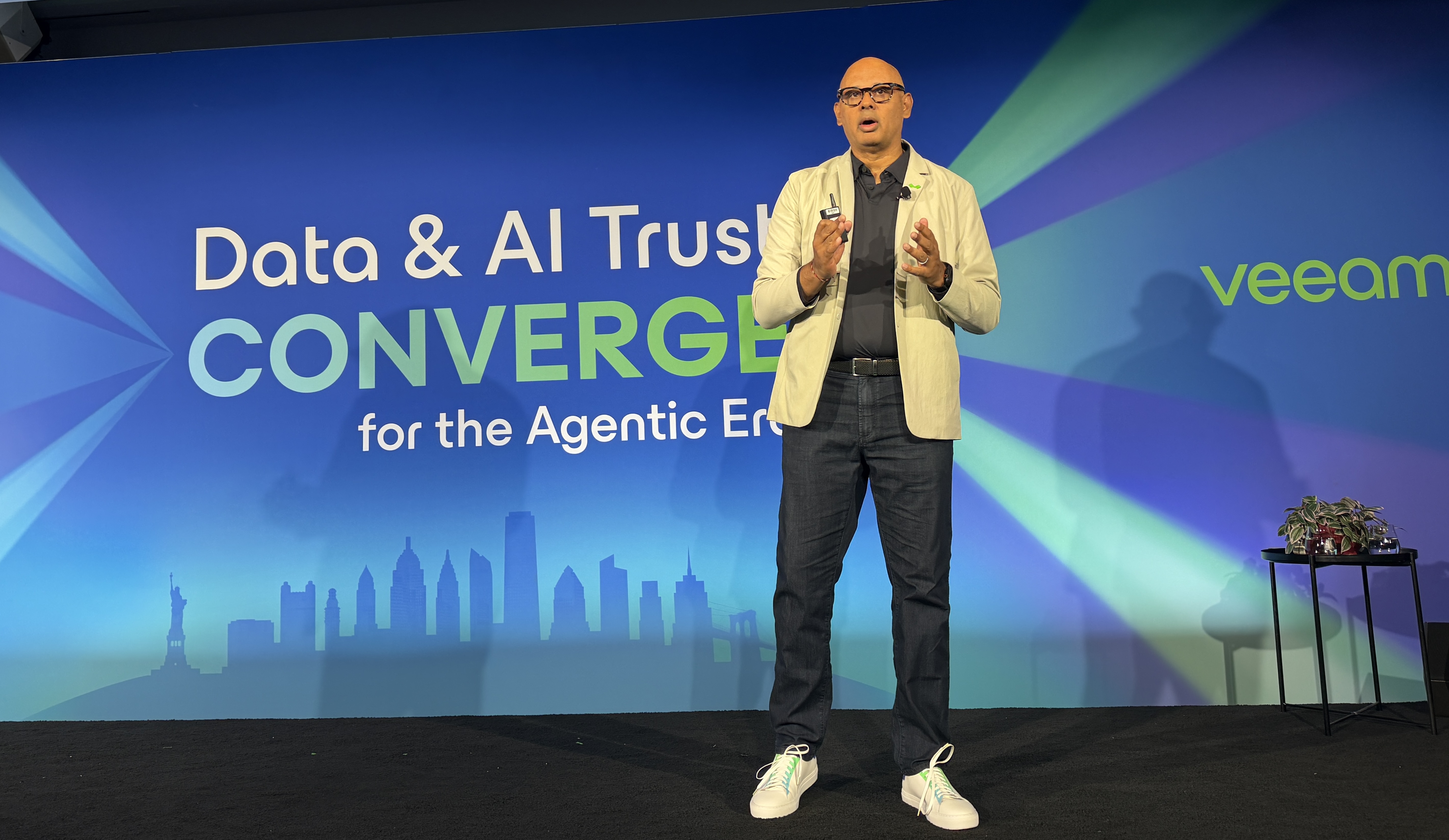
From backup vendor to trust layer
For most of its 20-year history, Veeam has been synonymous with backups and fast recovery.
- ›Veeam reduced customers' recovery time objectives from hours to about two minutes.
- ›The company built what Eswaran called the broadest workload coverage across virtual machines, physical, hybrid multicloud, and SaaS.
- ›That foundation now protects more than 550,000 customers in more than 150 countries.
Eswaran said what has changed is not the importance of recovery but the nature of the threats and the actors who access enterprise data.
The three eras framing
Eswaran described Veeam's history and the market in three phases.
- ›Traditional backup and recovery, described as assume restore.
- ›Cyber resilience, described as assume breach.
- ›The agentic era of AI, described as assume autonomy.
In the agentic era, nonhuman identities operate at a scale and speed that existing tools were never designed to govern.
Defining the agentic AI problem
Veeam's research and telemetry frame the risk in terms of agent scale and privilege.
- ›Autonomous AI agents already outnumber human employees by 82 to 1 on average.
- ›That represents more than 250,000 non-human identities per organization.
- ›97% of those agents have excessive privileges, expanding the blast radius of a single compromised agent.
Eswaran said legacy security architectures assumed the actor was human, an assumption that broke when agents began accessing ERP, CRM, warehouses, email, files, and SaaS systems in parallel. He cited examples such as an AI agent deleting a production database and its backups in nine seconds, and an agent recreating a cloud environment and triggering a 13-hour outage and millions of lost orders.
The missing layer in the AI stack
Veeam argues there is a gap between data platforms and models.
- ›The proposed fix is a unified data and AI trust layer.
- ›It treats data, identities, access, regulatory posture, and resilience as a single system.
- ›Eswaran said the infrastructure to deploy AI exists but the infrastructure to trust it does not.
Inside the DataAI Command Platform
The new platform is positioned as the company's answer to that missing layer.
- ›It is described as the industry's first unified data and AI trust infrastructure for the agentic era.
- ›It results from the December 2025 acquisition of Securiti combined with two decades of Veeam's data protection.
- ›By design it spans production and backup systems, showing what agents can access, what they did, and how to undo it.
Architecturally, the platform is anchored by the DataAI Command Graph, which Veeam calls a unified intelligence layer.
Frequently Asked Questions
What is Veeam shifting toward?
Veeam is moving from being known as the backup company to positioning itself as a data and AI trust platform for the agentic era.
What is the DataAI Command Platform?
It is Veeam's new offering, described as the industry's first unified data and AI trust infrastructure for the agentic era, built from the Securiti acquisition and Veeam's data protection capabilities.
When did Veeam acquire Securiti?
Veeam acquired Securiti, a data and AI security posture management vendor, in December 2025.
How large is Veeam's customer base?
Veeam protects more than 550,000 customers in more than 150 countries, including 82 of the Fortune 500, and drives more than $2 billion in annual recurring revenue.
Why does Veeam say agentic AI changes security?
Veeam reports agents outnumber human employees 82 to 1 on average and that 97% of agents have excessive privileges, so a single compromised agent can act at machine speed across many systems.
Veeam is betting that trusting AI to act on enterprise data, not just restoring it, will define the next decade of infrastructure.
Continue Learning
Comments
Sign in to join the conversation