Why Performance per Watt Is the Ultimate Metric for AI Infrastructure Efficiency
Power is AI infrastructure's inescapable constraint. How many tokens an AI factory can generate within a fixed power budget determines its revenue and profitability. Because of this, performance per watt - a metric that can't be gamed, only earned through real-world results - is the foundation for AI factories.
Key Takeaways
- From benchmark to production, NVIDIA Blackwell NVL72 delivers the highest performance per watt to maximize revenue and the lowest token cost to maximize profit margins.
As agentic AI drives token demand higher, the infrastructure decisions organizations make today will determine who scales and who doesn't in a power-constrained world.
- It's this foundation that the NVIDIA Vera Rubin platform builds upon next to further elevate rack-scale energy efficiency.
Maximizing Performance per Watt for Frontier AI Each new generation of frontier models brings architectural changes that unlock greater intelligence while demanding new optimizations to run efficiently at scale.
- To best represent these operating points, NVIDIA showcases Pareto curves for each model rather than a single point and provides tools such as DynoSim to help teams find their optimal point on the Pareto frontier before spending a single GPU-hour on validation.
The performance per watt NVIDIA Blackwell delivers is a result of extreme codesign: every component of the rack-scale system, from silicon to software , designed together to maximize token throughput for AI inference workloads.
- NVIDIA's inference software stack , including NVIDIA Dynamo and TensorRT LLM, as well as SGLang and vLLM, is built to run the full range of optimizations: NVFP4 quantization, disaggregated serving, large-scale expert parallelism, KV-aware routing, KV cache offloading and more.
These stack together to multiply the performance each GPU delivers.
- Production Is Where It Counts Rack-scale reliability at AI factory scale is hard-won.
Stats & Key Facts
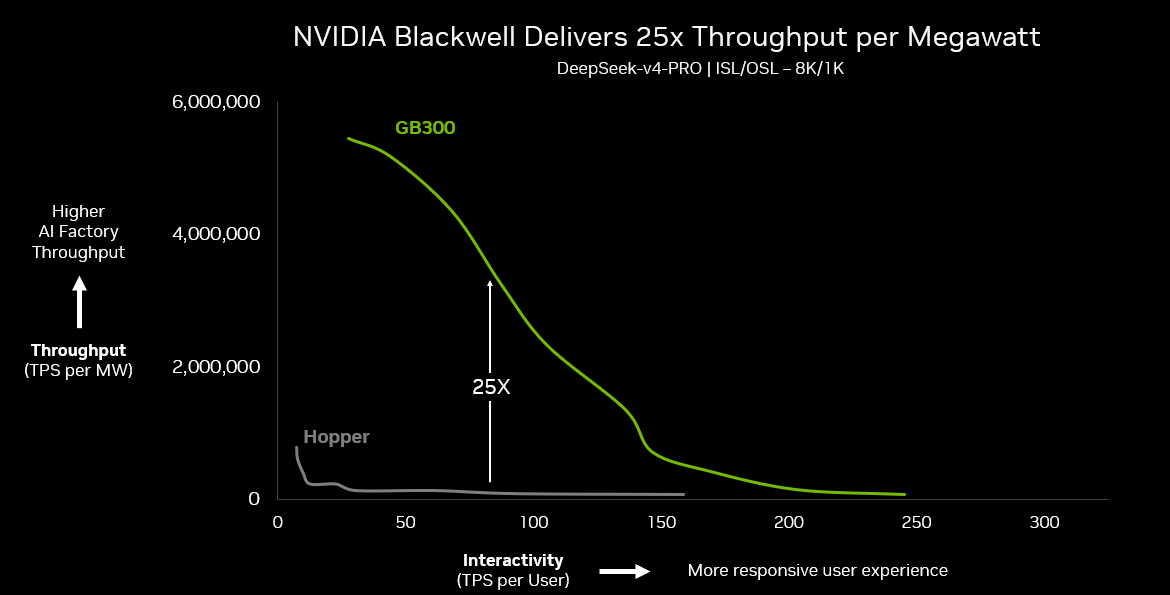
- #Across the newest generation of leading open models, NVIDIA GB300 NVL72 delivers up to 25x performance per watt compared with the NVIDIA Hopper generation.
- #In AI factories, power lost to cooling and rack-level inefficiencies can mean only about 60% of the electricity pulled from the grid turns into useful AI work.
- #This enables operators to run up to 40% more GPUs within the same power budget.
From benchmark to production, NVIDIA Blackwell NVL72 delivers the highest performance per watt to maximize revenue and the lowest token cost to maximize profit margins. Power is AI infrastructure's inescapable constraint. How many tokens an AI factory can generate within a fixed power budget determines its revenue and profitability.
Because of this, performance per watt - a metric that can't be gamed, only earned through real-world results - is the foundation for AI factories. As agentic AI drives token demand higher, the infrastructure decisions organizations make today will determine who scales and who doesn't in a power-constrained world. Virtually every frontier AI model today runs on a mixture-of-experts (MoE) architecture.
Serving MoE at rack scale demands codesign across every layer of the system and software stack, plus the operational depth earned from running these models under real production load. With the NVIDIA Blackwell NVL72 platform , that rack-scale foundation is already built and proven, delivering the highest performance per watt to maximize revenues and the lowest token cost to maximize profit margins. It's this foundation that the NVIDIA Vera Rubin platform builds upon next to further elevate rack-scale energy efficiency.
Maximizing Performance per Watt for Frontier AI Each new generation of frontier models brings architectural changes that unlock greater intelligence while demanding new optimizations to run efficiently at scale. Across the newest generation of leading open models, NVIDIA GB300 NVL72 delivers up to 25x performance per watt compared with the NVIDIA Hopper generation. These numbers reflect where Blackwell stands today, a starting point that continues to improve.
Any single number only tells part of the story. Different workloads demand different operating points: some optimize for latency, others for throughput and cost - and most need to move between the two. To best represent these operating points, NVIDIA showcases Pareto curves for each model rather than a single point and provides tools such as DynoSim to help teams find their optimal point on the Pareto frontier before spending a single GPU-hour on validation.
The performance per watt NVIDIA Blackwell delivers is a result of extreme codesign: every component of the rack-scale system, from silicon to software , designed together to maximize token throughput for AI inference workloads. That codesign touches every layer of the stack. For example, NVIDIA NVLink Switch , critical for rack-scale performance, is purpose-built for scale-up GPU domains, not adapted from general-purpose networking.
Now in its sixth generation with the Vera Rubin platform, its capabilities are designed specifically for AI workloads such as SHARP, which performs in-network computing directly in the switch, offloading work from the GPUs themselves. NVIDIA's inference software stack , including NVIDIA Dynamo and TensorRT LLM, as well as SGLang and vLLM, is built to run the full range of optimizations: NVFP4 quantization, disaggregated serving, large-scale expert parallelism, KV-aware routing, KV cache offloading and more. These stack together to multiply the performance each GPU delivers.
Moreover, software keeps improving performance over time: On DeepSeek V4, performance per watt improved by up to 5x in a single month. In AI factories, power lost to cooling and rack-level inefficiencies can mean only about 60% of the electricity pulled from the grid turns into useful AI work. NVIDIA DSX MaxLPS, the power-and-efficiency software in the NVIDIA DSX platform, closes that gap by shifting power between GPUs and racks in real time, supporting warm-water liquid cooling and using techniques like power steering to wring more performance.
For more details please read the original article at NVIDIA Blog.