Official channel - product launches, demos, and safety talks.
OpenAI has launched the Agents API to provide a hosted version of the Codex harness for running long-running production agents. The Agents API manages backend infrastructure including orchestration, execution sessions, and context management. Developers can run agents in OpenAI-hosted sandboxes, third-party sandboxes, or their own self-hosted environments while connecting tools via MCP plugins and skills. Programmatic tool calling allows agents to filter large datasets in code, drastically reducing token consumption compared to direct tool calls. The system supports multi-agent delegation to run sub-tasks in parallel and uses context compaction to sustain long-running investigations.
A worker uses voice input in ChatGPT on mobile to request an update to a project launch deck based on latest meeting notes. ChatGPT accesses connected workplace sources, including Microsoft Teams and Outlook, to retrieve notes, product specifications, timelines, and budgets. The AI tool analyzes forecast models and team communications to generate an updated presentation file titled Launch-Brief-v2.pptx. The generated presentation incorporates specific survey data, including key findings and product strategy summaries. OpenAI presents ChatGPT Work under the slogan 'Work directed by you'.
ChatGPT Work uses GPT-6 Astra High to automate complex multi-step professional workflows across business applications. A single voice prompt can prompt ChatGPT Work to access dashboards, review feedback, analyse previous campaign data, and assemble a complete strategy slide deck in a team template within seven and a half minutes. Users can interact directly with generated presentation slides to request specific visual adjustments, such as animating process diagrams. ChatGPT Work coordinates administrative tasks across multiple formats simultaneously, including updating project intake forms, populating spreadsheet budgets, scheduling calendar meetings, and drafting briefs.
A tester demonstrated an interactive 3D voxel simulation of historic London generated with Astra. The application features an interactive timeline that transforms the voxel city across historical periods from Roman and medieval eras up to modern times. Users can control an individual voxel character to explore the environment directly from a playable third-person or overhead perspective. Astra added unprompted functional features on its own initiative, including a top-down view reminiscent of GTA 2 and a detailed mini-map.
Industry partners from Box, Figma, cxo.dev, Ramp, BAM, and Cognition share early impressions of GPT-6 Astra across complex real-world workflows. Box demonstrates how GPT-6 Astra handles nuanced business calculations across spreadsheets, avoiding double-counting errors in complex financial data. Figma shows GPT-6 Astra generating complex vector animations by coordinating moving elements to create optical motion effects. cxo.dev and Ramp highlight the model's autonomous computer and browser use capabilities to construct multi-step workflows and implement code changes directly. BAM and Cognition demonstrate Astra's capacity to navigate ambiguous research trees and optimize lower-level GPU kernels for significant runtime speedups.
OpenAI introduced two new image generation models called GPT-Image-2.5 Sunburst and GPT-Image-2.5 Flare. GPT-Image-2.5 Sunburst is designed for high visual fidelity with sharper detail rendering, natural lighting, richer textures, and precise instruction following. Sunburst improves multi-turn editing workflows by preserving key image details across iterative modifications. GPT-Image-2.5 Flare is OpenAI's fastest image model to date, running over 50 percent faster than GPT-Image-2 while maintaining equal visual quality. Both Sunburst and Flare natively support transparent PNG backgrounds for graphic design and game asset workflows. Both new image models are available immediately through the OpenAI API, ChatGPT, and Codex.
ChatGPT Images 2.5 includes a template workflow designed to generate visual assets from scratch. Users can define a brand by entering its name and purpose into guided conversational prompts. The logo generation template provides multiple style options, including emblem, symbol, playful, retro, wordmark, lettermark, and integrated formats. Branded merchandise can be created across multiple apparel and accessory templates, including hats, hoodies, shirts, mugs, and keychains. The system generates cohesive brand imagery across product mockups, promotional collateral, and dynamic action photography.
ChatGPT introduces a Sketch feature accessed directly through the prompt bar using @sketch. Users can draw concepts using an in-app canvas with basic pen tools and color options. Drawn sketches can be transformed into detailed, rendered images across multiple visual styles. The demonstration shows sketches converted into character figures, furniture designs, landscape plans, tapestries, and fashion apparel. Text and sketches can also be rendered into textured real-world mediums like denim embroidery and beading.
ChatGPT Images 2.5 allows users to design, iterate, and refine visual concepts from text prompts and uploaded photos. The tool supports iterative image editing through conversational refinements, such as modifying style or adding specific objects to a scene. Users can generate tattoo designs based on reference photographs of pets. Hand-drawn sketches can be converted into realistic three-dimensional product designs across multiple material options. The model assists with lifestyle visualizations, including trying on bold new hairstyles and arranging floral compositions.
Tom Krcha shares his early impressions of using GPT-6 Astra to build interactive, parametric design tools and creative applications. Astra generated a fully parametric logo design application that allows users to adjust algorithm properties and export variations directly. The model created complete website concepts for an offline gathering, iterating on art direction from woodsy aesthetics to modern stainless steel styling. Astra built a film lab and shader experimentation tool that applies adjustable procedural effects and engraving textures over existing photography. Krcha notes that Astra eliminates the need for a dedicated engineer to write complex visual shaders, enabling new creative workflows for designers.
The Astra model successfully solved two difficult DEF CON puzzle challenges that human participants previously spent days attempting. Astra solved a puzzle featuring Rubik's cubes arranged in a 3x4 pattern three out of three times once provided with the official hint. To solve complex tasks, the primary model formulates a theory and deploys sub-agents to test hypotheses. The model architecture supports ten parallel agent slots coordinated by a primary agent. Providing explicit instructions on workflow orchestration allows Astra to effectively grind through complex multi-step challenges.
Peter Gostev evaluates GPT-6 Astra using complex and sustained workloads rather than medium difficulty tasks that most contemporary models can easily solve. Astra built a multi-era 3D voxel simulation of historical London with minimal prompt guidance, including aerial and overhead camera angles. Unlike earlier models that excessively agreed with user criticism, Astra communicates more naturally by either accepting errors or pushing back like a human collaborator. Astra successfully migrated and refactored a legacy codebase of approximately 150,000 lines without requiring manual debugging or step-by-step supervision. The primary operational bottleneck shifted from model capability and manual babysitting to local hardware compute, prompting Gostev to offload execution to a dedicated Linux machine.
Ben Davis evaluated GPT-6 Astra against complex DEF CON puzzle challenges that human teams had spent days trying to solve. GPT-6 Astra successfully solved a puzzle that no other participant in the world had managed to solve. The model solved a visual puzzle involving twelve Rubik's cubes in a three-by-four grid three out of three times once provided with the creator hint. GPT-6 Astra uses a coordinator model that manages up to ten parallel sub-agent research branches to test theories simultaneously. The architecture maintains focus across long multi-step reasoning tasks without drifting into unproductive assumptions.
GPT-6 Astra is OpenAI's latest frontier model designed for complex tasks requiring high raw intelligence and minimal hand-holding. The model demonstrates improved accuracy and efficiency in computer use, executing desktop application tasks in the background using screenshots. Astra shows enhanced creative and reasoning performance across code generation, 3D rendering, and text generation. OpenAI introduced asynchronous tool calling in the responses API, allowing the model to continue working while tool executions run in parallel. Steering support in the responses API enables developers to inject context and redirect active model runs without cancelling ongoing processes.
ChatGPT ads allow brands to present relevant products while consumers actively evaluate choices and describe their purchasing constraints. OpenAI maintains strict separation between advertising and model answers, ensuring ads do not influence ChatGPT response generation. The ChatGPT Ads Manager plugin allows advertisers to query campaign performance and metrics directly in conversational text. Advertisers can ask the model to interpret performance data, explain underlying drivers, and recommend iterative creative adjustments. ChatGPT ads are available across forty global markets, including thirty-one European markets, and are managed via ads.openai.com.
Non-technical creatives can use ChatGPT Work to build custom, bespoke production tools without writing code. Prompts can combine text instructions, PDF brand guidelines, 3D model files, and hand-drawn wireframes to direct tool creation. In a demonstration scenario, ChatGPT Work generated an interactive composition studio tool in 7 minutes and 13 seconds. The generated design tool enabled rapid layout iteration across formats such as out-of-home, social media, and print while embedding interactive 3D assets. Within the same project, a separate prompt conversation created a fully interactive launch website featuring a 3D headphone viewer and color picker. The entire suite of custom tools, marketing assets, and product launch website was assembled in approximately one day.
OpenAI uses its Image Gen 2 model in ChatGPT to visualize complex campaign ideas and generate multilingual typography. Creative teams can convert angled real-world scouting photos into straight-on rectilinear mockups using natural language prompts. ChatGPT Images allows designers to prototype surreal concepts, such as brick walls crumbling into portal landscapes or trains bursting from buildings. Prompting enables direct output of multiple high-resolution variations matching exact billboard aspect ratios like 1920 by 2560. AI-assisted visualization eliminates the bottleneck of only testing three or four ideas, allowing teams to explore and iterate on every concept on their whiteboard.
ChatGPT Work combined with Figma compresses the end-to-end email campaign creation cycle from two weeks down to approximately two days. Marketing teams can convert raw spreadsheets of prompts into interactive web dashboards using ChatGPT Sites in a few minutes. Public-facing showcase sites can curate user-generated social media content alongside actionable prompt buttons. Custom plugins package approximately a dozen specific marketing skills, including brand guidelines and Figma handoffs, into reusable workflow engines. Automating draft generation allows marketing teams to focus collaborative meetings on refining messaging, copy, and visuals rather than administrative overhead.
Product marketing teams facing tight launch deadlines can use ChatGPT Work to simulate user research before heading into the field. Teams can build custom skills loaded with historical CRM data, call notes, and past research to generate synthetic buyer personas. ChatGPT Work simulates a meeting where synthetic C-suite executive personas review, score, and debate a campaign brief. The model outputs specific recommendations on what messaging to keep or pivot, then directly generates an updated brief for download. Internal customer insights teams benefit because preliminary testing sharpens surveys and interview guides before launching expensive field research.
ChatGPT Work transforms ChatGPT from a conversational question and answer tool into an action-oriented personal assistant for business workflows. The gap between conceptualising a marketing idea and executing it has compressed, enabling team members across departments to produce mockups rapidly. Work mode connects directly to external workplace applications and plugins including Google Drive, Microsoft Office, Notion, Figma, and Canva. The system supports automated execution across diverse tasks such as assembling slide presentations, generating images, scheduling browser workflows, and building apps or websites. Because generating ideas and assets has become faster and cheaper, strategic marketing judgment and customer-centric fundamentals have become more critical.
Developers report that GPT-6 Astra enables complex workflows that were previously difficult or impossible to execute with prior models. The model was used to create an interactive 3D voxel simulation of historical London that dynamically evolves through multiple historical eras. GPT-6 Astra assisted in generating creative, unconventional web layout concepts and targeted visual asset prompts for website design. The model solved intricate multi-step DEF CON puzzle challenges by coordinating parallel research branches and maintaining focus without falling into repetitive failure loops.
OpenAI presents a promotional concept video showcasing GPT-6 Astra performing cross-application tasks via voice and screen control. Astra handles multimodal creation workflows including 2D digital illustration, Blender 3D modeling, interactive game generation, and preparing STL files for 3D printing. The system performs real-time productivity tasks across web applications, such as assembling slide presentations in Google Slides and drafting legal licensing agreements. The demonstration highlights autonomous computer operation for personal assistance tasks, including listing items on eBay, ordering food delivery, and booking recreational courts. Viewers are directed to download the ChatGPT desktop application to experience Astra functionality.
A creative artist drawing in a bookstore discovers a magical floating pen that initiates a superhero transformation. The transformed hero, named Ink Nova and titled Guardian of the Unfinished Page, wields a weapon known as the Pen Slugger. Ink Nova battles swarms of shadowy ink monsters invading the city by upgrading her weapon from a spiked bat into a high-powered sonic boombox. The comic adventure sequence is revealed to be a manga titled Drawn Into Action, created with ChatGPT Images.
The advertisement demonstrates the creative range and visual versatility of ChatGPT Images through tennis-themed scenes. A single tennis match concept is rendered across numerous artistic mediums, including claymation, wool felting, 16-bit arcade graphics, and anime. The video showcases diverse textural styles, including rhinestone embroidery, liquid chrome effects, and comic book illustrations. The demonstration concludes with the prompt "Imagine what you can make" followed by the ChatGPT Images title card and OpenAI logo.
Computer Use and Chrome Use allow ChatGPT to interact directly with desktop applications and websites inside the Work tab of the ChatGPT desktop app. Computer Use enables ChatGPT to click, type, and navigate between desktop applications in the background on macOS. Chrome Use lets ChatGPT operate within the Chrome browser to perform tasks across websites where the user is already logged in. Pressing Command twice captures an App Shot, which acts as a context-aware screenshot so ChatGPT can see the active screen without detailed manual explanations. ChatGPT pauses before finalizing critical actions, such as submitting a paid time off request or creating calendar events, allowing users to review and approve drafts first.
ChatGPT Work connects with external productivity tools like Google Drive through plugins to generate live Google Docs and Google Slides presentations. Raw meeting transcripts can be structured into designated sections including executive summaries, categorized updates, bolded decisions, and action items tables. ChatGPT Work flags missing owners or deadlines explicitly instead of fabricating or guessing missing data. Generated Google Docs can serve as the direct foundation for concise five-slide leadership update decks formatted according to previously created slide decks. The Template Creator feature stores formatting, layouts, and structures for docs and decks, enabling direct reuse for recurring weekly meetings.
ChatGPT Work allows users to use voice commands on desktop to kick off interactive tasks and coordinate connected tools. Users can brainstorm project concepts conversationally with ChatGPT and receive constructive feedback and new ideas in real time. ChatGPT can autonomously generate visual presentation decks in Google Slides in the background while the user continues other desktop work. The desktop application supports remote pairing via QR code so users can trigger voice commands and inspect work from a mobile phone.
ChatGPT Work operates directly on mobile phones to summarize work communications and handle personal tasks. Voice dictation allows users to instruct ChatGPT to search connected Slack and Gmail accounts for urgent updates and active discussions. A dedicated finance plugin with read-only access lets ChatGPT review checking, savings, and credit card balances without manual account logins. Users can instruct ChatGPT to perform recurring daily financial reviews to identify unexpected or unusual spending. The remote feature pairs the mobile app to a laptop via a QR code, enabling mobile monitoring of computer-based tasks and files.
ChatGPT Work allows users to automate repetitive prompts by setting them up as scheduled tasks that execute hourly, daily, or weekly. Scheduled tasks can integrate directly with external productivity tools such as Google Calendar and Gmail through connected plugins. Prompts can be tested and verified interactively before instructing ChatGPT to automate them on a recurring schedule. The Scheduled tab in the sidebar provides controls to view upcoming execution times, alter schedules, pause tasks, or delete them. Scheduled tasks can be paired with skills, where skills define formatting and workflow preferences while scheduled tasks manage execution timing.
ChatGPT Work mode connects to third-party tools such as Gmail and Google Calendar through plugins. Users can prompt ChatGPT to read email details and calendar availability simultaneously to draft and schedule meetings. Meeting briefs can be generated directly from connected email threads and calendar events with structured sections like objectives, client priorities, decisions, risks, and next steps. Custom workflows can be saved as reusable skills that ChatGPT can execute on demand for future tasks without re-prompting the full instructions. Saved skills can be verified by running them against different calendar entries to confirm consistent formatting and context extraction.
ChatGPT Work can build, host, and update interactive websites without requiring the user to write code or configure hosting. Sites can store data like votes and expenses in a database, accept file uploads such as receipts, and manage user access. Users can prompt ChatGPT by voice dictation or text across the desktop app, web browser, and mobile devices. Access controls allow websites to be kept private to invited individuals with ChatGPT accounts or published publicly on the internet. ChatGPT can automate ongoing maintenance by connecting to tools like Databricks, Slack, and Chrome to refresh site data and flag anomalies on a schedule.
ChatGPT Work connects to third-party workplace applications like Gmail and Slack to complete cross-app tasks. Users can access Work mode through the ChatGPT desktop application or directly on chatgpt.com. Third-party integrations require installing plugins and authenticating account permissions once. ChatGPT Work allows users to review, edit, and approve drafts before messages or emails are dispatched. The Wake Pet feature provides a visual notification when background tasks are completed or need attention.
Mandela Cocores, owner of Welcome Home, prepares more than 250 meals each week for new mothers alongside managing packaging, customer communication, and deliveries. Designing and updating food packaging labels manually in Canva previously required ninety minutes of work. Using ChatGPT in Work mode with the Canva plugin allows users to connect a Canva design template directly to a recipe spreadsheet. ChatGPT automated the batch generation of label names and ingredient details across the Canva design in six minutes.
ChatGPT Work can process visual inputs, such as app screenshots of notes, to extract dietary preferences and allergy constraints. The tool can convert meal planning schedules into a customized web application for sharing with caregivers. Integrated plugins, such as Instacart, allow automated generation of grocery shopping carts directly from meal lists. Interactive tracking features on generated sites enable caregivers to log child meal ratings and allergy reactions from mobile devices. Scheduled weekly routines and automated message drafting streamline ongoing meal planning and communications with healthcare providers.
ChatGPT Images allows users to generate and stylize images incorporating text across multiple languages. The demonstration shows a retired couple's travel experiences transformed into various cultural poster styles. Showcased multilingual designs include Spanish coastal artwork, Hindi street scene and movie posters, and Japanese adventure graphics. The video illustrates turning personal travel memories into themed memorabilia, such as decorative refrigerator magnets.
ChatGPT Images supports generating visuals across a wide range of sizes and aspect ratios. The demonstration displays a subject adapted into vertical posters, wide billboards, and elongated banners. Generated assets are shown in various contextual environments, including street poles, outdoor billboards, and airplane banners. The video uses a humorous story arc where the lost cat named Ozzy is shown safe under the living room couch.
ChatGPT Images generates cohesive brand identity assets starting from rough pencil sketches to polished vector-style logos. The image tool applies branding across sports apparel including jerseys, numbered player kits, and embroidered socks. Promotional print materials such as matchday program covers, interior spread layouts, and tickets are created with integrated typography. Fan and supporter collateral can be designed across multiple mediums, from stadium posters to car decals and novelty accessories.
Explores the concept of 'Slop' in contemporary AI-driven art. Features an exhibition, 'Epistemologies of Slop,' in San Francisco. Highlights the use of AI tools like Codex in the creative process.
IT admins play a crucial role in managing AI tools like ChatGPT. New admin APIs facilitate efficient scaling in workspace management. Admins can analyze usage patterns and manage costs effectively.
ChatGPT enhances productivity for enterprise teams. Allows rapid transition from ideas to final products. Enables automation of workflows with minimal overhead. Facilitates significant content output with smaller teams. Improves cost efficiency in time and resources.
Introduction of voice feature in the desktop app enhances workflow. AI assistance is used for drafting materials and troubleshooting. Preparation for launch includes checking feature configuration and bug fixes.
Using Chat GPT for ticket monitoring can simplify the process. The AI can check theater websites directly for better seat options. Notifications are sent for any newly available tickets.
ChatGPT can now assist with documents, spreadsheets, and slides. It can consolidate multiple sources into a single document. Users can create templates and share polished files quickly.
Wondr partners with OpenAI to accelerate AI integration in enterprises. Focus on transforming organizations rather than building AI infrastructure. Longer horizon agentic tasks can optimize productivity beyond simple automation.
OpenAI Academy conducted workshops across six European countries. 1,500 participants learned to implement AI in various sectors. The SME AI accelerator supports effective AI adoption for small businesses.
Small businesses are increasingly using AI to enhance operations. The ChatGPT tool offers practical applications for entrepreneurs. Real-time demonstrations facilitate immediate understanding and implementation. Community education on AI tools is vital for business growth. Accessibility and support during learning enhances user experience.
ChatGPT now supports plugins to connect with various tools like email and calendars. Plugins assist in automating tasks such as report structuring and meeting preparation. Users can create design assets and prepare for meetings using specific plugins tailored to roles.
ChatGPT helps Virgin Atlantic improve customer experience. It accelerates project timelines from weeks to hours. Custom dashboards created with ChatGPT enhance data insights. The tool increases cost-efficiency in delivering new features.
BNY embraces AI optimism for growth. CEO Robin Vince collaborates closely with AI teams. AI updates inform strategic decision-making. Eliza, BNY's AI platform, supports daily operations. The company aims to harness AI for increased capacity.
ChatGPT enhances productivity by reducing dependencies. AI agents perform discrete tasks traditionally handled by larger teams. Focus on effective AI tool adoption in non-R&D sectors.
ChatGPT accelerates workflow with reduced dependencies. AI agents enable delegation and task automation. Redesigning workflows using AI tools improves efficiency. Non-R&D disciplines benefit significantly from AI adoption. ChatGPT allows for complex tasks previously requiring large teams.
ChatGPT can now control websites and apps on your computer. You can analyze online forums and compile reports effortlessly. Integration with existing browsers and desktop apps enhances productivity.
AI is transforming racing operations and improving logistics and driver performance. Data processing in real-time is essential for gaining racing insights. Collaboration between human and machine is critical for success in competitive racing.
The AI era requires teams to adapt and evolve their talent acquisition. Creative individuals with non-traditional backgrounds can excel in AI roles. Interview processes may need to be revised to attract the right candidates.
AI-first mindset is essential for building successful companies. Focus on solving specific problems with AI integration. Verso exemplifies AI-native business models. Understand the whole workflow to enhance efficiency with AI.
Shift from prompting AI to setting clear goals. Everyone can now be a builder, expanding the developer landscape. Innovative use of AI technologies is on the rise, especially in France.
Organizations are transitioning from AI pilots to full production. Measuring AI value and prioritizing use cases are crucial steps. Automation of processes is where companies see the most benefit. Executive involvement in AI projects enhances adoption and showcases value.
Innovation thrives across Europe in startups and large enterprises. Effective founders continuously test, listen, and iterate. AI should be at the core of business strategy for founders. Focus on solving problems rather than perfecting technology. Generational companies are being built by ambitious European founders.
Codex can help bring your creative ideas to life. The tech scene in Paris is vibrant and full of energy. Being curious and trying out ideas is essential for innovation. AI models are evolving rapidly, with new releases every six weeks.
Use the ChatGPT app to prioritize and schedule tasks. Create automated daily briefs and feedback summaries. Convert local workflows into Workspace Agents for team use.
Solutions engineers use Codex to address customer needs effectively. Codex can analyze customer feedback from platforms like Trustpilot. Mocking up websites with Codex demonstrates tangible changes to clients. Lightbulb moments occur when Codex executes tasks flawlessly. Codex is versatile for various workflows and thinking styles.
AI aspirations often lack actionable starting points. Custom GPTs for portfolio companies enhance contextual workflows. Codex aids in developing MVPs for real-world business applications.
Pietro Schirano explores the intersection of AI, creativity, and design. GPT-5.5 represents a significant advance in AI capabilities, enhancing multimodal interactions. An innovative app converts images to sound and back, facilitating unique communication.
Verso operates as an autonomous AI-native company. Their Company Brain enables efficient consumer research that is ten times faster and half the cost of traditional methods. The Verso Brain manages workflows, reducing the need for human intervention. Clients receive consumer insights in just 72 hours instead of weeks.
Imagines a world where plants can communicate their needs. Plants express desires like sunlight, water, and humidity. The video showcases playful interactions between a person and plants.
AI has the potential to bridge gaps in society. There is hope for AI to improve access to education and healthcare. Technology should be leveraged for humanity and purpose. Individual creativity is enhanced through AI. Future leaders should remain grounded in their mission.
Omio leverages AI tools like Codex and ChatGPT to enhance product development. The integration of AI has reduced product development time by 80%. Codex aids in decision-making and task automation across various platforms. Omio encourages a rethinking of workflows to adapt to AI capabilities.
Innovators are using AI across diverse sectors such as education, space, and healthcare. Significant societal challenges, like unclaimed scholarships and dating app inefficiencies, are being addressed with new technologies. The current era is highlighted as an optimal time for creativity and innovation in various fields.
Focus on specific problems to drive change in workflows. Assemble the right team for effective problem-solving. Engage with customers regularly to understand their needs. Measure success through automated resolutions and customer satisfaction. Embrace change and upskill employees to leverage AI effectively.
Codex rapidly gained over 10,000 active users in a short time. It automates complex analysis tasks, reducing time from two days to 30 minutes. Sales teams use Codex for automating customer list maintenance.
ChatGPT's health model is developed by practicing physicians. Real-world medical expertise is integrated into AI responses. The goal is to enhance healthcare accessibility and empower patients.
Codex can learn tasks by observing user actions. Users can teach Codex their preferences for repetitive tasks. Codex automates tasks like video publishing and metadata management.
Tejal Patwardhan emphasizes the importance of developing frontier evaluations as old benchmarks become saturated. Model capability overhang indicates that AI models may exceed perceived limitations quickly. Understanding and measuring model progress is crucial for preparing society for advanced AI capabilities.
Wayfair uses GPT-5.5 for catalog enrichment of 40 million products. The technology helps accurately represent and enrich product listings. Collaboration with OpenAI enhances operational efficiency.
Solutions engineers like Stephanie Annani leverage Codex to enhance customer experiences. Codex helps analyze customer feedback from platforms like Trustpilot. The tool aids in creating mockups of customer websites to implement feedback. Codex generates insights leading to lightbulb moments in problem-solving. Codex can adapt to various roles and styles of thinking.
Codex accelerates Payward's shipping process significantly. The AI infrastructure team is vital for enhancing user experiences. Speed of deployment is the team's top priority.
OpenAI's investing plugin streamlines public equity research. Codex enhances data analysis with third-party integrations and structured outputs. The plugin transforms data into actionable insights for investment decisions.
LSEG uses AI to enhance decision-making through trusted data. Partnership with OpenAI accelerates product development and operational efficiency. Release cycles for AI products have been reduced to every two weeks.
Preply integrates AI to enhance human tutoring, not replace it. Lesson Insights feature provides personalized recaps for learners and tutors. 70% of tutors and 75% of learners actively use Lesson Insights, showing high engagement. OpenAI was chosen for its accuracy in language feedback and effective collaboration. The AI-driven approach significantly reduces lesson preparation time for tutors.
Codex now supports Chrome DevTools Protocol (CDP) for better debugging. Enabling Developer Mode allows advanced functionalities like performance profiling. Codex can inspect network traffic and local storage for deeper insights. Real-time debugging helps identify bottlenecks and improve application performance.
Codex acts as a collaborative partner for creative professionals. It can rapidly generate campaign ideas based on provided brand and emotional cues. Codex understands creative fundamentals like brand books and style guides.
Cattle rancher turned restaurateur shares insights on local business growth. The data center has boosted tourism and restaurant patronage in Buffalo Gap. Community engagement from data center companies helps preserve local culture.
BBVA is integrating AI across its entire business structure, aiming for a transformative approach. They have developed six specialized AI robots to enhance various banking functions. The initiative includes empowering all 120,000 employees with AI tools to improve productivity. BBVA's AI strategy is guided by a top-down agenda involving multiple executive teams. Ongoing short-term deliverables are emphasized to ensure tangible impacts are realized.
Codex assists in automating the prospecting process in sales. Integration with Salesforce and Gmail streamlines account prioritization and email drafting. Codex can create daily automated updates for sales outreach strategies.
The Event Horizon Telescope captured the first image of a black hole in 2017. Codex enables the simulation of black hole plasma dynamics, overcoming computational challenges. New algorithms created with Codex significantly speed up simulation processes. Successful simulations could lead to capturing the first video of a black hole. Exploring black holes may alter our understanding of physics and the universe.
The creator aims to cycle solo and unsupported from Antarctica's edge to the South Pole. ChatGPT serves as an expedition assistant, helping with weight management and planning. Adapting to cold weather conditions is critical for the success of the expedition. The journey is about pushing personal limits and self-discovery.
OpenAI's Creative Production plugin streamlines the marketing process. Codex can generate and modify campaign images in minutes. Integration with tools like Canva allows for easy editing of assets.
Codex streamlines finance workflows. Used for creating reports, dashboards, and executive slides. Transforms messy processes into repeatable workflows. Essential tool beyond coding for finance tasks. Unlocks new possibilities in finance technology.
Codex acts as an automated data analyst for business impact reporting. The integration allows for real-time modifications and edits in reports. Users can export reports directly into familiar templates like Google Slides. The data analytics plugin connects to multiple data sources for comprehensive insights. Codex enhances efficiency in report generation, saving significant time.
Codex transforms engineering processes at Nextdoor. Single engineers can efficiently take ideas from concept to production. Codex serves as a reliable tool for solving complex technical challenges. Nextdoor supports over 105 million users across multiple countries.
AI is transforming finance roles and tasks. Emerging skills in finance include adaptability and operational understanding. Career paths can be non-linear; expect pivots in your journey.
OpenAI has doubled its business customers to 2 million in the last year. Codex now has 5 million weekly active users, a growth of 400% since January. Integration of Codex into ChatGPT is expected to enhance enterprise workflows. OpenAI emphasizes a positive outlook on AI's potential for business capability. The goal is to provide accessible intelligence to every human globally.
GPT-4.5 enhances breadth and token efficiency. Cybersecurity reporting workflows improve significantly with detailed outputs. Time from analysis to deliverable is materially reduced.
Economic analysis time reduced from two days to 30 minutes. 97% of Balyasny Asset Management uses the AI platform daily. Cortex and model 55 enhance investment research and back office automation. Real-time insights are essential for timely earnings report analysis. Future developments aim to shift from search to work systems by 2026.
OpenAI's finance team is leveraging AI to enhance efficiency and decision-making. Three key principles guide their approach: being AI native, ensuring headcount leverage, and iterating quickly. An investor relations agent built with ChatGPT has streamlined responses to investor inquiries, saving both time and costs.
AI adoption in businesses can take two forms: employee tools and system-level products. A new layer of automation, known as 'Workspace agents', aims to bridge gaps in team-level workflows. These agents allow users to create customized AI assistants with minimal technical skills. The recent advancements with GPT 5.5 enhance the agents' ability to manage complex tasks efficiently. Workspace agents integrate smoothly with existing productivity tools like email and calendars.
Financial services leaders seek to leverage AI for enhanced workforce capabilities and product innovation. AI technologies, like ChatGPT, are helping banks improve operational efficiency and customer satisfaction. OpenAI is providing advanced AI models, such as GPT-5.5, for professional applications while ensuring data security.
Erste Group prioritizes AI as a board-level strategy, focusing on practical challenges and compliance. The bank's approach involves cautious integration of customer data and security measures. ChatGPT is being rolled out internally for productivity, but customer-facing AI is centrally managed.
Emily Prince discusses the London Stock Exchange's AI strategy. The 'AI Seg Everywhere' initiative aims to unlock vast data for customer use. LSEG focuses on both internal scaling and external customer service with AI.
OpenAI's Codeex automates software development tasks and enhances productivity. Over 4 million weekly users are leveraging Codeex for coding tasks. Codeex allows for smart integration with existing tools to streamline workflows.
Allica Bank uses AI across all areas of its operations. AI adoption within the bank rose from 25% to 77% in one year. The bank has restructured teams into smaller 'squadlets' for increased efficiency. Adapting an agile operating model has enabled over 3,700 deployments in the last year. Combining roles and embracing a T-shaped model has fostered innovation.
AI can enhance workforce productivity by automating routine tasks. ChatGPT integrates valuable data sources to support financial services. Users can interact with Excel workbooks in natural language for efficient analysis.
Codeex enhances enterprise workflows by solving complex problems. Real-time question capabilities streamline daily operations. ChatGPT's Excel plugin accelerates business processes significantly. 2,700 employees now use enterprise ChatGPT, boosting efficiency. A flywheel effect from multiple GPTs integrates into daily operations.
Sites in Codex enables quick application development and publishing. Built-in features include hosting, authentication, and database support. Users can refine apps through conversation without coding requirements.
Engineers are experiencing faster feature deployment cycles. OpenAI is leveraging Codex for quicker prototype and production transitions. Security policies are integrated into development through AppSec skills. Internal AI projects are being developed using Codex APIs. Faster feedback loops can enhance customer satisfaction.
Codex transforms coding into an operational layer for engineers. It integrates various tools used in remote work environments. Codex streamlines processes like generating tickets and documenting incidents.
Codex serves as an operational layer for coding within engineering tasks. It integrates smoothly with tools like Slack and Google Docs. Codex significantly reduces the time to generate detailed tickets in Jira. Teams can produce comprehensive work documentation in hours instead of weeks.
Codex streamlines data access for sales teams. Tasks that took hours now completed in minutes. Focus shifts from data hunting to customer engagement.
OpenAI's Product Design plugin streamlines the design process from idea to prototype. The plugin facilitates ideation by generating multiple visual options for evaluation. Interactive prototypes can be created and tested quickly, incorporating real-time feedback. Finished prototypes can be smoothly shared with teams through Figma and interactive websites. This tool enhances collaboration and efficiency in product design workflows.
OpenAI's reasoning model solved a significant math problem. The model's capabilities evolved from immediate responses to prolonged reasoning. Achievements include winning gold medals in math competitions.
Codex allows Amgen to focus on impactful science rather than coding. The technology enhances data analysis by providing insights through simple prompts. AI impacts Amgen through multiple small applications rather than a single solution.
The video features a launch sequence metaphor using coding. Codex is introduced as a tool for building applications. The narrative emphasizes the thrill of exploring new possibilities.
Abilene, Texas is embracing innovation through OpenAI's Stargate Project. The project will diversify the local economy and improve infrastructure. Stargate represents a significant opportunity for educational enhancement and community growth.
Travelers Insurance is deploying AI to streamline the claims process. The AI focuses initially on the first notice of loss, which is crucial for effective claim management. Travelers anticipates AI will enhance customer experience and operational efficiency.
GPT-5.5 shows significant improvements in planning capabilities. Users experience a 31% increase in understanding intent during planning sessions. There are 22% fewer instances of amnesia in context retention.
AI is enabling mathematicians to experiment and collaborate more effectively. Tools allow for quicker literature searches and reduce cognitive friction in problem-solving. OpenAI aims to empower a larger community of mathematicians rather than focus on individual accolades.
Matias Castello discusses integrating AI, particularly Codex, into Alchemy's development processes. Code reviews using AI tools have significantly improved incident detection and management. Alchemy is evolving its platform to accommodate a new class of AI-assisted developers.
Codex on Windows introduces Computer Use and mobile access features. You can control apps on your computer without being at your desk. Codex can perform browser tasks via Codex for Chrome integration. Mobile access allows you to monitor and start tasks remotely.
Rapid evolution of AI tools like Codex enhances developer productivity. Tasks that once took weeks or months are now completed in minutes or hours. Engineering teams are increasingly excited about AI capabilities.
Loblaw uses ChatGPT Enterprise for enhanced productivity. Codex accelerates the development process across multiple e-commerce platforms. Increased innovation allows for diverse product imagery and scenarios.
The Agents SDK has received significant updates to improve performance and usability. New features include a codec-style harness and first-class support for various sandbox environments. Live demos will demonstrate building a task tracker using the updated SDK.
Abridge uses GPT-5.5 for enhanced clinical decision support. Increasing tool usage improved information synthesis and clinical reasoning. The goal is to provide high information density at the point of care.
OpenAI collaborates with Chip Ganassi Racing to improve racing performance using AI. Data-driven approaches help analyze trends and strategies for better race outcomes. Efficient pit stops and human performance training are crucial for competitive racing.
The developer landscape has shifted with AI integration. All developers are now leveraging AI in software development. It's an ideal time for founders to turn ideas into reality.
Workspace agents streamline team workflows by automating data gathering and updates. Admins and agent builders can customize access and actions to ensure secure information handling. Agents can learn from feedback and improve their responses over time. Role-based access controls enhance security and governance in ChatGPT Enterprise. Human confirmation flows add an extra layer of oversight for important actions.
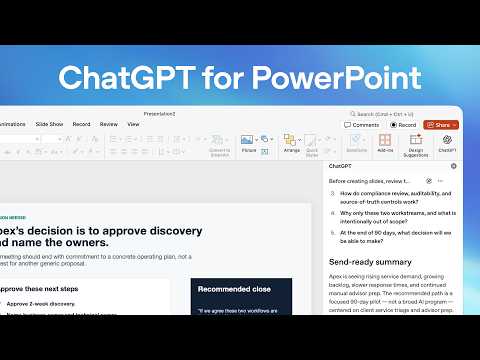
ChatGPT for PowerPoint streamlines presentation creation. Users can integrate various sources for context. The tool provides structured slide recommendations and refinements.
ChatGPT can assist with personal finance questions. It provides budgeting tips and financial planning advice. Users can gain insights on saving and investing strategies.
Codex significantly accelerated AI defense development at Cisco. All new features for AI defense are fully written by Codex. The open source tool 'defense claw' was created in under one week.
Codex can now work persistently towards specified goals. Use the /goal command to set clear, measurable objectives. Codex allows for pausing and resuming tasks, ideal for long projects.
Codex introduces plugin sharing for teamwork. Share specific plugins with teammates or the entire workspace. Access shared plugins easily from your directory.